
blog | 4min Read
Published on July 22, 2026


How High School Students Can Build a Political Science Profile for College Admissions
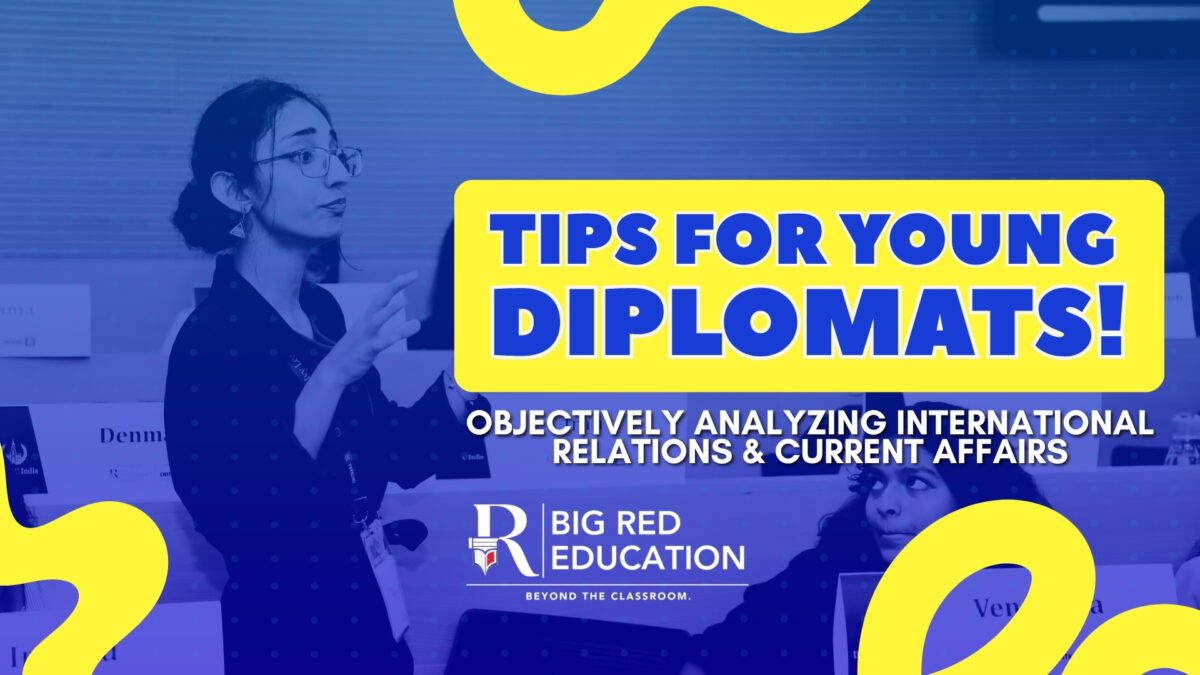
Today’s top universities aren’t just looking for students who can debate global issues—they’re looking for students who can analyze them critically, conduct independent research, and communicate nuanced perspectives. While staying informed about international relations (IR) often feels overwhelming in a fast-paced news cycle, simply reading headlines or participating in Model United Nations (MUN) isn’t enough anymore to stand out in competitive admissions.
To build a compelling academic profile for top Political Science, Public Policy, and IR programs, you need to analyze world events objectively—moving past sensationalism and media bias to uncover the structural, economic, and strategic drivers behind global decisions.
Here is a practical guide on how to analyze international relations like a future diplomat and turn current affairs into high-level research for your college application portfolio.
1. Separate Fact from Framing
Every news outlet presents events through a specific lens—whether influenced by national interests, corporate ownership, or editorial leaning. High-level IR analysis requires stripping away emotional language to isolate core facts.
- Spend 15 Minutes Comparing Coverage: Take a single news event and compare reports from three major publications across different regions (e.g., North American, European, Middle Eastern, or Asian perspectives) to see how framing shifts.
- Identify Primary Sources: Go straight to original documentation whenever possible. Read official diplomatic statements, texts on the United Nations Digital Library or the UN Official Document System, treaty texts, and international legal statutes rather than relying solely on commentator summaries.
2. Ask the Three Core Analytical Questions
Rather than getting bogged down in complex academic jargon, start your research by asking three foundational questions about any state or political actor:
- What does this actor want? (Focuses on power, security, and national interest—known in academic IR as Realism).
- What global institutions or agreements shape their options? (Focuses on international law, trade, and multilateral cooperation—known as Liberalism).
- What historical or cultural factors influence their decisions? (Focuses on identity, history, and values—known as Constructivism).
By grounding your analysis in these questions first, you can naturally introduce international relations theory as a bonus framework to elevate your writing into a university-level paper.
3. Map Stakeholder Incentives and Constraints
An objective analysis requires viewing an issue through the eyes of every party involved—including adversaries. To avoid bias in your research paper, map out:
- Primary Actors: Governments, state leaders, and international bodies like the UN General Assembly or Security Council.
- Secondary Actors: Non-state actors, multinational corporations, civil society, and domestic voters.
- Constraints: Economic limitations, constitutional boundaries, geographic challenges, and public opinion.
Key Takeaway: Understanding what an actor cannot do is often just as revealing as understanding what they want to do.
4. Move Beyond “Good vs. Bad” Narratives
Moral judgments make for passionate debates, but objective academic research demands nuance. Avoid labeling countries or policies simply as “good,” “bad,” “wrong,” or “aggressive.” Instead, focus on cause and effect:
- Analyze strategic calculations rather than moral intentions.
- Evaluate unintended consequences (e.g., how foreign sanctions might affect local populations or alter regional trade routes).
- Acknowledge complexity and address counterarguments directly to demonstrate mature, critical thinking.
5. What Universities Look For in Global Affairs Applicants
Admissions officers evaluate applicants in social sciences through proof of sustained intellectual engagement. When reviewing your extracurricular activities and essays, they want to see:
- Intellectual Curiosity: Going beyond standard high school curricula to explore global affairs independently.
- Critical Thinking & Analysis: The ability to evaluate complex global events without taking a single narrative at face value.
- Global Awareness & Nuance: Understanding multiple cultural, political, and historical perspectives.
- Strong Written Communication: Producing clear, structured, and evidence-based policy briefs or papers.
6. Five Ways to Build Your Political Science Profile
To demonstrate these qualities on your application, diversify your profile beyond Model UN delegates:
- Conduct Independent Research: Write a comprehensive research paper or policy brief on a pressing global issue under expert guidance.
- Publish Your Work: Submit op-eds, essay competition entries, or articles to high school journals and regional publications.
- Start a Global Affairs Initiative: Launch a school newsletter, student podcast, or debate club focused on international relations.
- Organize Community Policy Forums: Host discussions or awareness campaigns around global issues like climate policy or human rights.
- Pursue Mentorship Programs: Work with mentors to learn formal social science research methodologies.
Take Your Profile Beyond Model UN
If you’re aiming for top university programs in Political Science, Public Policy, International Relations, or Diplomacy, building your profile shouldn’t begin and end with Model UN. Admissions committees increasingly value students who demonstrate sustained intellectual curiosity through structured research, leadership initiatives, and meaningful academic output.
Through Big Red Education, high school students gain access to personalized research mentorship, leadership development, and specialized guidance tailored for future diplomats and policy advocates. Whether you want to develop an independent research paper, publish policy briefs, or sharpen your leadership potential, expert mentorship can help you turn your passion for global affairs into a standout college application portfolio.


