
blog Communication Entrepreneurship Higher Education Innovation Leadership | 4min Read
Published on June 23, 2026


5 Essential Skills Schools Don’t Always Teach—But Every Student Needs
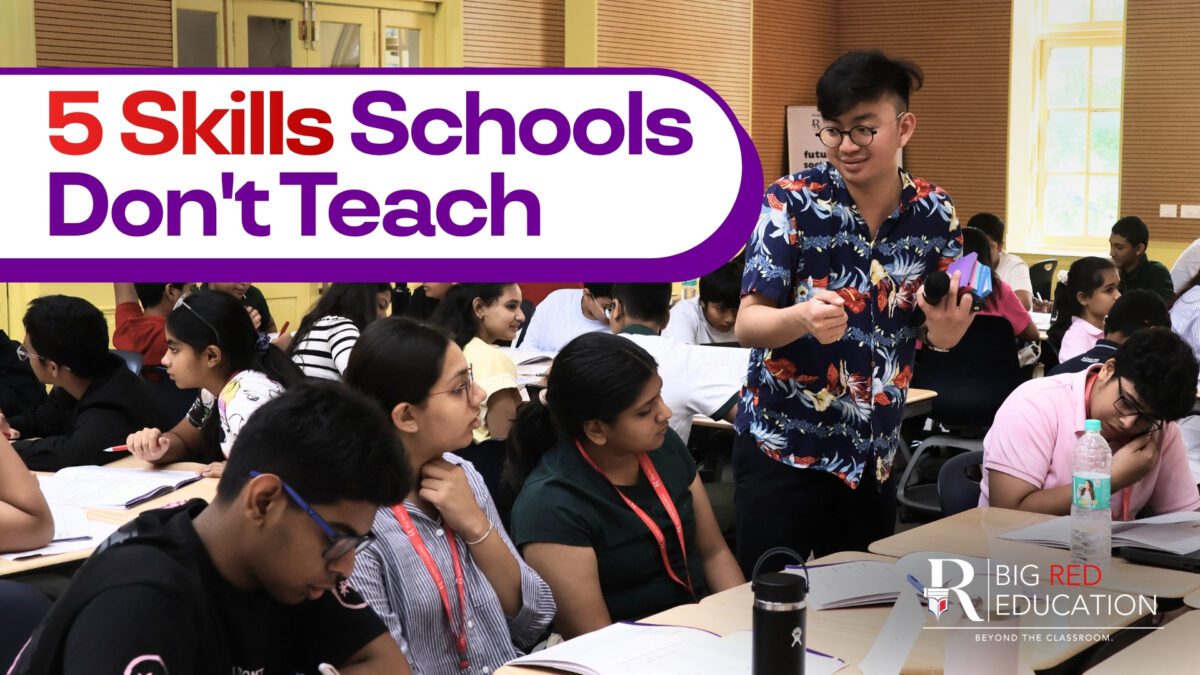
5 Essential Skills Schools Don’t Always Teach—But Every Student Needs
As a parent or educator, there is almost nothing more frustrating than watching a brilliant, straight-A student freeze up the moment they step outside the classroom. They can memorize complex formulas, write flawless essays, and ace standardized tests—but when it comes to pitching an original idea, negotiating a team conflict, or interviewing for their first real opportunity? Blank stares.
Here is the reality: Traditional education is doing a fantastic job of preparing students for a world that no longer exists. Academic intelligence is the baseline, but it is no longer the differentiator. The rules of success have fundamentally changed, and the modern landscape demands adaptability, emotional intelligence, and technological fluency over rote memorization.
In this post, we will explore the future-ready skills students need for the future, why these essential skills for students are often left off the syllabus, and how you can help your child transform into a confident, proactive problem-solver through experiential learning.
The Real-World Curriculum: What’s Actually Missing?
Traditional education does a fantastic job of building a foundation in core subjects. But when it comes to the modern workplace, the playbook changes entirely. Knowing the formula for a chemical reaction is great, but knowing how to pitch a new idea to a room full of stakeholders? That’s transformative.
According to the World Economic Forum’s Future of Jobs Report, the most in-demand skills are shifting rapidly toward cognitive abilities and self-efficacy. Here are the 5 crucial, highly relatable life skills for students that are often left off the syllabus:
1. Analytical & Creative Thinking
- The Reality: In school, there is almost always a “right” answer in the back of the book. In the real world, problems are messy and unprecedented.
- The Skill: Students need critical thinking skills to connect the dots, challenge assumptions, and brainstorm original solutions. The WEF ranks creative and analytical thinking as the top core skills for the future because innovation cannot be automated.
2. Technological Literacy & AI Fluency
- The Reality: It’s no longer just about knowing how to code; it’s about knowing how to collaborate with technology.
- The Skill: As AI reshapes industries, students must learn to use digital tools not just as consumers, but as creators and problem-solvers. This requires true AI literacy—which includes practical applications like prompting AI tools effectively, evaluating AI-generated content for accuracy and bias, and understanding ethical risks. As highlighted by experts at MIT Sloan Management Review, digital fluency and the ethical application of AI are massive differentiators for the next generation of leaders.
3. Communication & Public Speaking
- The Reality: We all know the brilliance of a quiet student whose ideas never see the light of day because they are afraid to speak up.
- The Skill: It doesn’t matter how brilliant an idea is if you can’t articulate it. Building communication skills for students isn’t just about the corporate boardroom; it’s about succeeding in everyday academic scenarios like school presentations, college interviews, debate competitions, and Model UN. Public speaking teaches students how to command a room, read an audience, and convey their thoughts with conviction. It’s no surprise that LinkedIn’s Workplace Learning Report consistently ranks communication as a top, non-negotiable skill for professionals.
4. Entrepreneurship & Negotiation
- The Reality: Waiting for instructions works in a classroom, but the real world rewards initiative.
- The Skill: Entrepreneurship isn’t just about starting a business; it’s a mindset. It teaches resilience, risk assessment, and how to spot opportunities. Coupled with negotiation—which Harvard Business Review notes is essential for everything from everyday problem-solving to high-stakes deals—these skills empower students to advocate for their own value and find mutually beneficial solutions.
5. Empathy, Leadership & Collaboration
- The Reality: We’ve all experienced the dreaded “group project” where one person does the work while the rest watch.
- The Skill: True leadership isn’t about bossing people around. It’s about active listening, navigating diverse personalities, and inspiring a team. Building leadership skills for students requires active practice in the real world. Experiences such as Model United Nations, social innovation challenges, and leadership conferences help students practice collaboration and leadership in high-pressure environments. In fact, comprehensive research highlighted by Forbes identifies empathy as the single most important leadership skill for driving innovation and engagement.
Bridging the Gap with Big Red Education
At Big Red Education, we don’t just recognize this gap—we built our entire experiential learning ecosystem to fill it. We believe learning should prepare students for life, not just the classroom.
Every program we offer is designed to move students from passive learning to active creation, cultivating these exact future-ready skills through hands-on, expert-led environments.
Here is how we bring these skills to life through our immersive, in-person, and intensive programs:
- STEM Research Accelerator: Perfect for building analytical thinking and tech literacy. Students transition from learners to researchers, diving deep into data architecture, AI workflows, and methodology under the guidance of global experts from institutions like Stanford, MIT, and Cornell.
- Leadership & Social Innovation Conference: In collaboration with the NYU Stern Initiative on Purpose & Flourishing, this immersive workshop puts students in the driver’s seat. They learn to tackle real-world social challenges, building deep empathy, collaborative problem-solving, and actionable leadership skills.
- ILMUNC India 2026 (Ivy League MUN): Communication and negotiation take center stage here. Led by UPenn students, this residential program forces students to debate global policies, forge alliances, and speak publicly with unshakeable confidence.
We are turning today’s students into tomorrow’s innovators, leaders, and change-makers. Don’t let your child’s education stop at the textbook. Equip them with the toolkit they actually need for the real world.


