“Poetry is when an emotion has found its thought and the thought has found words.”
Poetry is the clear expression of feelings, thoughts, or ideas. It is the rhythmical creation of beauty in words. Though writing poetry is a creative endeavor, having a guideline can help you put your thoughts and feelings into words and give a definite shape to your ideas.
How do you enter the intriguing world of Poetry?
Poetry is not only a dream and vision; it is the skeleton architecture of our lives. It is a spontaneous overflow of powerful feelings but laid out in proper, rhythmic order. It is a collection of the right words in the best order. To develop your poetic skills all you have to do is listen to your emotions and thoughts in tranquility. But if finding that inner voice is becoming a little hard, you can tune up your poetic skills by following these tips –
1. Read Read Read
Reading poetry is a great way to trigger your poetry writing passion. As a start, just read poems from your favourite poet without delving into the layers of meanings. As you read more, the underlying meanings begin to unravel themselves and give you ideas to write one on your own.
2. Listen to Glisten
Poetry readings are a fun exercise that nurture the aspiring poet in you. Listening to good poetry is a great way to discover its construction and examine the words’ usage. It is an instructive activity that will help you get familiar with the beauty of rhyme, alliteration, syllable stresses, assonance, line breaks and other art forms that create poetic magic.
3. Start Simple
Do not obsess over creative magic. Remember, you need to learn to crawl before you can walk. Keep writing and try to improve your writing step by step. Small poems are an attainable goal and are a good stepping stone. Focus on quality instead of just quantity. A simple poem that conveys your thoughts in an impressive way is much better than a rhyme-fest that conveys nothing.
4. Familiarise yourself with styles
There are many ways and styles to express emotion through a poem. Develop your poetry writing skills by learning how to insert metaphors, similes, allegories, metonymy and other literary tools appropriately. The right rhyme scheme, meter, number of lines, subject etc are what set apart a good poem from a great one. A dictionary and a good thesaurus are your ideal partners as you start off.
Many ideas you might have and want to express can be given wings through the right poetry writing course. Poetry exercises help you produce great poetry through the right combination of inspiration, guidance, encouragement and corrections. A poetry course helps you brainstorm ideas and teaches you the nuances of poetry writing. It helps you unlock your inner poet.
Poetry in America Intensive
Poetry in America Intensive is for poets like you who want to board the flight to literature.
Join our poetry classes to hop on a literary field trip across America through time, to experience poetry as it speaks to other art forms–music, visual art, dance, photography–and, as it opens new windows on many of the social and political issues of our time.
Created by Poetry in America founder and director Professor Elisa New, Director of the Center for Public Humanities at ASU, and the Powell M. Cabot Professor of American Literature at Harvard University, the Poetry in America Intensive will prepare learners for college-level literature courses in a fun, interactive setting.
This week-long poetry workshop offers 15 hours of intensive programming, including live virtual instruction and pre-recorded video content, and confers one ASU credit that can be transferred to a college or university of the learner’s choice.
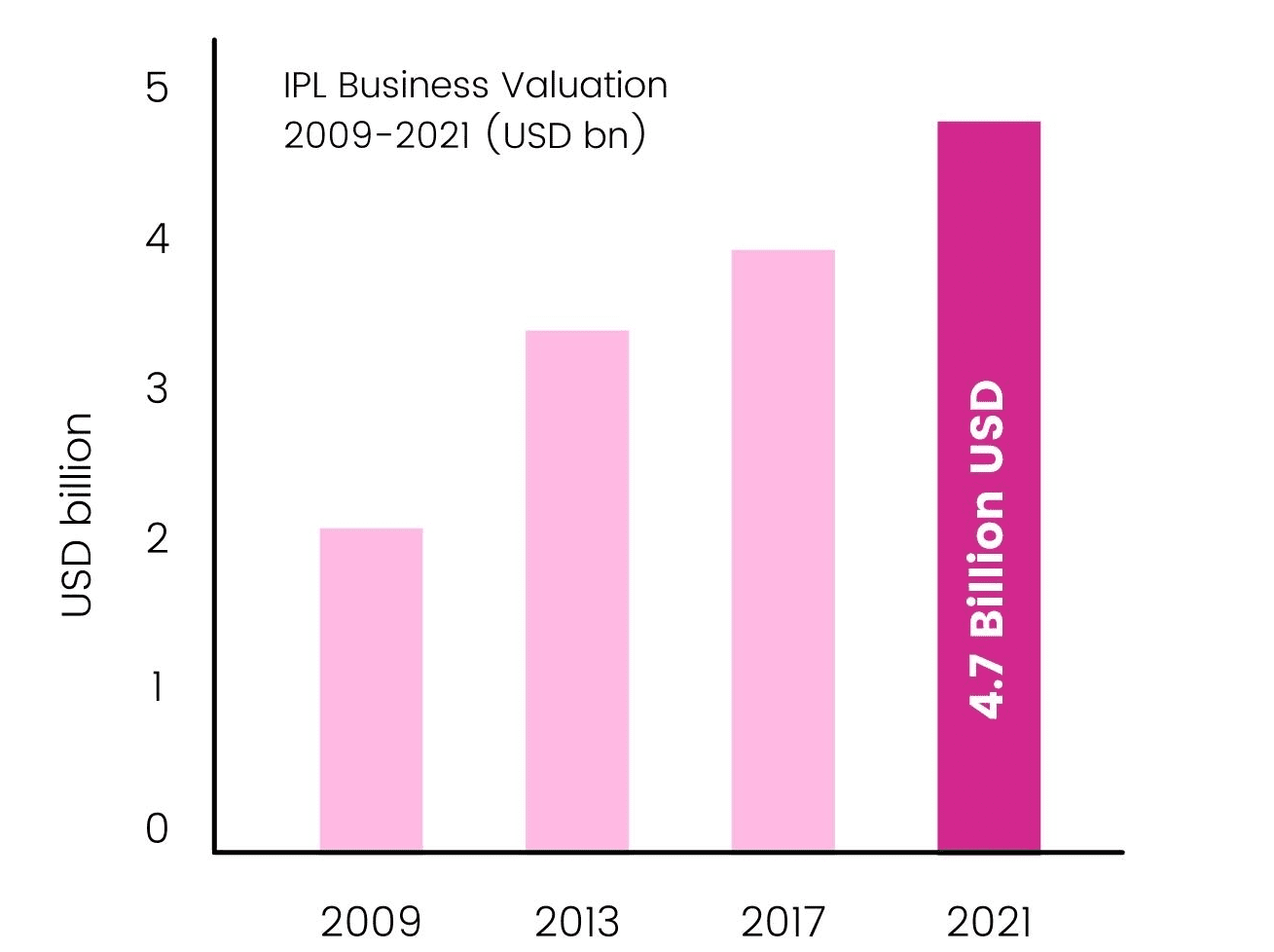
The success of IPL has been nothing short of revolutionary, inspiring various sports in India to follow in their footsteps – including Indian Super League and Pro Kabaddi.
And subsequently, the Indian sports industry is booming!
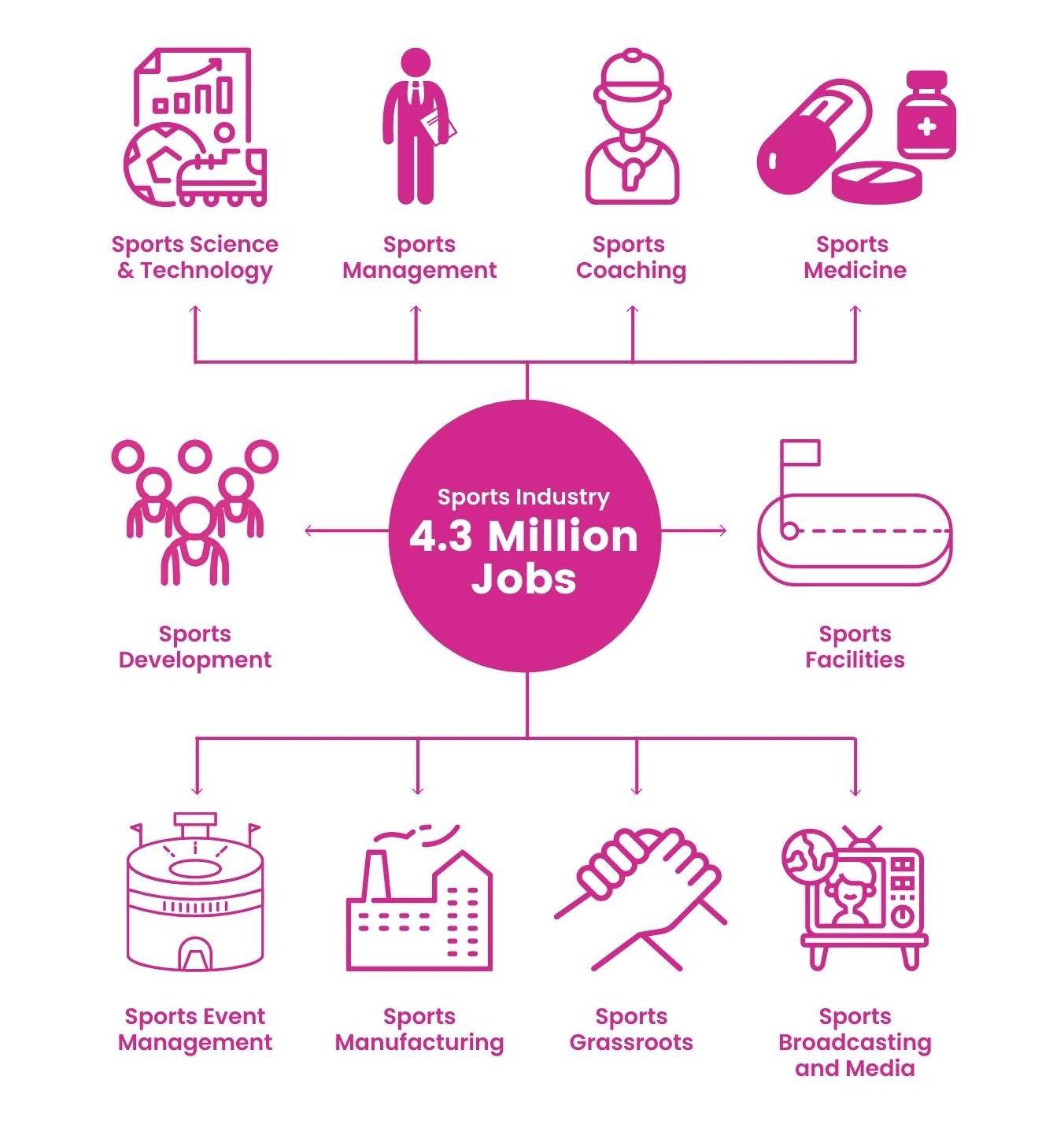
In fact, according to Federation of Indian Chambers of Commerce & Industry (FICCI), India will require a whopping 4.3 million sports jobs by 2022, with the number sure to grow in the years ahead.
What this means is an abundance of career opportunities for sports aficionados like you! And you don’t even have to be an athlete, as these opportunities come across a vast and exciting range of fields and professions!
Got a knack for graphic design? Then why not try your hand for the Sports Media and Marketing industry?
Passionate about mental health? Then why not try your hand for the Sports medicine and wellness industry?
The industry is bursting with opportunities, and you are bound to find one that suits your talents!
But how do you make your big break?
You have a talent and are passionate about sports. But how do you take the next step? How do you navigate the challenges and hurdles of an up-and-coming industry? How do you make yourself stand out from the countless other job-seekers?
That’s where we come in!
Presenting, Business of Sports 101, our Sports Programme in collaboration with none other than Inaugural IPL champs Rajasthan Royals, and the 3rd highest ranked university in the world for Sport Science, Deakin University!
The 12-day summer program, taught by experts such as IPL head coach Paddy Upton, teaches you the ins and outs of the Sports Industry, covering topics from Sport Organisation and Marketing to Nutrition and Coaching. Following the intensive summer program, you are offered a Guaranteed Internship with Rajasthan Royals to apply your learnings in a practical setting!
Ready to make your name in sports? Click here to learn more!
Financial Planning helps you fulfill all your dreams and goals in a systematic and planned manner. Managing your money need not be boring. It’s not rocket science and you need not be an adult with a financial background. You only need to show a bit of commitment!
Q. I’m still a student, am I not too young?
A. You need to start practicing now so that you can manage it better when you grow up.
Q. I have no income!
A. Pocket Money, money gifted to you, borrowed from parents, internship stipends, earning from house chores – these are all sources of income.
Q. How will this help me?
A. Don’t you want to earn more? Retire rich & early? Live comfortably? Make your dreams come true? If yes, then Financial planning is the way.
Now that you know the WHY, Let’s move on to the HOW!
1. Planning the MANTRA to success!
All of us have dreams. But how many achieve theirs?
First step in realizing any dream, financial or otherwise is to put it in writing—i.e., to set a goal. Dreams should be translated into SMART goals if they are to be realized. SMART goal is
Tip From Mentor: Spend on – Needs first! Wants later! Waste Never!
2. Planning the MANTRA to success!
A well-crafted budget can help you identify areas where you are spending unnecessarily. You can thus further reduce your expenses, improve savings, build assets and thus meet your goals/dreams faster.
Track/ record your money on apps like Spending tracker, Goodbudget App, or Excel sheet
Trim all the extra/unnecessary expenses
Envelope Budgeting – A certain amount of money is set aside (allocated) for a specific purpose or category, in an envelope marked for that purpose.
3. The Savings Mantra Start NOW! Save First! Save Regularly!
Time is Money’ and certainly so. The surest way to save is to make ‘saving’ your first and most important expense. There is no better time to start saving than NOW.
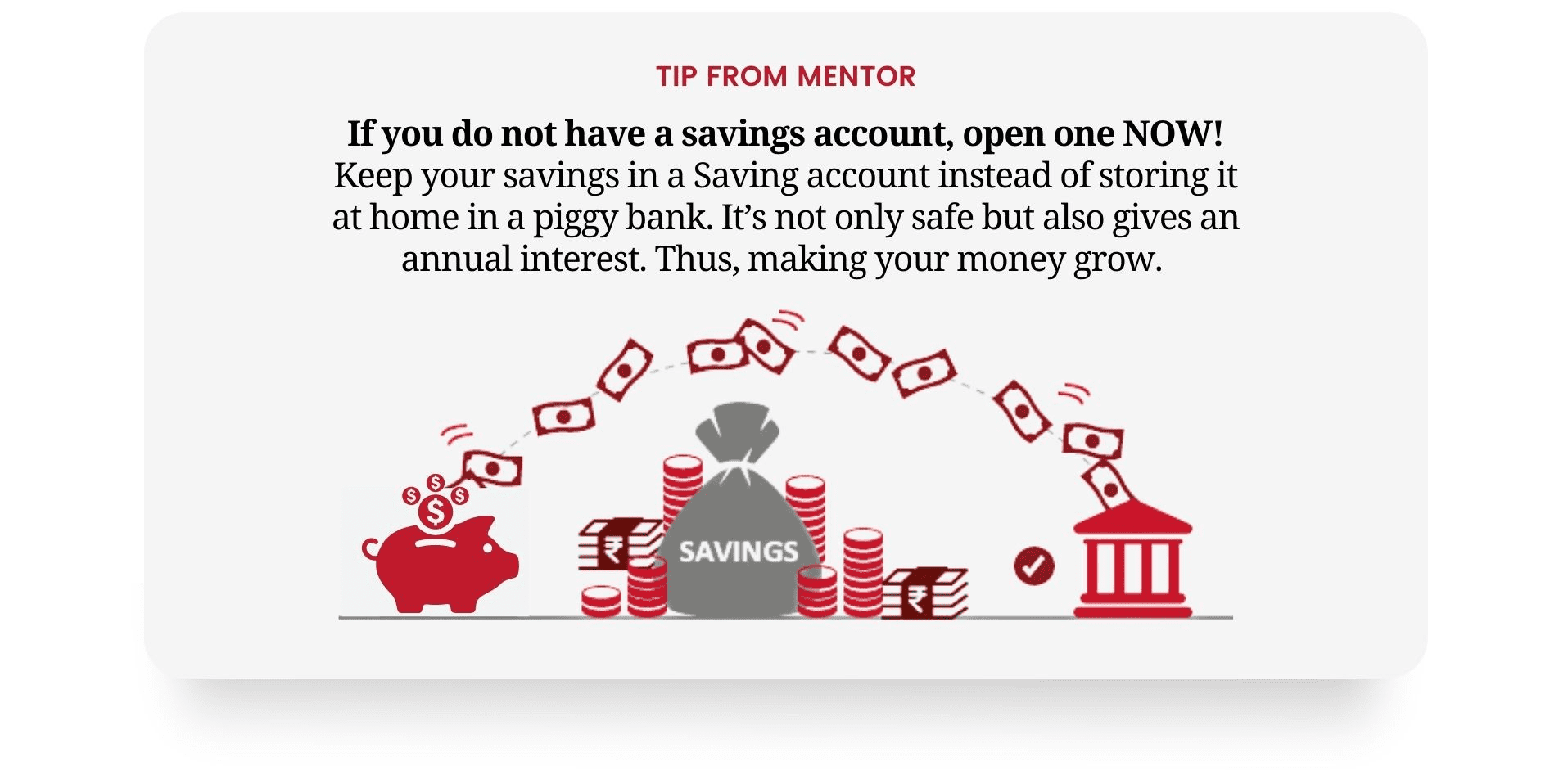
If you do not have a savings account, open one NOW! Keep your savings in a saving account instead of storing at home in a piggy bank. It’s not only safe but also gives an annual interest. Thus, making your money grow.
4. The Savings Mantra Start NOW! Save First! Save Regularly!
The investment allows you to build wealth by making your money earn steady returns and grow over a period of time. You don’t need a significant amount, you can start with an amount as low as Rs 50. per month. Start with low-risk channels like Bank Deposits, Post office deposits, Bonds & Debt Funds. If you start investing today, you cannot imagine the amount of wealth you would build by investing for 40 years. Time will be on your side.
Proper Financial Planning will help you achieve financial freedom, where you would no longer need to work for money, instead, your money would work for you.
“Do not save what is left after spending, but spend what is left after saving.”- Warren Buffet
When you have money in hand, you’ll find a hundred ways to spend it. But in how many ways can you save it? The abundance of savings you have goes hand-in-hand with your financial independence. There are a lot of categories of saving plans to improve your financial stability. Still, often, it’s difficult to find an efficient money-saving plan for students that is easy to follow and can help you save money consistently.
Folks, it’s time to forget the complicated saving plans because we have a challenge for you!
Did you know you can save Rs.1,37,800 by starting to save just Rs.100 a week in one year? And you can buy one brand new MacBook Pro or two latest iPhones with this money! Sounds a bit confusing and tough to believe, right? But that’s the magic behind this 52-week challenge! So, hop on to discover more about this challenge.
What is the 52-Week Money Challenge?
Money challenges can make the whole concept of a money-saving plan for students more fun and give them the much-needed motivation to save even more. The 52-week challenge is a strategic approach to save a certain amount every week over a period of 52 weeks, i.e. one year. If you keep up and follow it throughout the year you’ll end up saving a good amount of money in the end.
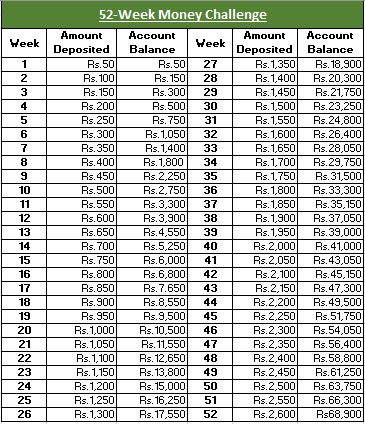
For the 52-week money challenge, you can start by saving money in multiples of Rs. 50 every week. You save and keep aside Rs.50 in your first week, Rs.100 in your second week, Rs.150 in the third week, and you’ll end this year by saving Rs. 2,600 in the final week. If we add up these total savings, it would be Rs. 68,900.
Check the sheet below to understand the amounts of money you will be saving every week, throughout the year.
You can use this planner as a checklist to keep a track of the amount of money you are saving each week.
How to Get Started and Stay on Track?
So, the very first thing to start with is deciding where to store your savings. It’s advisable to keep the money in your bank account. You may consider opening a high-yield savings account and transferring the money every week from your main account. You can automate the process by getting in touch with the bank officials, making it easier for you.
To stay on track you have to consider a couple of points:
Set reminders on the calendar and get weekly notifications so that you don’t forget about the challenge. Money management apps can come in handy in this case.
To get some extra motivation, set certain benchmarks for yourself like rewarding yourself at the end of every 5 or 10 weeks.
Ask your family members and friends to take up the challenge. Keep checking on each other on a monthly basis to ensure you’re keeping up with the challenge.
How to Make it Work?
If you take a look at the challenge sheet, you’ll see that you start by saving Rs. 50, Rs. 100 and so on per week. But by the end of the year, you need to be saving Rs. 2600 in a week. How to save this amount of money?
52-weeks is a long time, and you need to take small steps to reach the end. You can start by limiting those frequent visits to cafes, fast food restaurants, and eating inside. This will help you to save some of your pocket money for the challenge.
While ordering pizza next time, maybe cancel on that extra cheese burst and toppings that would fulfill the initial weeks of the challenge.
A huge amount of money is to be saved in the last quarter of this challenge. For the last 3 months, you can start cutting down on some unnecessary subscriptions or outings. Utilize that time to learn and grasp financial literacy crafts that would help you to make some extra money.
Inform your parents that you’re taking this challenge up and ask for their assistance in the last 3 months if you’re falling short of the challenge money.
Make use of those hefty student discounts and save money on academic courses, software, travel, food, retail, etc.
Prepare your monthly budget accordingly by keeping the challenge in mind, and the money you would dedicate every month towards it.
Is saving regularly enough? It can be. But what’s better is that you can make this money grow. Start studying about investment options available for you as a student, set a target to invest a specific amount after every 4 weeks, and watch it grow as you progress further.
Even after this, if you feel that starting with Rs. 50 is not feasible for you, don’t worry! You can start saving only as much as 10 bucks a week as well. Just building the habit of saving is important.
Have a look at the image below to understand how much money you would save in 52 weeks if you start with Rs. 10, Rs. 20, Rs. 30, etc.
The ball is in your court now, on what amount to start with, when to begin and how you would bring the best out of this challenge for yourself.
Benefits of the 52-Week Money Challenge
Alright, we hear you! Savings are important and you are well aware of that. But why should you follow the 52-week challenge? Let’s have a quick look at the top 3 advantages of the 52-week challenge:
By taking up this challenge, you are taking small steps towards your savings plan and financial goals for the future. A huge sum doesn’t just appear in your account one day out of nowhere. It has to be built consistently. The challenge helps you to save a larger amount by starting small.
Though you’re starting small, you can gain momentum slowly and notice results as each week passes by. This would motivate you to save more and encourage you to develop a long-term financial habit.
Taking small actions is always more convenient. Rather than saving large amounts like Rs.2,000 or Rs.5,000 at the end of the month, you can focus on saving small amounts like Rs.30 or Rs.300 every week, without taking any extra load.
The challenge is surely going to check your perseverance. So, instead of spending on things that give you immediate gratification, you can delay your spending and end up buying something substantial for yourself.
Tips for Completing 52-Week Money Challenge
Now that you know what is the 52-Week Money Challenge and the benefits it offers, here are some exclusive and fantastic tips from Big Red Education that will help you to complete this challenge:
Tip Number 1: Pre-plan the amount to save along with your budget
While creating your monthly budget, calculate the amount that will go towards this challenge that month. Once you have it pre-planned, you can manage your other expenses accordingly and won’t face any issues by month-end.
Tip Number 2: Reduce your expenses wherever possible.
You won’t just end up with a large amount without cutting down your expenses. So, keep an eye on your daily expenses and avoid things that urge you to spend money. Start small by avoiding that extra cheese slice on your burger or taking an extra cup of cold drinks while you eat outside, and gradually you’ll save up money for the challenge. You can also gain some extra money by selling things that you don’t need.
Tip Number 3: Stay motivated and stick till the end.
The challenge is not meant to be easy for sure, so even if you have a few misses in between, that’s completely okay. Remember that you have already accomplished the most difficult part – getting started. Pat your back for that, and save whatever amount possible every week. You can save even in multiples of your favorite number and make things interesting.
When to Start This Challenge and What to do With the Savings?
The most ideal time to start this challenge is at the start of the year along with your New Year Financial Resolutions. This helps you to keep track of both things simultaneously. However, this is not a rule, and you can literally begin with your challenge whenever you feel like taking one! The key is TO START, and you already have passed it!
The amount that you save through this challenge can be used as an emergency fund, sinking fund, or even investment. You can also do something fun for yourself like buying things that are on your wishlist for a long time or planning a vacation for your family.
By taking this challenge, you are starting to build a strong financial base for yourself that will act propel you toward your dreams. Continuing to invest this money for the next few years can help you build a good sum and contribute to your university expenses or entrepreneurial endeavors.
Try out the 52-Week Money Challenge Now!
Needless to say, this 52-week challenge is just the first step toward a giant leap in your personal financial journey. It is an excellent opportunity to improve financial management skills, build money management skills for the future, and get used to financial goals. If you complete this challenge, do celebrate. But remember to save further and use this experience as a springboard for achieving your other financial goals.
Looking for more such challenges and interesting things to learn about the financial world? Connect with Big Red Education now and take a step towards your financial journey.
Let’s start with a simple activity. Define the picture you see when you hear the word ‘budgeting’.
Do you see a person sitting on a table with tons of bills like grocery, household, electricity, wifi & mobile plans, etc., taking a note of the money spent and making a list of it on the paper? Probably then, categorizing it further according to the different expenses categories and calculating the funds available in hand? Is this what you imagined?
Well, it’s not you, it’s everyone!
This same picture flashes in front of everyone on hearing ‘budget’, and that’s the very reason why people refrain from making one for themselves. But, is budgeting that boring? Does it give a hard time to everyone? Let’s dig in and find out.
Do I ‘Really’ Need to Budget
Budgeting does sound like the cornerstone of your personal financial literacy, but the real question is “Do I need to budget?” Before jumping on to what is budgeting and how to create one for yourself, you have to understand your personal finances and see if a budget helps you in the process.
You need to create a budget right away in the following scenarios:
You are overspending every month on things like food, online shopping, electronic accessories, OTT platform subscriptions, etc., and need extra money other than your monthly allowances.
You have set financial goals to achieve, but are having a hard time keeping up with them. You are finding it difficult to achieve them and skip them midway.
You want to save more money every month and keep aside a certain portion for yourself, but are clueless on how to assign money for the expenses.
You are looking to have true financial freedom and gain complete control over your personal finances to be prepared for the future.
If you find yourself in any of these scenarios, then it’s high time that you understand budgeting is an excellent tool for your financial future and would make your financial journey much easier.
How to Create a Budget and Why is it so Important?
A classic financial budget helps you to spot where your money is going, and where you are spending more than you would have realized. So, it’s advisable to brainstorm for some time, understand your finances well before you pen it down. There’s a four-step approach you need to follow :
Step-1: Gather your allowances/income, and expenses in one place
When you’re starting to create a plan, you first need to get a hold of all your money. This might be the first time you have set out to plan your money. For starters, you can record all the financial activities, expenses for a month or two. Eventually, you can make a note of the major expenditures that are expected in the upcoming months.
Step-2: Create a budget worksheet/plan
Before Step 1, you had negligible visibility on the inflow and outflow of your money. By now, you know a bit about it.
Now, it’s time to get even more precise.
Noting down your expenses and mentioning your plan on a budget worksheet is a good practice. You can simply check every month where you’re spending and how much are you left with at the end of the month. You can also make use of budgeting apps to view everything right on your smartphone.
You can make use of some of the following budget templates when you sit down to create one:
Microsoft My College Budget Worksheet: A budgeting template that is flexible even for high school students to track their expenses and manage personal finances.
Microsoft Savings Estimator: A savings template that helps you set financial goals and visualizes savings plan details for effortless goal tracking.
Microsoft College Expense Estimator: An easy-to-use expense estimator template that calculates the cost of living and other activities while in school.
P.S. Although these templates are more oriented towards college students, you can get hands-on experience on them while in school, and utilize them in the best possible way while in college.
Step-3: Calculate each set of figures
Next, let’s get a holistic idea of your income, expenditure, and savings to be able to decide the future plan. Add your total income/monthly allowance, subtract your monthly expenses from it, and you get a picture of your financial health. Pat your back, if this amount is a good number, as you can use that money for savings or invest it in the right place. And if your expense tab is larger than your income, then don’t press the panic button just yet, but do make some changes in your spending plan.
Step-4: Analyze your expenses
Drill down on your expenses and categorize them into fixed expenses like school supplies, transport, phone/internet bills and variable expenses like fast food, trips with friends, clothing, etc. Look at the opportunities where you can end up saving money for yourself.
How do I Stick to a Budget?
The plan’s ready, now let’s have a look at the implementation part and how to stick to your budget till the end. Keeping a budget is not easy. You can have a bad month, feel discouraged and just give up on it. This is undoubtedly the hardest part of the process, and if you ask the adults in your house about it – you’ll end up getting the same answer. While you can get some useful advice from them too, we would like to add a few more points to that –
Don’t set an unrealistic budget or a process that you can’t handle currently and is way out of your scope. Take all financial and external factors into consideration before you begin. Because once you go even a little out of the line, you would eventually feel like giving up the entire plan.
Think twice before making any purchases, ask yourself if it is the need of the hour, and do I need to buy it right away? This would help you to steer clear of large amounts that negatively affect your budget.
Apprehend the concept of ‘budgeting to zero’, i.e. while creating a budget, your income (allowance) minus expenses should be zero. So, when you budget to zero, all the buffer or extra money altogether contributes to your savings and allows you to take complete control over personal finances. You can make use of investment plans for studentsto put this extra money to the right use.
The BRE Exclusive Budgeting and Saving Tips
Tip #1: Avoid Unnecessary Purchases
Think twice before you buy things like electronic gadgets, OTT platform subscriptions, expensive food, etc. Ask yourself if the purchase is necessary and would it benefit you? Most times, such big purchases mess up your budget making it difficult to get back on track again. Make use of student discounts wherever and whenever possible to save up some money.
Tip #2: Don’t spend more than what you have in hand
Overspending is certainly not a good habit, and you would end up in debt soon if you continue doing so. If you can’t afford something or don’t have enough money, put it off for next time.
Tip #3: Try a No-Spend Challenge
You can take up this challenge and go on a spending freeze or spend fast for a week, fortnight, or even more. The idea is not to spend money on any unnecessary things and limit yourself to spending very little. To make it more fun you can challenge your friends, and family and see who saved the most in the end.
Tip #4: Connect your spending with your Income/Allowance
You get your monthly/weekly allowances from parents, and similarly, you can also make use of financial crafts to make some money of your own. An important aspect of budgeting is to reframe the way you look at money. So, before spending on anything, take a moment to reflect upon the efforts that you or your parents have undergone to earn that amount of money.
Tip #5: Treat yourself to achieving your goals
Remember, budgeting or personal finances isn’t just about discipline, but it’s an approach to set and reach your financial goals. So, carry along with the fun, reward yourself when you stick to your budget every month, and don’t look at it as a chore, but a fun activity.
Wrapping Up
With this, now you should have a good idea of how to create a budget for yourself, stick to it, and improve your financial literacy. Budgeting is all about making a plan to bring your financial life on track and putting in efforts to stay committed to it. So, no more worrying about where your money went at the end of the month because now you have your plan to gain financial freedom right in school.
That’s all folks! But if you have any more doubts related to budgeting, savings, or want to explore more about finance, Big Red Education is right here to lend you a helping hand. Connect with us now.






 Q. I’m still a student, am I not too young?