blog | 9min Read
Published on July 28, 2022


Setting SMART Goals in High School!

I am sure everyone has heard of goals, but now you must be wondering what ‘SMART’ goals are. As the name suggests, it is pretty direct – goals that are smart! But now you might ask, how do we make our goals smart? Do not worry, we have got you!
Let’s start by understanding what exactly are smart goals. Could the word ‘smart’ have another meaning to it when it comes to goals?
SMART goals are one of the most invaluable objective-setting techniques and yes, the word SMART does have another meaning when it comes to goals. SMART is a popular acronym that stands for Specific, Measurable, Attainable, Relevant and Time-bound.

To get a better sense of this, let us take a look at each letter of the SMART acronym:
Specific

General vs Specific Goals:
General goals are vague and that makes it hard for you to make a concrete action plan for them. Thus they are less likely to be accomplished. For example, “I want to get in shape.”
On the other hand, specific goals are more likely to be accomplished because thinking specifically about the goal you want to achieve helps devise a plan of action with ease. For example, “I will join the gym, workout 4 times a week, and start eating better.”
It is easy to spot the difference between the 2 examples above and one must follow the latter to achieve one’s goals.
Now, how do we set specific goals?
We do so by including the 6 W’s- Why, When, Who, Where, Which, and What.
- Why: Identify Specific reasons, purpose or benefits of accomplishing the goal.
- When: Establish a time frame.
- Who: Figure out who is involved
- Where: Identify a location.
- Which: Identify requirements and constraints.
- What: What do you want to accomplish?
So, if I wanted to make a goal regarding finishing my exam syllabus before time, this is what the six W’s could look like-
- Why: Because I want to score well on the exam.
- When: 1 month before the exam month (say July).
- Who: Myself/ tutor/ teacher (whom I may want extra hours with for doubts)
- Where: At the study table in my house/ local library.
- Which: Not managing my time well and giving into distractions might slow down my progress. Thus, I need a fixed schedule with breaks and need to put my phone away while studying.
- What: Finishing the syllabus so that I can score well on my exams.
Measurable

When you measure your progress, you hold yourself accountable. This accountability factor oftentimes gives you a push to reach your goals. To make your goals measurable, you need to have concrete criteria, which in turn can be done using the 3 H’s, wherein numbers come into play.
To ensure that your goals are measurable, you can ask yourself questions such as:
- How much work?
- How many people, hours?
- How will I know when it is accomplished?
Taking the same example of studying to complete my syllabus before the exam, this is what the 3 H’s could look like.
- How much – 10 chapters
- How many – 6 hours per day for 1 month, and 1 hour of tuition with 1 tuition teacher
- How will I know when it is accomplished – when my 10 chapters are over/ when I finish studying 6 hours a day
Achievable/Attainable
A good goal would be that which you believe you can achieve.
Planning your steps wisely can help achieve any goal. However, it is always better to start small and then grow to meet the bigger goals. The reason behind this is that when you list down or come up with goals that mean something to you and are important, you start searching for qualities within yourself that can facilitate the attainment of these goals. This is because in order to achieve bigger goals you need to acquire qualities that you may not possess at present. Thus, you must be self-aware before deciding on your goals. Once you know of the qualities you have and those you will need it becomes easier to grow into achieving a larger goal.
However, achieving goals like getting into an Ivy League Universities can be intimidating. As important as this goal is, it is not achievable without achieving smaller goals like starting an extracurricular activity, acquiring leadership skills or making sure you have a well-rounded development etc. These activities will help build your portfolio, and that is what will then facilitate admission into a great university.
Now you may easily observe that a small activity like starting an extracurricular activity is more achievable than a big goal like getting into a great university. However, the small activity does not need to be an isolated one, it could be a way or step to reach your big goal. What this brings us to is that when you identify goals that are important to you, you begin finding out ways/steps that will help you achieve those big goals. You grow and expand into these goals by developing attitudes, financial capacity, skills, abilities, etc.
If you make unrealistic goals which are not achievable in the time frame you give yourself, it will just lead to demotivation and stress. Hence, we should judge our capability and capacity before deciding on our goals in order to plan them in an achievable manner.
Realistic

To make your goals realistic, you must be “willing” and “able” to work towards them. Even the hardest of goals are achievable with the right motivation and resources.
The willingness brings us to the relevance of the goals as well. Naturally, you would be more willing to work on a goal that you yourself deem important and urgent. This is because that goal is more relevant to you. If today you say you want to study medicine, you will be more willing to work towards it than if your teachers or parents were to tell you the same. Thus, the more personal or urgent the goal is to you, the more willing you are to take the necessary steps to achieve it.
Moreover, you are also more likely to want to work towards expanding and developing your abilities for a goal that you are willing to achieve because the right motivation is present. Thus, with the right balance and combination of willingness and ability, or in other terms, your motivation and resources, you make your goal realistic and relevant.
Furthermore, if you believe that you can achieve your goal, it is probably realistic. Another way to check whether your goals are realistic or not is to analyse what resources you would need and if you have access to them; what conditions/obstacles could arise and if you will be able to overcome them or if you have been able to achieve something similar in the past.
Time-Bound

Deadlines are going to be your saviour when it comes to accomplishing your goals because they bring in a sense of urgency. If you say “I will finish 20 chapters”, what that misses is a time frame. You can easily finish 20 chapters in 2 months but if your exams are in 1 month then asserting the timeline of 1 month is imperative. Now the goal will look something like this, “I will finish 20 chapters in less than a month.”
One thing to keep in mind, however, is not to make unrealistic deadlines. If you say you want to finish 20 chapters in 5 days, it is quite impossible and it will in turn crush your willingness and motivation. So again, make sure that it is doable.
All letters of the acronym SMART, tie in with each other in some way or the other. By making your goals time-bound, you are not only making them specific but also realistic and measurable.
Something you could do is time yourself finishing one of the hardest/ longest chapters to gauge an estimate of how long it will take you to do each chapter. You should time the hardest/ longest chapter because if you time the easiest one, it is obvious it will be a much lesser timing. And when you are not able to finish every chapter at the same time, you will get demotivated and feel stressed because you have now planned your schedule according to the easiest chapter and now the hard chapters start looking even more intimidating than they already are.
Now that we have successfully analysed the 5 letters of the acronym SMART, here are a few tips especially for students who are preparing for an exam and struggling, that could help them frame and follow their SMART Goals:
- Get yourself a planner well in advance. Being ahead of time will help you plan much better and it will be easier for you to follow it. Even if you lag behind on something you will have enough time to come back to it later.
- Write down the syllabus you need to complete for each subject and be as specific as you can. You can divide your syllabus into a number of chapters and chapters into a number of further sub-divisions etc. This will break it down for you so that you can estimate how much time it would take you to finish a chapter and subsequently the syllabus, which in turn will make your goal measurable as well.
- Tick each topic off your list once you are done with it because not only will you get a boost from the topics you are finishing but also an idea about how much work is remaining. If a chapter ever got too much for me, I would leave the last 1 or 2 subtopics and move on to the next; however, since those subtopics were not ticked in my planner, I always remembered to come back to them later.
- Make a week-wise timetable and again try to go into the number of hours you will study in a day, the number of chapters you will finish in a day and by the end of the week etc. Do make sure to add in the necessary breaks to make it achievable because we all know it is impossible to study for 24 hours a day. Add in some power naps, some physical activity, maybe a music break etc. You can use the Google Calendar app to device your schedule; it is what I used and was extremely helpful because it gave me reminders too!
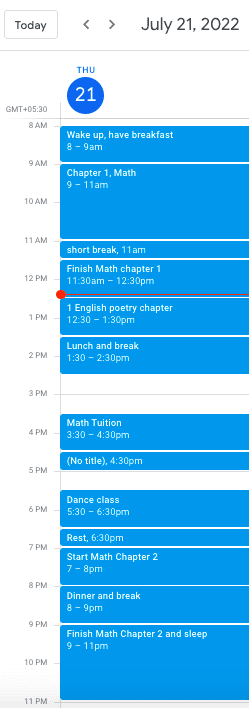
This is an example of a schedule on Google Calendar that you can take reference from. I have planned a day where I aim to mainly get done with some math syllabus. As you can see, on the app I can be specific with the number of hours I want to devote to each task. I have also added necessary switch ups i.e. English, because just one subject can get monotonous, breaks, and physical activity like dance which would help me reduce anxiety or stress that may come up during the day. Physical activity releases endorphins as well, which facilitate the production of the brain’s feel-good neurotransmitters, called endorphins which elevate mood, energise you etc. Moreover, I have left blank, white spaces in the schedule so that if I am unable to complete a particular task in the stipulated time then I could carry it over to the blank spaces. For more useful study resources, check out this blog.
- Make sure to keep your goals for the week/day realistic. If you expect too much from yourself, not reaching said goals may demotivate you. This was a mistake I always made and I hope that after reading this you will avoid it.
- If you want, add a reward for yourself at the end of every week or maybe at the end of every day too! This worked for me because I had something to look forward to once I completed a certain portion of my syllabus.
- The obstacle that you may face in general while trying to accomplish your SMART goals is procrastination. Putting your work off to the end will go against the entire concept of smart goals. All your effort will go to waste if you do not follow through with your schedules and deadlines effectively. Here is where you can get a few tips on how to stop procrastinating- https://www.snhu.edu/about-us/newsroom/education/how-to-stop-procrastinating.
- Prioritise – put away your distractions, be it your phone, food (a huge distraction, at least for a foodie like me) etc. while you are studying. This is actually one of the most helpful tips. Everyone knows they should do this but actually executing it will help you focus.
- The sense of satisfaction you will get when you tick off topics on your syllabus sheet will naturally motivate you to do more 🙂
If you follow these, you will be able to manage your time much better and will be able to effectively achieve your SMART Goals.
Pro Tip– Try to start studying early in the morning. Your focus will be much more and by lunchtime, you will already feel like you have accomplished a lot. Trust me, I have tried studying from 2-6 am without sleep telling everyone that I study better at night, but the amount I could study that way compared to what I could early in the morning differed by leaps and bounds.
Happy SMART Goal Setting!! Here is a worksheet you can use as an activity to get started on your goals- https://trio.ucsd.edu/_files/staff_forms/SMART%20goal%20setting%20sheet