Uncategorized | 7min Read

Research vs Internships: Which Matters More for College Admissions?

Published on July 3, 2026

FacebookTwitterWhatsApp
Categories
Uncategorized

Research vs Internships: Which Matters More for College Admissions?

Research vs. Internships: Which Matters More for College Admissions?

Building a College Profile That Goes Beyond Grades

“Should I spend my summer doing research or apply for an internship?”

It’s one of the most common questions we hear from ambitious high school students and their parents. As university admissions become increasingly competitive, students are looking for experiences that not only strengthen their applications but also help them discover their interests.

The internet is filled with conflicting advice. Some believe research is the golden ticket to top-tier universities, while others argue that internships provide the real-world experience admissions officers value most. The truth, however, is far more nuanced.

At Big Red Education, we encourage students to stop asking, “Which looks better on my application?” and start asking, “Which experience will help me grow, learn, and tell my story?”

Because that’s what selective universities are looking for not a checklist of impressive activities, but students who have pursued opportunities with purpose.

In this blog, we’ll break down the differences between research and internships, explore how universities evaluate both experiences, discuss which students benefit most from each, and help you decide which path aligns with your academic and career goals.

What Do Top Universities Really Look For?

One of the biggest myths surrounding college admissions is that there is a secret formula for getting accepted. Students often believe that completing a prestigious internship or publishing a research paper automatically gives them an advantage.

In reality, admissions officers take a much broader view.

Leading universities evaluate applicants holistically. Alongside academic performance, they look for evidence of curiosity, initiative, resilience, leadership, and a genuine willingness to explore ideas beyond the classroom.

Imagine two students applying for Computer Science.

The first spends two weeks observing software developers at a technology company. They gain insight into workplace culture but have limited opportunities to contribute.

The second spends several months investigating how machine learning algorithms detect diseases, working closely with a mentor to analyse data and present findings.

Neither experience is automatically “better.” Instead, admissions officers will ask:

  • Which student demonstrated greater depth?

  • Which experience aligns more closely with the student’s academic interests?

  • What did the student actually learn?

  • How will these experiences shape their future contributions on campus?

These are the questions that matter.

Understanding Academic Research

Research is often misunderstood as something reserved for university students or aspiring scientists. In reality, research is simply the process of asking meaningful questions and seeking evidence-based answers.

For high school students, research provides an opportunity to move beyond textbook learning. Instead of memorising concepts, students investigate real-world problems, analyse information, develop hypotheses, and communicate their findings.

This process cultivates habits that universities highly value: intellectual curiosity, critical thinking, persistence, analytical reasoning, and independent learning.

Research also encourages students to embrace uncertainty. Unlike classroom assignments with predetermined answers, research involves exploring questions that may not have clear solutions. Learning to navigate that uncertainty is a skill that prepares students for higher education and beyond.

When Research Can Make a Bigger Impact

Research is particularly valuable for students applying to academically rigorous programmes where intellectual inquiry forms the foundation of learning.

Students considering fields such as Computer Science, Artificial Intelligence, Engineering, Medicine, Biotechnology, Physics, Mathematics, Economics, Environmental Science, or Psychology often benefit from demonstrating that they have already engaged with research before arriving at university.

For example, a student interested in biomedical engineering who investigates wearable healthcare technology demonstrates initiative far beyond classroom expectations. Similarly, a student passionate about climate change who conducts research on sustainable energy solutions shows universities that their interest extends beyond academic grades.

This is why meaningful research often becomes a powerful part of personal statements, essays, and interviews. It gives students authentic experiences to discuss rather than hypothetical ambitions.

Understanding Internships

While research focuses on discovering new knowledge, internships focus on experiencing the professional world.

Internships allow students to observe how organisations operate, collaborate with professionals, solve workplace challenges, and understand the realities of different careers.

For many teenagers, internships provide something equally valuable: clarity.

A student may believe they want to become a lawyer until they spend time in a legal office and realise they enjoy negotiation more than litigation. Another student may intern at a marketing agency and discover a passion for branding, communication, or consumer psychology.

These insights are difficult to gain from classrooms alone.

Internships also help students develop practical workplace skills such as communication, teamwork, professionalism, time management, adaptability, and responsibility qualities that universities appreciate because they contribute to success both inside and outside the classroom.

When an Internship Is the Better Choice

Internships are especially valuable for students exploring industries where practical exposure is essential.

Students interested in business, entrepreneurship, journalism, finance, architecture, media, design, consulting, public policy, or hospitality often gain significant perspective from working alongside professionals.

An internship enables students to understand what the day-to-day reality of a profession actually looks like. That experience often strengthens university applications because students can explain not only what they want to study, but also why they have chosen that path.

Admissions officers appreciate applicants who make informed academic decisions based on exploration rather than assumptions.

Research vs. Internships: The Real Comparison

One of the biggest mistakes students make is treating research and internships as competitors. In reality, they serve different purposes.

  • Research demonstrates how you think. It highlights your ability to investigate complex questions, analyse information, and contribute to academic conversations.

  • Internships demonstrate how you work. They reveal your professionalism, communication skills, adaptability, and willingness to learn in real-world environments.

Think of research as showing universities your intellectual depth, while internships reveal your professional maturity. Neither replaces the other. Instead, they tell different parts of your story.

Can You Do Both?

Absolutely and for many students, combining both experiences creates the strongest profile.

Consider a student interested in Artificial Intelligence. They might spend one summer participating in a research project exploring ethical machine learning models before completing an internship at a technology startup the following year.

The research demonstrates academic curiosity and analytical thinking, while the internship shows how those ideas translate into practical innovation.

Similarly, a student passionate about environmental science might conduct research on climate resilience before interning with an organisation working on sustainability initiatives.

Together, these experiences create a cohesive narrative that universities find compelling.

Common Mistakes Students Make

At Big Red Education, we often see students fall into the trap of collecting experiences rather than pursuing meaningful ones.

One common misconception is believing that prestigious opportunities automatically impress admissions officers. In reality, a short internship with little involvement rarely carries more value than a long-term research project driven by genuine curiosity.

Another mistake is choosing opportunities simply because friends are doing them. Every student’s academic journey is unique. What strengthens one application may not strengthen another.

Students also underestimate the importance of reflection. Completing an internship or research project is only part of the process. Being able to articulate what you learned, how you grew, and how the experience shaped your future aspirations is what truly makes an application memorable.

Depth consistently outweighs quantity.

How Big Red Education Helps Students Build Meaningful College Profiles

At Big Red Education, we believe that profile building should never be about chasing trends or ticking boxes. Every student’s journey begins with understanding their interests, strengths, and long-term aspirations.

  • For students passionate about scientific discovery and innovation, the STEM Research Accelerator offers an opportunity to work alongside experienced mentors on authentic research projects. Rather than simply learning concepts in a classroom, students engage with real-world questions, develop analytical skills, and experience the research process that underpins higher education.

  • Students curious about emerging technologies can explore Command Z, where they gain exposure to Artificial Intelligence, digital innovation, and future-ready skills that are becoming increasingly valuable across industries.

  • Those interested in diplomacy, law, public policy, and global affairs can develop leadership, negotiation, and public speaking abilities through ILMUNC (the official Ivy League Model United Nations Conference hosted by the University of Pennsylvania).

  • Aspiring entrepreneurs can transform ideas into impactful solutions through Innovate NOW.

  • For students passionate about athletics, the Sports Program run in collaboration with Deakin University demonstrates that excellence in sports and academics can go hand in hand, opening pathways into sports science, management, and international education.

Each programme offers a different way for students to explore their interests before making important academic decisions.

So, Which Matters More?

If you’re hoping for a simple answer, here it is:

Neither research nor internships are inherently better for college admissions.

What matters is whether the experience aligns with your goals, challenges you to grow, and helps you build a genuine story about who you are.

  • Research is ideal for students who love asking questions, solving complex problems, and exploring academic ideas in depth.

  • Internships are ideal for students who want to understand industries, gain workplace experience, and test potential career paths.

For many students, the most powerful college profile includes both—because together they demonstrate intellectual curiosity, practical application, and personal growth.

Final Thoughts: Build a Story, Not Just a Resume

One of the most valuable lessons students can learn is that college admissions are not won by accumulating the longest list of achievements. They are strengthened by building a clear, authentic narrative.

Every activity you choose should answer a simple question: What does this experience reveal about me?

Did it deepen your curiosity? Did it help you solve meaningful problems? Did it confirm your academic interests? Did it teach you resilience, leadership, or collaboration?

When your experiences connect naturally, your application becomes more than a collection of certificates—it becomes the story of a student who is genuinely excited to learn, contribute, and grow.

At Big Red Education, we help students build that story through meaningful opportunities in research, innovation, technology, leadership, entrepreneurship, diplomacy, and global learning. Because the strongest college applications don’t begin with impressive extracurriculars. They begin with curiosity, purpose, and the courage to explore.

Continue Your Career Exploration

If you’re ready to help your teenager make informed academic and career decisions, explore Big Red Education’s programmes designed to foster research, leadership, innovation, technology, and global learning. The earlier students begin exploring their interests, the more confident they’ll be when it’s time to choose their future.

Editor's Pick

Uncategorized | 4min Read

Future-Proofing Your Child: The Skills Students Need to Succeed in an AI-Driven World

Published on June 24, 2026

FacebookTwitterWhatsApp
Categories
Uncategorized

Future-Proofing Your Child: The Skills Students Need to Succeed in an AI-Driven World

Future-Proofing Your Child: The Skills Students Need to Succeed in an AI-Driven World

As a parent, you are constantly making decisions to set your child up for success. You invest in the best schools, encourage high grades, and carefully map out extracurriculars. But here is the candid, slightly uncomfortable truth: the playbook for success has fundamentally changed. Preparing children for the future using yesterday’s educational blueprint is no longer enough.

In this blog, we are cutting through the noise. You will discover exactly what future-ready education looks like and the specific future-ready skills your child will need to thrive in a workforce disrupted by AI in education and automation. By the end of this read, you will have a clear, actionable roadmap to navigate the intersection of parenting and education, ensuring your child has the career readiness to not just survive the future, but to lead it.

The Reality Check: What the Data Tells Us About the Future of Work

If you are wondering whether the traditional “study hard, get a safe job” path is still viable, global economic data provides a clear picture: Strong academics remain important, but on their own, they are increasingly insufficient in a rapidly changing workforce. We are experiencing a rapid shift in the skills for the future that employers actually value.

Looking at data from the WEF Future of Jobs Report 2025 and McKinsey’s future skills research, the trend is undeniable. Although they approach the future of work from different perspectives, both reports point to the same conclusion: employers increasingly value adaptable, collaborative, and analytical thinkers. With generative AI handling increasingly complex, routine tasks, human-centric skills—empathy, complex problem-solving, and intellectual curiosity—are becoming the ultimate premium currencies. Rote memorization is out; dynamic application is in.

The Essential Skills Students Need (And How to Cultivate Them)

So, how do you translate these daunting macroeconomic trends into practical parenting? It starts by focusing on active, experiential learning. Here are the core pillars you should encourage:

1. Technological Fluency (Beyond Screen Time)

It is not enough for your child to know how to use an app; they need to understand how to build with technology. They must shift from being passive consumers to active creators. Encouraging them to explore the ethics, application, and mechanics of emerging tech gives them a distinct edge. By fostering AI literacy, digital citizenship, and responsible technology use, you prepare them to navigate and shape the digital world safely and effectively.

2. Entrepreneurial Thinking and Innovation

Entrepreneurship is not just about starting a business; it is a mindset. It involves looking at a broken system, identifying a problem, and having the audacity to build a solution. This teaches resilience, pivoting after failure, and deep analytical thinking—skills that translate to any career path.

3. Global Diplomacy and Complex Communication

In an increasingly fragmented world, the ability to negotiate, debate logically, and master cross-cultural communication is paramount. Learning to structure an argument, listen actively, and lead with empathy are traits that AI simply cannot replicate.

4. Social Impact and Leadership

Top-tier universities and future employers are no longer just asking, “What can you do?” They are asking, “How have you used your abilities to impact your community?” True leadership involves mobilizing others toward a common, meaningful goal, requiring high levels of teamwork and the initiative to take the first step.

What Parents Can Start Doing This Month

The shift to future-ready learning doesn’t have to happen overnight. You can start laying the groundwork right away. Here are practical steps to take this month:

  • Encourage curiosity by asking open-ended questions.
  • Let your child take ownership of a project or household challenge.
  • Prioritize depth over collecting endless extracurricular activities.
  • Support participation in experiential, hands-on learning programs.
  • Discuss real-world problems together to build critical thinking.

Bridge the Gap with Big Red Education

As a parent, you don’t have to navigate this shifting landscape alone. You simply need to point your child toward environments where these skills are actively forged.

At Big Red Education, we exist to bridge the gap between traditional schooling and the real-world demands of the future. We move students away from passive learning and into active creation through our world-class, immersive programs.

Whether your child is ready to dive into the mechanics of AI at our Command Z: Future Tech Lab, build and pitch their own startup at InnovateNOW, master the art of global diplomacy at ILMUNC India, or learn to drive meaningful change at the Social Startup Bootcamp or the Leadership & Social Innovation Conference, we have a pathway tailored to their ambitions.

Don’t let your child face tomorrow with yesterday’s toolkit. Empower them to build, create, question, and lead. Explore Big Red Education’s programs today and give them a meaningful edge for the rapidly changing world ahead.

Editor's Pick

blog Entrepreneurship Higher Education Internship Leadership MUN Productivity Research Uncategorized | 5min Read

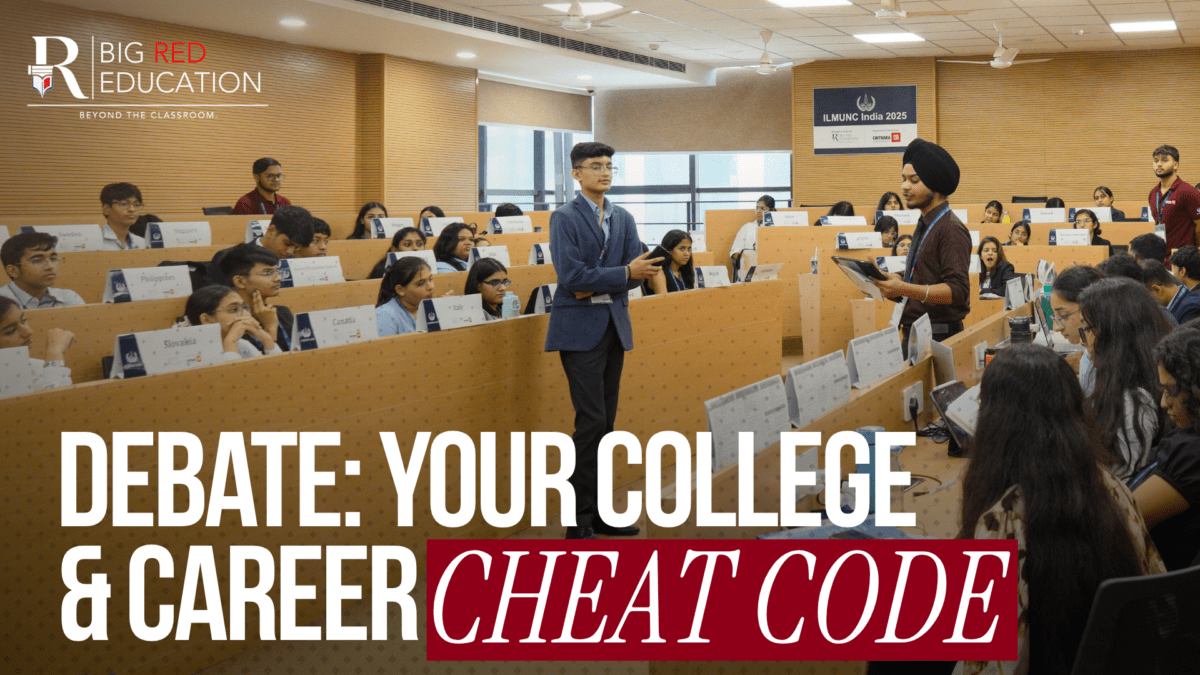
Why Debate Is Your Ultimate College & Career Cheat Code.

Published on June 3, 2026

FacebookTwitterWhatsApp
Categories
blog Entrepreneurship Higher Education Internship Leadership MUN Productivity Research Uncategorized

Why Debate Is Your Ultimate College & Career Cheat Code.

Why Debate Is Your Ultimate College & Career Cheat Code.

This article highlights the key reasons why participating in debate can significantly boost your academic journey and career prospects. It explores how debate programs enhance public speaking skills, critical thinking skills, and networking opportunities, all of which are valuable assets in the academic and professional world.

At Big Red Education, we have worked with students participating in international debate and MUN programs, helping them develop communication skills, leadership, and analytical skills that support both academic and personal growth. By addressing the most common questions regarding the benefits of debate for students, this post breaks down the cognitive, structural, and practical values that make finding your voice at the podium a major advantage.

Does Debate Look Good for College Applications? 

Admissions officers are flooded with identical transcripts and test scores. When evaluating extracurricular activities for college applications, universities look for a track record of critical engagement. Committing to a student debate program proves you have the intellectual stamina to handle the rigors of higher education, making debate for college admissions an incredibly powerful tool.

The Academic Proof: According to data from the National Speech & Debate Association (NSDA), the academic benefits are measurable: students who participate in debate are 17% more likely to graduate high school and 29% more likely to enroll in tertiary education.

Beyond Rote Memorization: Whether you are navigating competitive university cutoffs or drafting complex academic papers on state policy and fundamental rights, debate proves you can research deeply and articulate complex ideas under immense pressure. If you are wondering, does debate look good for college? the answer is a resounding yes.

The 3 M’s of Debate: Matter, Manner, and Method

To take a room by storm in any debate competition, you need to master the three core pillars of argumentation. Honing these debating skills will set you apart:

  1. Matter (The Content): This is the logic, evidence, and substance behind your claims. It is about taking daily observations—like the sociology of household dynamics or political science theories—and transforming them into air-tight, structured arguments.
  2. Manner (The Delivery): How you say something matters just as much as what you say. This encompasses your vocal modulation, eye contact, and the sheer, unshakeable confidence you project.
  3. Method (The Structure): This is the strategic flow and organization of your speech. Good debaters act as academic mentors for their audience, signposting their points so seamlessly that anyone can follow their train of thought.

“Debate isn’t just about winning an argument; it is about learning to view the world through multiple lenses and articulating your stance with absolute conviction.”

How Debate Improves Public Speaking Skills.

One of the most immediate benefits of joining a student debate program is the mastery of Public Speaking. While many students fear the podium, debate transforms that anxiety into confidence in public speaking.

Thinking on Your Feet: In a live debate, you cannot rely on a pre-written script. You must actively listen, process opposing arguments, and deliver sharp rebuttals on the spot. This ability to think quickly is essential for handling questions during presentations or defending a thesis.

Interview Preparation and Success: The communication skills built through debate translate directly into real-world success. When you learn to speak confidently and structure your thoughts under pressure, college interview success becomes much more attainable. Admissions officers and future employers alike value candidates who exhibit strong presentation skills and the ability to articulate their value clearly.

Does Debate Improve Intelligence and Critical Thinking?

Measurable Cognitive Growth: The cognitive agility you build through debate is scientifically proven. According to a study published in the Journal of Educational Psychology, researchers found significant improvements in critical thinking skills and analytical thinking among students who regularly participated in structured debate activities.

Accelerated Learning: Academic research further reveals that debate participants improve their reading scores by the equivalent of roughly two-thirds of a year of learning. This makes debate one of the most powerful educational tools available for developing advanced problem-solving skills.

Enhancing Emotional Intelligence: By constantly anticipating counter-arguments and being forced to understand opposing perspectives, debaters develop a profound sense of empathy alongside their analytical prowess.

Why is debate important for students?

Developing a Robust Worldview: Debate forces you to step outside your comfortable echo chamber. You learn to dissect societal issues and complex concepts from viewpoints you might not naturally agree with, a core component of student enrichment programs.

Scientifically Proven Teamwork: Research highlighted by frameworks like Harvard Project Zero emphasizes how collaborative learning environments build deep understanding. Working in teams on debate topics dramatically enhances students’ collaboration skills and their ability to genuinely understand diverse viewpoints.

Fostering Unshakeable Confidence: When you learn to hold your ground in a rapid-fire rebuttal, pitching a creative vision board to your peers or presenting a project to a room full of people becomes effortless second nature. These are the foundations of true leadership development.

Take Your Debate Skills Global Through ILMUNC India –

If debate has taught you to think critically, communicate persuasively, and defend ideas with confidence, the next step is applying those skills in real-world global discussions.

Join the Ivy League Model United Nations Conference (ILMUNC) India!

Brought to you by Big Red Education and organized by UPenn’s premier high school MUN conference resources, ILMUNC India 2.0 offers students the opportunity to move beyond classroom debates and engage in international diplomacy simulations led by mentors from top universities.

This isn’t just a mock debate—it is an immersive simulation where you will tackle the world’s most pressing challenges and collaborate with future leaders from across the globe. Whether you are looking to enhance your college admissions consulting profile, join elite summer programs, or participate in a world-class MUN conference, ILMUNC India is the ultimate platform.

You will connect with top-tier mentors, engage in intense multilateral negotiations, and walk away with real-world diplomacy skills, collaboration, and leadership traits that don’t just look good on a report card, but actually work in the real world. No memorization marathons here; you are in the driver’s seat.

Apply for ILMUNC 2026 Here

Editor's Pick

Uncategorized | 3min Read

Witness: Zero

Published on May 7, 2026

FacebookTwitterWhatsApp
Categories
Uncategorized

Witness: Zero

Witness: Zero

November 12, 1888

The late nineteenth century in London is not a pleasant place or time to live in.

As the 1880s come to an end, danger is at my doorstep.

A series of murders following five females, Mary Ann Nichols, Annie Chapman, Elizabeth Stride, Catherine Eddows, and Mary Jane Kelly has stirred chaos among the locals of London.

This may seem off topic, but my name, “Fannie,” comes from the Latin word, Franciscus, meaning free one or freedom. So, I have taken it upon myself to figure out who is responsible for these brutal murders. Although I’m not the sharpest tool in the shed, my determination itself is enough to drive me deep into this case until I can set these people free or the fear that consumes them.

November 15, 1888

I suppose I have vastly overestimated myself. My factual knowledge is quite little, if I do say so myself. Today is the day that I got to know that this notorious serial killer is known as “Jack the Ripper.” I find this name mediocre, for “Jack” is too simple to fit someone who has the ability to commit such horrifying crimes.

I am beginning to think that I should keep a journal to remind myself of each and every fact that I have gathered so far. “Frances, come down for dinner,” my mother’s voice slices through the silence, snapping me out of my enigma of thoughts. I set my ideas aside for a moment, for I have all the time in the world to solve this case.

November 17, 1888

I don’t have all the time in the world to solve this case. It is now that the realization has dawned on me that Jack the Ripper could strike anytime. So far, I have visited the house of Mary Ann and Elizabeth Stride’s parents, simply to question them about where their daughters went before they were met with tragic circumstances.

A similarity that I have noticed between both of their stories is that they occurred during the evening, which I could have assumed, but confirmation helps solidify this. My current plan is to go out around 6 p.m., generally with a weapon for self-defense, and record my observations, noting any specific people that we see frequently. It may be a vague plan, but I have to try to do whatever I can to save lives.

November 25, 1888

Surprisingly, in the past few days, a new murder was committed. My observations have been dry, and I haven’t noticed anything unusual. Perhaps all of this is over, and I’m simply chasing ghosts. I do believe that a person this cruel deserves to be punished, but I won’t be the one wasting my life away just to punish him. If the police can find out who it is, then I’m happy, but this is the end of my investigation.

December 25, 1888

On this delightful December evening, I glance down the alleyway as I make my way through the thin passage.

Something shifts in less than a second. Red splatters as the scene unfolds in front of my eyes. There lies the body of a woman, coated in crimson, taking her last breaths. I think I know who the man beside her is, a powerful figure, and I can’t do anything. So I do the only thing I can do. I run.

January 1, 1889

I can’t live knowing what I’ve done, acknowledging my cowardice. The irony is suffocating me, for I found just who I was looking for, and I let him get away with it. I can’t, I won’t live this façade, I don’t deserve to. What if he

kills more women, ruins more lives? So, I take a leap of faith, as my mind fades to black, thinking of what I could have done, and what I should have done.

Editor's Pick

Uncategorized | 3min Read

College Application Checklist: How To Make An Impact!

Published on June 29, 2021

FacebookTwitterWhatsApp
Categories
Uncategorized

College Application Checklist: How To Make An Impact!


checklist.jpg

Finding your niche and something you are passionate about in high school isn’t the big question here. It is about making an impact using something you are incredibly passionate about. A common mistake several applicants make is that they make an impact, but use something they do not have strong opinions towards. Unless you pick something you are genuinely interested and invested in, there is no way to make an impact that satisfies you.

While applying to colleges in countries like the USA, and especially to colleges like Harvard, Stanford, or other top-tier colleges, one of the biggest challenges students face, apart from the GPA and grades, is the extracurriculars (ECs) that they want to include in the application. Whether it is sports, public speaking, theatre, or any other pursuit outside of school, students try to take their ECs to another level by participating in championships or applying for scholarships. Contrary to popular belief, you do not need to do ten different activities and be good at them; instead, having just one activity you are highly passionate about can say a lot about you!

Having said that, it is not always easy to make an impact. Here are the critical steps to make an impact using your extracurriculars:

Step 1: Identify

The first step is to identify your niche and your passion. This step requires taking a deep dive into everything you have tried and done for as long as you can remember. Students often mistake doing what other students at top-tier colleges did to get accepted into them. However, it would be best to find something that makes you happy and something you can continue to do for your four years of high school. It does not have to be mainstream –you do not have to pick a popular sport or a musical instrument or appear in your school drama to get noticed. You can turn something as simple as organizing, calligraphy, or track and turn it into something that shows your determination.

Incidents as tiny as running a marathon in the second grade can make you think about your interest in track. Even growing a sapling for a school project can make you realize your love towards the environment, making it much easier for you to take up environmental issues as your extracurricular!

Step 2: Invest

The next step is to invest more time and hard work into your EC. Once you identify your interest, you must take time to explore different aspects and branches of the activity. It is often a trial and error method, and there may be times where you dedicate much time to something only to realize that it is not meant for you, and that is perfectly normal.

After investing time and interest into your activity, you will either realize you want to continue working towards it in high school, maybe even in college, or that you need to re-evaluate everything. In the second case, you’re back to square one, but it is not as bad as it sounds since failures are learning experiences too. After a couple of tries, or just one, you’ll know that it is time to move on to the next step.

Step 3: Impact

The last step is how you make an impact and take your passion to the next level. Once you have invested enough time and achieved the first two steps, you will know what to do, whether it is starting a petition related to climate laws, representing your state in sports championships, or even being the next Mary Kondo for organising, or taking part in marathons for significant causes, like fundraiser marathons and Keep The Beach Clean marathons. The last step is your canvas: you can paint it however you like. Make an impact.

Editor's Pick