
blog Entrepreneurship Higher Education Innovation Productivity summer | 6min Read
Published on June 11, 2026


Why Every High School Student Should Learn Entrepreneurship (Even If They Never Start a Company)
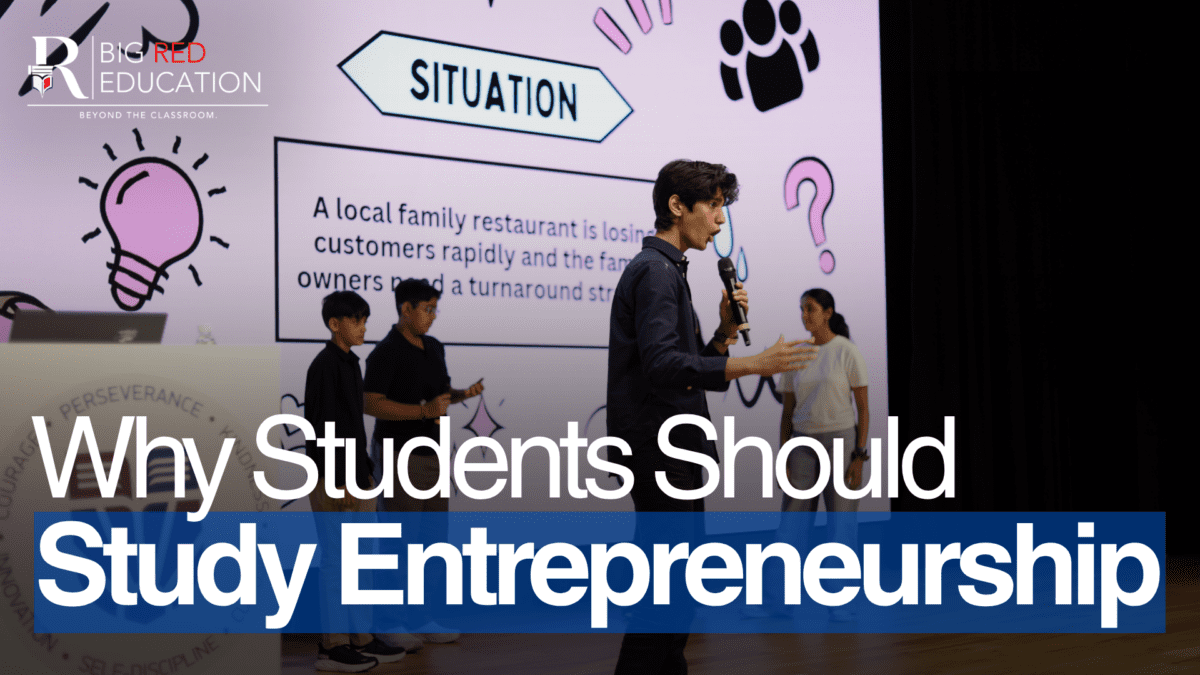
Why Every High School Student Should Learn Entrepreneurship (Even If They Never Start a Company)
When most people hear “entrepreneurship,” they picture a hoodie-wearing 22-year-old pitching a startup in Silicon Valley. Or maybe a shark tank. Or a business plan with revenue projections and a slide deck.
That’s one version of it. But it’s not the one that matters most for high school students.
The more useful version of entrepreneurship, the one that actually changes how you move through the world, has nothing to do with founding a company. It’s a mindset. A set of skills. A way of approaching problems that makes you more capable, more confident, and frankly more interesting to talk to.
And right now, it’s one of the most undervalued things a student can develop.
The Myth That’s Holding Students Back
Here’s a belief that quietly limits a lot of students: “Entrepreneurship is for people who want to run businesses. I want to be a doctor / engineer / lawyer / academic so it’s not really for me.”
It’s an understandable assumption. But it’s wrong.
Entrepreneurship, at its core, is about identifying a problem, figuring out a solution, and doing something about it with the resources you have. That’s not a business skill. That’s a human skill. It’s what good doctors do when they rethink a treatment protocol. It’s what engineers do when they design around constraints. It’s what lawyers do when they build a novel argument. It’s what researchers do every single day.
The students who learn entrepreneurial thinking early don’t just become better entrepreneurs. They become better at everything.
What Entrepreneurship Actually Teaches You
Let’s get specific, because “entrepreneurial mindset” is one of those phrases that can mean everything and nothing.
How to identify real problems – not just symptoms
One of the first things entrepreneurship teaches you is the difference between a symptom and a root cause. Why do students in this school skip lunch? Is it the food, the timing, the social dynamics, something else entirely? Entrepreneurs are trained to dig past the obvious answer. That habit of thinking, asking “why” until you get somewhere useful is genuinely rare, and genuinely valuable.
How to act without a complete roadmap
School, for the most part, rewards following instructions well. You’re given a syllabus, a rubric, a set of steps and your job is to execute. Entrepreneurship is the opposite. You’re given a problem and a blank page. Learning to move forward anyway, to make decisions under uncertainty, to iterate rather than wait for perfect information, this is one of the most transferable skills you can build as a teenager.
How to pitch and persuade
Whether you’re convincing a teacher to let you do an unconventional project, interviewing for a college program, or explaining your research to an admissions panel, you are constantly selling ideas. Entrepreneurship teaches you to communicate the value of what you’re doing clearly and confidently, to an audience that didn’t ask to be convinced.
How to handle failure without falling apart
This one is harder to teach in a classroom. Entrepreneurship, even at the student level involves things not working. A project that flops. A pitch that gets rejected. A plan that needed to be scrapped and rebuilt. Learning to process that, extract what’s useful, and keep going is arguably the most important thing entrepreneurship education offers. Students who’ve had structured experience with failure are, across the board, more resilient.
How to see opportunity where others see inconvenience
Walk through your school, your neighbourhood, your daily routine with an entrepreneurial eye and you’ll start noticing things: inefficiencies, frustrations, gaps between what exists and what could exist. That’s not just a business skill, it’s a creative habit that makes you more engaged with the world around you.
What It Does for Your College Application
Let’s be honest- college admissions is part of the conversation for most students reading this. So here’s the direct answer.
Admissions officers at top universities have said, repeatedly, that they’re not looking for students who did everything perfectly. They’re looking for students who did something meaningful who showed initiative, who led something, who demonstrated that they can think independently and make things happen.
Entrepreneurship experiences tick those boxes in a way that’s hard to fake. You can’t manufacture a genuine story about identifying a problem in your community and building something to address it. You can’t pretend you pitched an idea to a panel and took the feedback on the chin and came back better. Those experiences are visible in how students write and speak and admissions readers notice.
There’s also this: entrepreneurship adjacent activities- building something, launching something, solving something tend to generate the most compelling college essays. Not because they’re dramatic, but because they’re specific. Specificity is what makes an essay memorable, and nothing creates specificity like actually doing something.
You Don’t Need a Business Idea to Get Started
This is the part that trips most students up. They think they need a great idea before they can start learning entrepreneurship. They don’t.
Entrepreneurship education- done well gives you the frameworks and the experience before you have the idea. You learn to spot problems, test assumptions, build and iterate, present and defend your thinking. The idea, when it comes, lands in much more capable hands.
Some of the best entrepreneurship learning happens through structured programs that put students through the process in a compressed, intensive format with mentors who’ve actually built real things and know how to ask the questions you haven’t thought to ask yet. The kind of environment where you come out three days later thinking differently than when you went in.
That’s actually what the InnovateNow entrepreneurship workshop is designed to do. Not to produce startup founders, but to give students a genuine taste of entrepreneurial thinking working through real problems alongside mentors who’ve been on both sides of a pitch, who push back when your logic is soft, and who know the difference between an idea that sounds good and one that actually holds up. The kind that sticks.
A Note For Parents Reading This
If you’re a parent considering whether entrepreneurship programs are worth your child’s time especially when board exams and entrance tests are already demanding here’s a reframe worth considering.
The skills that are becoming hardest to automate, and therefore most valuable in any career, are exactly the ones entrepreneurship develops: problem-solving under uncertainty, creative thinking, communication, resilience, and the ability to lead. These aren’t soft skills. They’re the skills that determine who gets to do interesting work and who gets stuck doing the work that algorithms can handle.
Starting to build those skills at 15 or 16, in a structured environment, before the pressure of adult decisions kicks in, that’s an investment with a very long return horizon.
Where to Start
You don’t need to wait for a formal program to start thinking entrepreneurially. Here are a few ways to begin:
Notice problems deliberately. Spend a week writing down every frustration, inconvenience, or gap you encounter. Don’t try to solve them yet, just practice seeing them.
Read about builders. Not just the famous startup stories, but the messier, more honest ones. How founders actually figured things out, what went wrong, what they’d do differently. The unglamorous version is more useful than the TED talk version.
Find a small problem you can actually do something about. It doesn’t have to be world-changing. A school event that’s badly organised. A resource students need that doesn’t exist yet. Something small, real, and within reach. Try to make it better. Pay attention to what that process feels like.
Seek structured learning. There’s a limit to how much you can develop these skills alone. Programs that put you in a room with mentors, give you real constraints, and force you to present your thinking to people who’ll push back- these accelerate learning in ways that self-study can’t replicate.
The Bottom Line
The students who thrive in the next decade won’t just be the ones with the highest grades. They’ll be the ones who can look at an uncertain situation and figure out what to do next. Who can communicate their ideas clearly. Who knows how to lead a team, take feedback, and adapt.
Entrepreneurship education, at its best, is training for exactly that.
You don’t have to want to start a company. You just have to want to be capable of more things, in more situations, than you currently are.
That’s a goal worth working toward. And the earlier you start, the further it takes you.


