
blog Higher Education MUN Trending | 7min Read
Published on June 11, 2026


What Is Model United Nations (MUN)? A Beginner’s Guide to Leadership, Diplomacy, and College Success
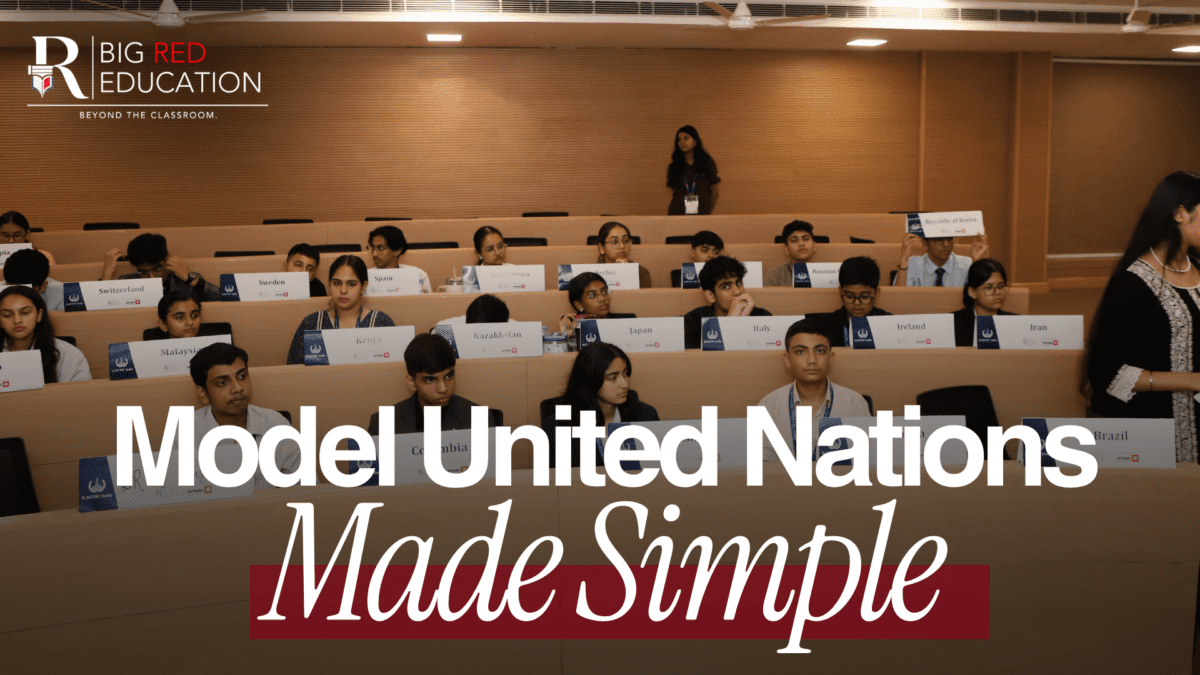
What Is Model United Nations (MUN)? A Beginner’s Guide to Leadership, Diplomacy, and College Success
Picture this: you’re 16, standing at a podium in a conference hall, representing the Republic of France in a debate on global climate policy. Delegates from 30 other “countries” are listening. You have three minutes to make your case, hold your ground, and maybe even change a few minds.
No, this isn’t a scene from a political thriller. This is a regular Saturday for thousands of high school students who do Model United Nations and honestly? It might just be the most underrated skill-builder available to students today.
So, What Exactly Is MUN?
Model United Nations or MUN is an educational simulation of the United Nations. Students take on the roles of delegates representing different countries and debate real-world issues: climate change, nuclear disarmament, refugee crises, global health emergencies, you name it.
Think of it as part debate, part diplomacy, part theatre except the issues you’re arguing about are very, very real.
Each MUN conference is organised around committees, which mirror actual UN bodies like the Security Council, the General Assembly, or the Human Rights Council. Delegates research their assigned country’s position, write policy papers called “position papers,” debate with other delegates, and ultimately work toward drafting and passing resolutions.
It sounds formal. In practice, it’s equal parts exhilarating and nerve-wracking and students consistently describe it as one of the experiences that changed how they think.
What Skills Does MUN Actually Build?
MUN has a reputation for being “great for college applications.” That’s true, but it’s almost selling it short. The skills MUN develops are things you’ll use for the rest of your life in college interviews, in boardrooms, in any situation where you need to think fast, speak clearly, and work with people who disagree with you.
Public Speaking and Persuasion – There’s no substitute for actually standing up and speaking in front of a room full of your peers. MUN forces you to do it repeatedly, under pressure, on topics you’ve had to deeply research. Most MUN veterans say their fear of public speaking essentially disappears after their first few conferences.
Research and Critical Thinking – To represent a country well, you have to understand its foreign policy, its alliances, its economic interests, and its history. That kind of research teaches you to think in systems to understand that every policy has a context, and every position has a reason behind it.
Negotiation and Diplomacy – Here’s the part most people don’t expect: MUN is as much about the hallway conversations as it is about the podium speeches. The real work happens when you’re trying to convince three other delegates to co-sponsor your resolution, or when you’re negotiating a compromise between two completely opposing blocs. These are negotiation skills that MBA students pay a lot of money to learn.
Writing and Structured Argumentation – Position papers, draft resolutions, amendments, MUN involves a surprising amount of writing, and it’s writing with a specific purpose: to persuade, to structure arguments, to build consensus. It sharpens how you think on paper in ways that directly translate to essay writing and college applications.
Cross-Cultural Awareness – When you spend a weekend arguing a position from the perspective of a country that isn’t yours, defending its interests, understanding its constraints- something shifts in how you see the world. MUN alumni consistently describe it as one of the first times they genuinely tried to understand a viewpoint very different from their own.
How Does a MUN Conference Actually Work?
Most MUN conferences run over two to three days. Here’s a rough sense of how it unfolds:
Before the conference: You receive your country assignment and committee topic weeks in advance. You research, write your position paper, and prepare your opening speech.
Opening ceremonies: Large conferences often begin with a formal opening session speeches, rules of procedure, committee assignments.
Committee sessions: This is where the bulk of the conference happens. Delegates make speeches, raise points of information, form blocs, draft working papers, and debate amendments. The committee chair (called a “dais”) manages the procedure.
Informal lobbying: Between formal sessions, delegates negotiate in the corridors, building alliances, merging draft resolutions, making deals. This is often where the most interesting action happens.
Voting: At the end, committees vote on final resolutions. Delegates can abstain, vote yes, or vote no, consistent with their country’s position.
Awards: Most conferences give out awards – Best Delegate, Outstanding Delegate, Honorable Mention recognising delegates who showed exceptional diplomacy, research, and speaking skills.
MUN and College Admissions: What Admissions Officers Actually See
Let’s be direct about this, because it matters.
College admissions officers, especially at selective universities in the US and UK aren’t just looking at grades and test scores. They’re looking for evidence of intellectual curiosity, leadership, and the ability to engage with complexity. MUN, done well, ticks all three boxes.
But here’s the nuance: the students who stand out in their applications aren’t the ones who just “participated in MUN.” They’re the ones who can speak to what they learned, how their thinking evolved, and what they did with that experience. A student who went from nervous first-timer to committee chair, or who wrote a compelling essay about the moment they had to argue a position they personally disagreed with- that’s a story admissions readers remember.
MUN is also one of the few extracurriculars where the quality of the conference itself can matter. Participating in a nationally recognised or university-affiliated conference signals a level of seriousness and preparation that carries weight.
That’s why some students, particularly those aiming for top universities intentionally seek out higher-calibre MUN experiences. Conferences affiliated with Ivy League universities, for instance, tend to attract more competitive delegates, more rigorous committee work, and a level of intellectual challenge that genuinely prepares students for what university-level discourse feels like. The Ivy League Model United Nations Conference (ILMUNC), organised by the University of Pennsylvania students, has been brought to India by Big Red Education giving students access to that kind of experience without having to travel to the US.
The real advantage: Colleges don’t just look for the activity, they look for the story. Someone who started as a nervous first-timer, worked their way to Best Delegate, and then organised their own conference isn’t just listing an extracurricular. That’s a character arc.
Is MUN Right for You?
“I’m shy and hate public speaking.” This is actually the most common profile of a student who ends up loving MUN. The structure of MUN where you have a role, a script, a position makes it easier to speak than open-ended conversation. Most students who start terrified of the podium become some of the most confident speakers in their school within a year.
“I don’t know anything about global politics.” Perfect. that’s the point. You learn as you go. The research process is built into the experience. Most first-time delegates are surprised by how quickly they absorb geopolitical context when they have a reason (a speech, a debate) to understand it.
“My school doesn’t have a MUN club.” Start one. Seriously. The initiative of founding a MUN club at your school is, on its own, a significant leadership story and it makes every conference you subsequently attend mean more.
“Is it just for students who want to go into law or politics?” Not at all. The skills MUN develops- structured argumentation, negotiation, research, public communication are directly applicable in business, medicine, engineering, journalism, and virtually every field where you need to work with other people and make a case for your ideas.
How to Get Started
If you’re new to MUN, here’s a practical path forward:
- Find a conference near you. Most cities in India now have active MUN circuits; school-hosted conferences are a great entry point. Look for ones with beginner-friendly committees.
- Do your prep seriously. The delegates who get the most out of MUN are the ones who actually research their country. Even two or three hours of focused reading can transform your experience.
- Attend more than once. Your first conference will feel chaotic. Your second will feel like you’re starting to understand the game. Your third is when it starts to get genuinely exciting.
- Aim higher over time. As you gain experience, look for larger, more competitive conferences including those affiliated with universities. The challenge level matters.
- Reflect on what you learn. Keep notes. Think about what changed in how you see an issue, how you argued, how you negotiated. These reflections are what turn MUN participation into something you can actually articulate in a college essay or interview.
The Bottom Line
MUN is one of those activities that sounds impressive on a CV but is actually impressive in practice. It’s a place where curious, driven students learn to hold their own in a room, argue a case under pressure, listen carefully to the other side, and find common ground where it seemed impossible.
If you’re a student who wants to build real-world skills, not just tick boxes- MUN is worth your time.
And if you’re ready to take it seriously, the quality of the experience you choose matters. Seek out conferences that challenge you. Find ones that connect you with students and mentors who push your thinking. The more you put in, the more the room starts to feel like yours.


