
blog Colleges Higher Education MUN Productivity summer Trending | 7min Read
Published on June 25, 2026


Model UN vs. Debate Club: Which Actually Teaches You to Think on Your Feet?
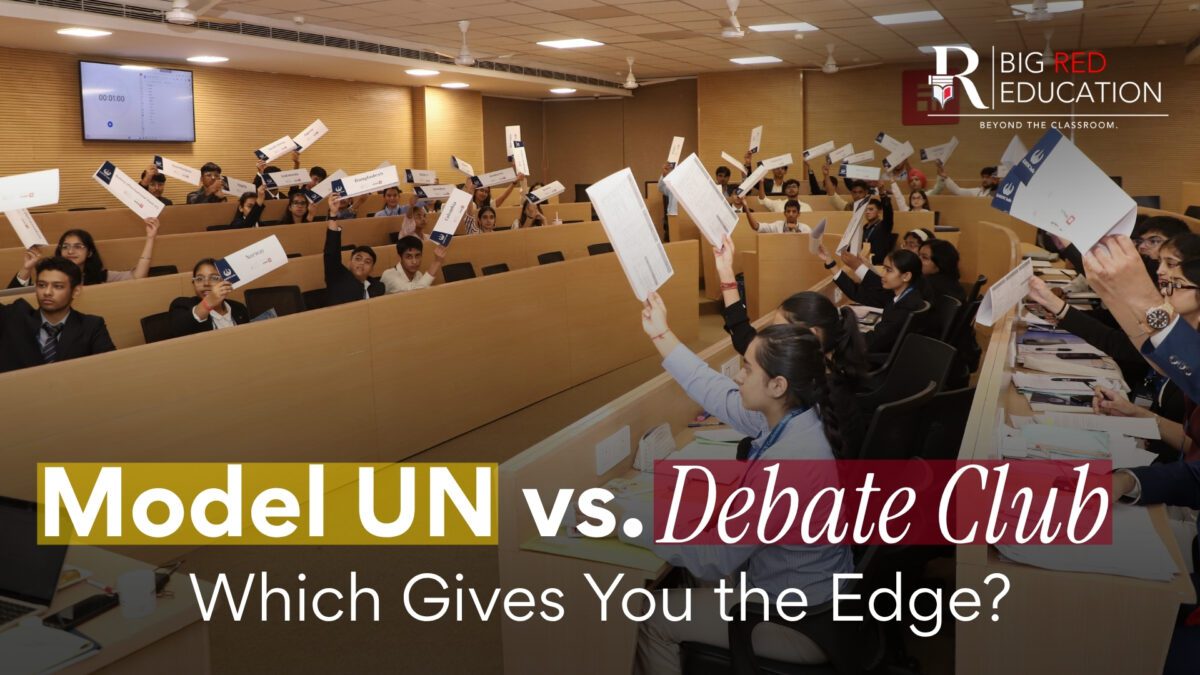
Model UN vs. Debate Club: Which Actually Teaches You to Think on Your Feet?
Picture this: It’s 11 PM the night before your conference. One student is memorizing their country’s position on climate finance, rehearsing opening speeches in front of a mirror. Another is speed-reading about nuclear non-proliferation, scribbling arguments they’ve never thought about before – because they just found out they’re arguing the other side tomorrow.
Both are sharpening skills that could define their careers. But they’re sharpening very different ones.
The Model UN vs. Debate Club debate has been alive in school corridors for decades. Parents wonder which one looks better on college apps. Students wonder which one is actually fun. Teachers wonder which one builds the sharper mind.
The real question everyone’s dancing around: Which one actually teaches you to think on your feet?
Let’s break it down – honestly, and without the usual fluff.
First, Let’s Understand What We’re Actually Comparing
Model UN simulates the United Nations. You’re assigned a country, you represent their foreign policy position on a global issue, you collaborate (and sometimes clash) with 30–200 other delegates, write policy documents called “resolutions,” and try to build coalitions. Sessions can last hours. The clock is always ticking.
Debate Club (whether British Parliamentary, Asian Parliamentary, Oxford, or Lincoln-Douglas style) gives you a motion – a statement and asks you to argue for or against it. Sometimes you know in advance. Sometimes you find out 15 minutes before you speak. You deliver speeches, cross-examine opponents, and a panel of judges decides who argued better.
Same stage fright. Completely different game.
Round 1: Improvisation Under Pressure
Here’s where the two activities diverge dramatically.
In Debate, improvisation is the entire point. The best debaters aren’t the ones who memorize the most facts, they’re the ones who can listen to what their opponent just said and dismantle it in real time. In competitive formats like Asian Parliamentary, your “Points of Information” (POIs) mean opponents can interrupt your speech mid-sentence and demand you respond. Right now. No notes. No escape.
That moment – standing at a podium, mid-thought, while someone punches a hole in your argument is one of the highest-pressure cognitive experiences a student can have. And it’s routine in debate.
MUN’s pressure is different. It’s less about sharp, one-on-one verbal sparring and more about navigating a crowded room where dozens of agendas are in play simultaneously. When the chair opens the floor for an unmoderated caucus, you have 20 minutes to convince five delegates from five different countries to sign your working paper – while someone else is trying to poach your allies. That’s a different kind of on-your-feet thinking: diplomatic, strategic, almost chess-like.
Edge for raw improvisation: Debate. But MUN teaches a kind of lateral, real-world improvisation that debate doesn’t.
Round 2: Research, Depth, and Intellectual Rigor
This is where MUN pulls ahead – and it’s not close.
Preparing for MUN means genuinely understanding geopolitics. When you represent Brazil in the UN Security Council’s discussion of AI governance, you need to know Brazil’s foreign policy stance, its economic interests, its relationships with the US and China, and what international AI agreements already exist. You’re not just pretending to understand global issues. You’re actually developing fluency in how the world works.
The research process for a well-prepared MUN delegate is closer to writing a policy brief than preparing a school presentation. The Position Paper alone – a formal document explaining your country’s stance demands structured argumentation, evidence, and awareness of competing perspectives.
Debate research is substantial too, but it often has a narrower intellectual scope. You’re prepping arguments for and against a specific motion, building a case rather than building a worldview.
If you want to walk out knowing more about the world than when you walked in, MUN wins.
Edge for intellectual depth: MUN – decisively.
Round 3: Public Speaking and Verbal Confidence
Here’s the honest truth most MUN enthusiasts don’t want to hear: if your goal is to become a genuinely powerful speaker, Debate will get you there faster.
Debate is ruthless feedback. You win or you lose. Judges score your clarity, your logical structure, your rebuttals, your delivery. You can’t hide behind a coalition or a bloc. When you stand up, it’s you and your arguments.
MUN speeches, especially at large conferences, can sometimes become performative – polished, prepared speeches that get applause but don’t actually engage with what other delegates said. The diplomatic norm of not directly attacking another delegate’s position can, ironically, reduce the sharpness of the verbal exchange.
The best MUN speakers are genuinely excellent communicators. But the format doesn’t force you to be one the way debate does.
Edge for public speaking development: Debate.
Round 4: Collaboration, Negotiation, and People Skills
This is MUN’s home turf, and no debate about it (pun intended).
MUN teaches you something schools almost never teach: how to get people who disagree with you to work with you anyway. Coalition-building in MUN – finding common ground between, say, India’s position and Sweden’s position – is a genuine negotiation skill. You’re not trying to win against someone. You’re trying to find a language that everyone can live with.
That skill – collaborative problem-solving under time pressure is what most leadership roles actually demand. CEOs don’t debate their board. Diplomats don’t win arguments; they find agreements. Activists don’t just speak truth to power; they build movements.
The best MUN conferences lean hard into this. At something like ILMUNC India organised by the University of Pennsylvania’s students the committees are designed to put delegates in exactly these high-stakes coalition moments, not just speech-making ones. That’s where the real growth happens.
Debate, by its structure, is adversarial. Even when debaters respect each other, the format rewards defeating the other side, not collaborating with them. That’s valuable but it’s a different muscle.
Edge for real-world leadership skills: MUN, by a mile.
Round 5: What Do Colleges Actually Think?
Let’s be real, this is what a lot of students and parents actually want to know.
Both activities look excellent on college applications. But the quality of your involvement matters more than the activity itself.
Here’s what stands out:
- Leadership positions: Secretary-General of a MUN conference, Debate Team Captain – both signal initiative and commitment.
- Achievements: Best Delegate awards, winning tournaments, being selected for high-profile conferences – these demonstrate excellence, not just participation. High-quality conferences like ILMUNC India can help students demonstrate sustained commitment, leadership, and global awareness-qualities that selective universities often value when considered alongside the rest of an application.
- Narrative: Which activity lets you tell a more compelling story about who you are and what you care about? If you’re applying for International Relations or Political Science, MUN is an almost perfect fit. If you’re headed toward Law, Philosophy, or any field that demands argumentation, Debate is your signal.
The mistake students make is treating these as trophies to collect rather than experiences to grow through. One deep, committed involvement beats two half-hearted ones every time.
The Surprising Answer: They Train Different Brains
After all of this, here’s the real verdict – and it’s not a cop-out.
Debate trains the sharp, analytical, adversarial mind. The kind that can construct and deconstruct arguments on demand, spot logical fallacies under pressure, and hold their own in a room full of people trying to out-argue them.
MUN trains the collaborative, strategic, globally-aware mind. The kind that can read a room, build alliances, think about systemic problems, and find solutions that work for multiple stakeholders at once.
The world’s most impactful leaders tend to need both.
And if you look closely, the skills actually complement each other. MUN delegates who do debate become sharper in their speech-making and better at engaging with opposing positions. Debaters who do MUN become more nuanced in how they think about complex issues – less interested in “winning” and more interested in “solving.”
The students who do both – and there are quite a few of them, often find that something clicks. They become the ones who don’t just speak well, but think well. Who don’t just argue convincingly, but lead convincingly.
So Which Should YOU Choose?
Ask yourself three questions:
- What kind of pressure do you want to get comfortable with? Verbal sparring, one-on-one → Debate. Diplomatic maneuvering, room dynamics → MUN.
- What skills feel weakest for you right now? If you freeze under challenge and struggle to articulate on the spot → Debate will force you to grow fastest. If you’re great at speaking but terrible at listening and adapting to others → MUN will humble you in the best way.
- What does your future look like? Law, journalism, policy advocacy, academia → Debate gives you the foundation. Diplomacy, business leadership, international development, consulting → MUN mirrors your future more directly.
And if you can’t choose — don’t. The best thing about high school is that you have time.
The Bottom Line
Model UN and Debate Club are two of the most genuinely skill-building extracurricular activities a high school student can pursue. Neither is “better.” Both are underrated.
But if you asked us which one teaches you to think on your feet faster, in the most raw, unforgiving sense of the phrase?
Debate draws first blood.
And if you asked which one prepares you for the actual complexity of the world you’re about to enter – where problems don’t have clean “pro” and “con” sides, where you need to bring people along rather than defeat them, and where global awareness is a superpower?
MUN is the longer game.
Play both if you can. Master one if you must.
And when you’re ready to take your MUN game to the next level – at a real Ivy League conference, with delegates from across India and beyond – you know where to find us.


