
blog Colleges Higher Education Productivity Research summer Trending | 9min Read
Published on June 24, 2026


From Hypothesis to Publication: The Complete Research Guide for High School Students
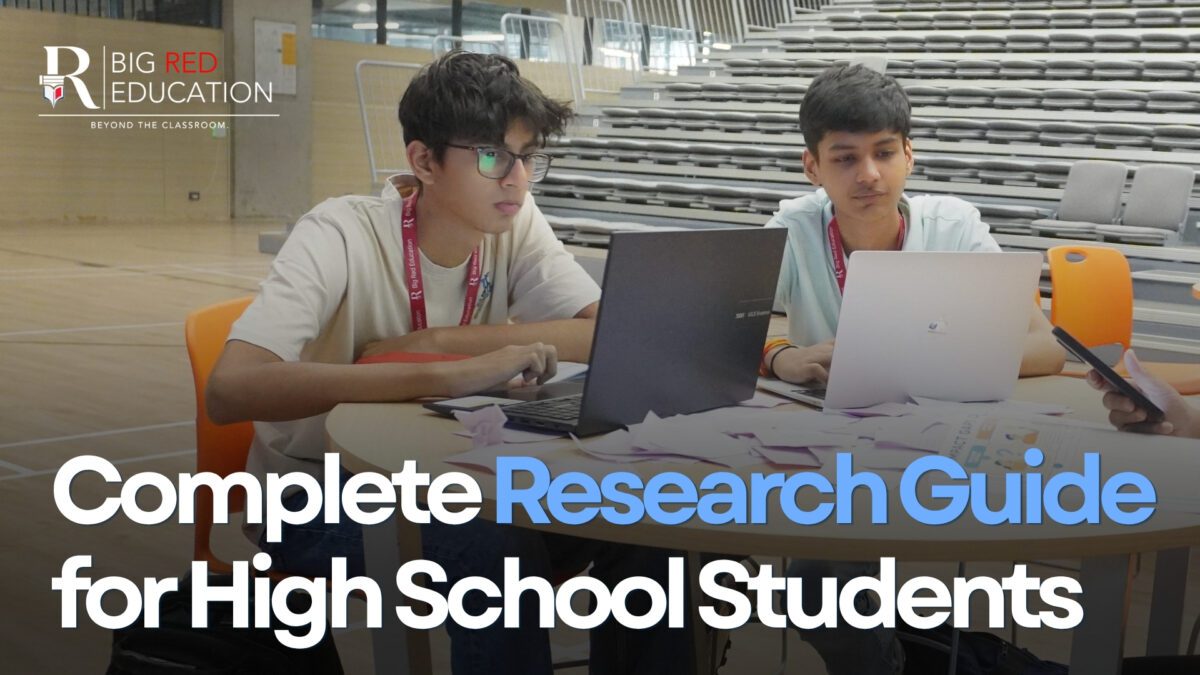
From Hypothesis to Publication: The Complete Research Guide for High School Students
Most high school students think research is something that happens in a lab coat, in a university, after years of studying. The kind of thing you see in documentaries – slow, serious, full of jargon.
Here’s the truth: the research process is one of the most learnable, most transferable, and most misunderstood skills in education. And the students who figure it out early? They don’t just get into better colleges. They think better. They ask better questions. They see the world differently.
This is the guide nobody gave you. From the first spark of curiosity to a paper with your name on it here’s how research actually works.
Stage 1: The Question (Your Hypothesis Starts Here)
Every piece of research – whether it ends up in Nature or in your school science fair begins with a question. Not an answer. Not a topic. A question.
There’s a big difference between:
- Topic: Climate change and food security.
- Question: Does rising temperature variability in North India correlate with decreased wheat yield per hectare over the past two decades?
The second one is researchable. It’s specific. It has variables. It points you toward data.
How to generate a good research question:
Start with what genuinely bugs you or fascinates you. The students who produce the best research are usually the ones who were annoyed by something – a statistic that seemed off, a claim their teacher made that didn’t fully add up, a problem in their own community that nobody seemed to be studying.
Then narrow it down. The more specific your question, the more manageable your project, and paradoxically, the more interesting your findings.
Finally, ask: is this answerable? A good research question has to be answerable with data, evidence, or reasoned argument – not opinion.
The hypothesis is your tentative answer to that question before you’ve collected evidence. It’s not a guess – it’s an educated prediction based on what you already know. It sets the direction for everything that follows.
Stage 2: The Literature Review (Standing on Giants’ Shoulders)
Before you start collecting your own data, you need to understand what’s already known. This is called the literature review, and most students skip it – which is why most student research projects reinvent the wheel or miss huge, obvious gaps.
A literature review does three things:
1. Shows you what’s been done. You don’t want to spend three months on a study that was published in 2019. Find out what exists.
2. Reveals the gaps. Good research fills a gap that existing work leaves open. The literature review is where you find your gap – the specific angle that hasn’t been explored yet.
3. Gives you a framework. The concepts, methods, and vocabulary of your field come from the literature. Reading existing papers teaches you how research in your area is actually structured and argued.
Where to find academic literature:
- Google Scholar (free, comprehensive)
- PubMed (for biology and medicine)
- JSTOR (for humanities and social sciences)
- Semantic Scholar (great AI-assisted search)
- ResearchGate (authors often share free PDFs)
Don’t be intimidated by papers full of jargon. Start with the abstract and conclusion. Work your way in. You’ll get faster at it.
Stage 3: Methodology – How You’re Actually Going to Answer Your Question
This is where most students get paralysed. Methodology sounds technical, but it just means: how will you collect and analyse your evidence?
There are broadly two types of research:
Quantitative research involves numbers, data, statistical analysis. If your question asks “how much,” “how many,” or “is there a correlation,” you’re probably doing quantitative research. Tools include surveys, experiments, datasets, and statistical software like SPSS, R, or even Excel.
Qualitative research involves understanding experiences, meanings, and patterns. If your question asks “why,” “how do people feel about,” or “what does this mean,” you’re doing qualitative research. Tools include interviews, focus groups, and thematic analysis.
Most strong research actually combines both.
The key questions to answer in your methodology:
- What data will you collect? From where? From whom?
- How will you collect it? (Survey? Experiment? Archive research?)
- How will you ensure your sample is fair and unbiased?
- How will you analyse what you find?
- What are the limitations of your approach? (Being honest about this isn’t weakness — it’s scientific integrity.)
This is also the stage where having a mentor makes an enormous difference. A good mentor — especially one who has done real research themselves — can save you months of methodological errors. They’ll spot when your sampling is off, when your variables aren’t controlled, when your analysis plan won’t actually answer your question.
This is exactly what the Big Red Education STEM Research Bootcamp is designed for. Unlike generic science programs, the Bootcamp pairs students with mentors from Harvard, Columbia, and other leading research universities, people who have actually navigated peer review, grant applications, and academic publishing and walks them through the methodology design process from scratch. Because methodology done right is the difference between a project that produces real findings and one that produces noise.
Stage 4: Data Collection – The Unglamorous Heart of Research
There’s a reason scientists are methodical to the point of seeming obsessive. Data collection is where everything can go wrong, and if it does, no amount of clever analysis will save you.
A few principles that separate serious researchers from everyone else:
Document everything. Keep a research journal. Note dates, conditions, anomalies, decisions you made and why. If you ran a survey, note who responded and who didn’t. If you conducted an experiment, note every variable – even the ones that seemed irrelevant at the time.
Collect more data than you think you need. Data has a way of shrinking once you start analyzing it – outliers get removed, incomplete responses get discarded. Start with more.
Stay honest with your data. This sounds obvious, but confirmation bias is real. If your data isn’t supporting your hypothesis, that’s not a failure. That’s a finding. Some of the most important discoveries in science came from results that surprised the researcher. Stay committed to what the data actually shows, not what you wanted it to show.
Protect privacy and get consent. If your research involves human participants – surveys, interviews, observations – you need informed consent. This isn’t optional. It’s ethical practice, and it’s what separates legitimate research from careless data collection.
Stage 5: Analysis – Making Sense of What You Found
You have your data. Now what does it actually mean?
Analysis is about looking for patterns, relationships, and answers to your original research question. This process looks different depending on your methodology:
For quantitative data: run your statistical tests (correlation, regression, t-tests – whatever your research question demands). Look for statistical significance, but also look for practical significance. A result can be statistically significant and still be too small to matter in the real world.
For qualitative data: use thematic analysis. Read through your interviews or responses multiple times. Identify recurring themes. Code them. Look for patterns across your sample.
In both cases, the goal is the same: let the data tell you what’s there, rather than telling the data what you want to find.
This is also the stage where you revisit your hypothesis. Was it supported? Partially supported? Contradicted? All of these are valid outcomes. Contradicted hypotheses are especially valuable – they mean you’ve discovered something that pushes against the current understanding.
Stage 6: The Paper – Writing Research That Actually Gets Read
Here’s the structure of virtually every research paper in every discipline, from biology to economics to literary criticism:
Abstract – A 150–250 word summary of your entire paper. Usually written last, placed first. It tells the reader what you studied, how, and what you found.
Introduction – Background on your topic, the gap in the literature your research addresses, and your research question/hypothesis. This is where you show you’ve done the literature review.
Methodology – Exactly what you did and why. Detailed enough that another researcher could replicate your study.
Results – What you found. Just the facts. No interpretation yet. Tables, graphs, and figures live here.
Discussion – What your results mean. How they connect to the existing literature. What’s surprising. What the limitations are. What questions remain unanswered.
Conclusion – A tight summary of the key finding and its implications.
References – Every source cited, in your field’s citation format (APA, MLA, Chicago, or Vancouver for sciences).
Writing advice that actually matters:
Write your methodology section first – it’s the most factual and will ground everything else. Then write results. Then discussion. Then introduction. Then abstract. Last of all, write your title (it should reflect exactly what the paper actually is, not what you hoped it would be).
Clarity beats impressiveness every time. The best research papers in the world are written in plain language. Jargon exists to be precise, not to sound smart.
Stage 7: Revision, Feedback, and Peer Review
Here’s something every first-time researcher needs to hear: your first draft is not a paper. It’s a starting point.
Real research goes through multiple rounds of revision. You share it with your mentor, your peers, your teacher. They point out what’s unclear, what’s missing, what’s contradictory. You fix it. You share again.
This is called peer review, and it’s the cornerstone of how science and scholarship maintain quality. When a paper is “peer reviewed,” it means other experts in the field – who have no stake in whether the paper is good or bad – have read it critically and agreed it meets the standards for publication.
As a student, your peer review process might look like:
- Sharing with a classmate in a similar field for a critical read
- Presenting your findings in a seminar or school symposium and fielding questions
- Getting feedback from a mentor who has published research themselves
That last one is invaluable. A mentor who has been through actual peer review knows exactly what reviewers look for – and what gets papers rejected. The STEM Research Bootcamp’s mentors from Harvard, Columbia, and leading research institutions bring this real-world editorial instinct to every student they work with, which is a genuinely rare thing to access at the high school level.
Stage 8: Publication – Getting Your Name on Real Research
Yes, students can publish. Real journals, real conferences, real platforms. It’s more accessible than most students think.
Journals that publish student research:
- Journal of Emerging Investigators (specifically for middle and high school students)
- American Journal of Undergraduate Research
- Cureus (medical and clinical research, open access)
- Young Scientists Journal
Conferences and competitions:
- Intel International Science and Engineering Fair (ISEF)
- Regeneron Science Talent Search
- Google Science Fair
- Regional and national science olympiads
Online platforms:
- ResearchGate (for sharing preprints and connecting with researchers)
- Academia.edu
- Your school’s research journal if one exists – and if it doesn’t, starting one is a project in itself
Publication is not the only measure of a good research project. A rigorous, well-designed, honestly reported research project is valuable whether or not it ends up in a journal. But if your work is strong, there’s no reason not to try.
What Research Does to You
Here’s the thing nobody tells you about research: it changes how you think permanently.
Once you’ve gone through the process of forming a hypothesis, reviewing what’s known, designing a rigorous methodology, collecting and analysing data, and writing it all up – you can never un-see the world that way. You start looking at news headlines and asking where the data came from. You notice when an argument is correlation dressed up as causation. You get comfortable saying “I don’t know, but here’s how we could find out.”
These are not just academic skills. They’re survival skills for the information age.
The students who learn to do research in high school – real research, with real methodology and real intellectual honesty – arrive at university running. And they arrive at the rest of their lives with a relationship to truth that most people never develop.
Ready to Start?
The research process can seem overwhelming when you look at all eight stages at once. It isn’t, when you take it one step at a time – and especially when you have someone in your corner who’s done it before.
If you’re a high school student curious about doing real research in STEM, the Big Red Education STEM Research Bootcamp is built exactly for this. Working directly with mentors from Harvard, Columbia, and other top research universities, you’ll go from research question to completed paper — with guidance at every stage from people who have actually published, peer reviewed, and navigated the academic research world themselves.
Your hypothesis is waiting. The only question is whether you’ll test it.


