blog Colleges Future career in sports Higher Education Productivity summer Trending | 6min Read
Published on July 8, 2026


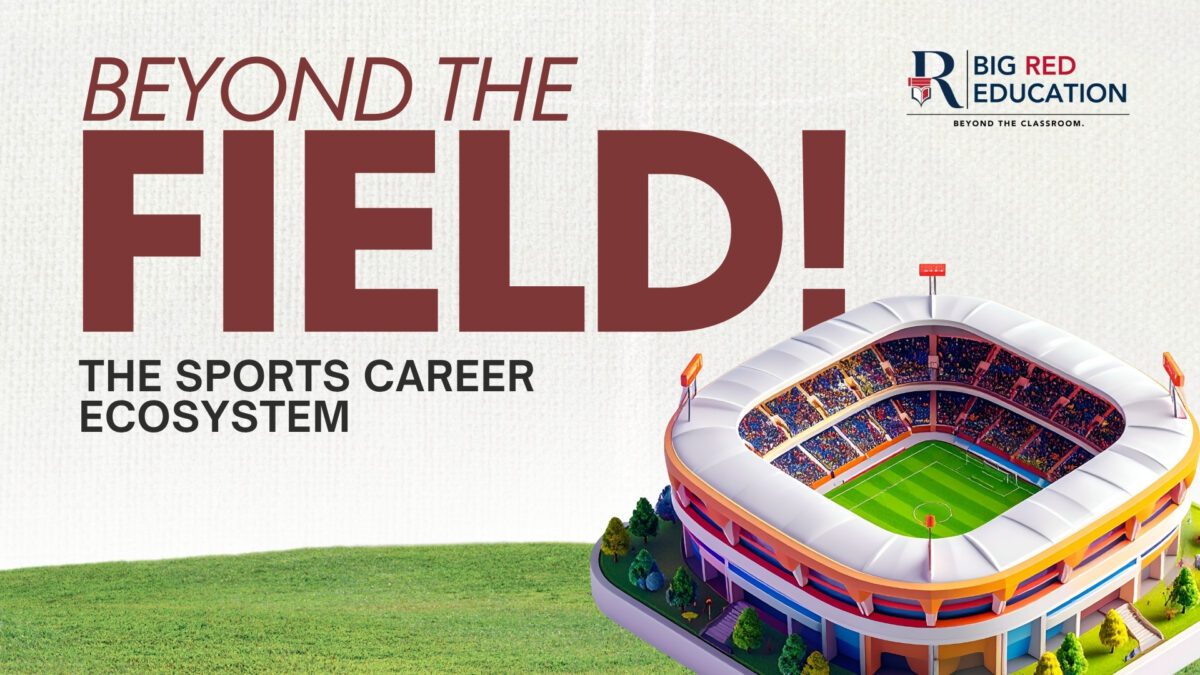
Beyond the Field: Mapping the Real Career Ecosystem Inside the Sports Industry
Ask a student what a “career in sports” looks like, and you’ll get one of two answers almost every time: play professionally, or become a coach. Ask a parent, and you might get a third option – sports journalism, maybe, if they’re feeling creative. That’s usually where the list ends.
It’s a strange gap, because sport is one of the largest, fastest-growing industries in the world, and the overwhelming majority of people working inside it have never played a professional match in their life. The playing career is the visible tenth of the iceberg. Underneath it sits an entire economy of analysts, physiologists, marketers, data scientists, event strategists, and business leads – all of whom are, in every meaningful sense, “in sport,” just never on the field.
The Misconception: Sport as a Talent Industry, Not a Skills Industry
Here’s the assumption worth challenging first: that a sports career is fundamentally about athletic ability, and everything else is a fallback. This framing quietly discourages a huge number of students who are genuinely fascinated by sport – its strategy, its business, its data, its psychology – but don’t see themselves as elite athletes, and so conclude the industry isn’t for them.
It’s the wrong read. Modern sport runs on two disciplines working in tandem: sport science, which is about understanding and optimising human performance, and sport management, which is about running the business, strategy, and commercial engine behind that performance. A student who’s sharp with numbers, curious about human behaviour, or drawn to strategy has just as legitimate a way into this industry as a student who’s fast on their feet – the entry point is simply different.
What the Real Ecosystem Actually Looks Like
Once you stop equating “sport” with “athlete,” the map opens up considerably.
On the performance side – sport scientists who design training loads and recovery protocols, physiologists who study fatigue and injury prevention, and performance analysts who break down match footage to find the half-second edge a team is missing.
On the business side – sport managers who run club operations, sponsorship and partnerships leads who negotiate the deals that fund a franchise, and event strategists who turn a single match day into a full commercial experience.
On the data and technology side – analytics teams who turn raw performance and fan data into decisions, from ticket pricing to player recruitment, in an industry where 95% of NBA teams, 92% of MLB franchises, and 80% of NFL organizations now reportedly rely on analytics platforms – sport runs on dashboards just as much as it runs on scoreboards.
On the pathway side – professionals who sit at the intersection of sport and education, helping the next generation of athletes and sport-industry hopefuls figure out where they actually fit.
None of these roles require you to have played the sport at a competitive level. Most of them require you to understand it deeply – which is a different, and for many students, far more achievable bar.
A Quick Reality Check on How These Roles Actually Connect
It helps to see how these roles aren’t separate silos so much as one continuous chain, because that’s usually what surprises students the most.
Take a single match day at a professional club. A sport scientist has already decided how much training load a player could safely handle that week. A performance analyst has broken down the opposition’s last five games to flag a pattern. A sponsorship lead has built the commercial package that’s funding the broadcast rights. An event strategist has planned the fan experience that turns a 90-minute game into a full day’s revenue. And an analytics team is watching real-time data throughout, feeding decisions back to the coaching staff before the next match even begins.
None of these people needed to be on the pitch to shape the outcome. What they needed was a specific, learnable skill set – applied to a domain they happened to care about. That’s a genuinely different starting point than “be good enough to go pro,” and it’s one a lot more students can realistically build toward.
Why This Gap Matters More Than It Seems
This isn’t just a fun trivia point about career diversity. It has real consequences for how students plan their next few years.
A student who only sees “athlete” and “coach” as sport careers will often drop the interest entirely the moment they realise professional playing isn’t realistic for them – even if their actual strengths (analysis, communication, strategic thinking, comfort with data) would make them exceptional in sport management or sport science. That’s a genuine loss, both for the student and for an industry that badly needs people who understand sport and can run the business or the science behind it.
The fix isn’t convincing every sports-loving student to become an athlete. It’s showing them the rest of the map early enough that they can start building toward the part of it that actually fits how they think.
The Trap: Treating “Passion for Sport” as a Hobby Instead of a Direction
A lot of students who love sport treat it strictly as a personal interest – something they watch, play casually, or follow closely, but never something they connect to an actual academic or career track. It sits in the “hobbies” section of a college application instead of the “direction” section.
That’s a missed opportunity, because a genuine, sustained interest in sport – when paired with some structure – is exactly the kind of specific, evidence-backed interest that colleges and career paths respond well to. The student who can talk about how a team’s data strategy shaped a season, or how an athlete’s training load was managed through an injury comeback, is showing far more than “I like sport.” They’re showing they understand it as a system.
So, How Do You Actually Explore This Properly?
Reading about sport management and sport science online only gets a student so far – most of what makes these fields interesting is genuinely hard to grasp without seeing how the pieces fit together in practice: how a training decision connects to a performance outcome, how a sponsorship deal connects to a club’s survival, how data connects to a coaching call made in real time.
This is exactly the gap the Turn Your Passion for Sport into a Real Career workshop, delivered by Deakin University – home to the world’s #1 Sport Science School is built to close. Over three immersive, offline days, students move through both sides of the industry at once: the science of performance and the business that runs around it, guided by mentors who’ve actually worked inside professional sport. The program has featured practitioners like Akshay Kodoth, who transitioned from a first-class cricket career into sport management and grassroots development, and Adit Pawha, whose work spans sport analytics and international education pathways – giving students a rare, direct line into how these careers actually take shape.
Students leave having built a “Career I Discovered” reflection, developed a real sports event pitch or athlete performance plan, and mapped out a personal action plan for their own next steps – with one standout participant also receiving a Golden Ticket to the final interview round of Deakin University’s Vice-Chancellor’s Meritorious 100% Scholarship. It’s less “watch sport” and more “understand how the whole machine behind it runs” – which, for a student trying to figure out if this industry is really for them, tends to be a far more useful three days than another highlight reel.
One Thing Worth Sitting With
If there’s a single question worth asking before choosing any direction in this industry, it’s not “do I love sport enough?” -most students who are even considering this already do. It’s “which part of the system am I actually pulled toward when no one’s watching?” Do you find yourself replaying a match to understand why a tactic worked, or curious about what it cost to put the event together, or wondering how a player’s recovery timeline was actually planned? Each of those instincts points toward a completely different corner of the industry, and none of them require a jersey.
The Bigger Point
Sport isn’t a single career. It’s an ecosystem – performance, business, data, and pathway all working together, with the athlete as just one visible piece of a much larger structure. A student doesn’t need to be the one on the field to build a real, serious career inside sport. They just need to figure out which part of the system they’re actually drawn to, and start understanding it properly.
The students who go furthest in this industry usually aren’t the ones who loved watching sport the most. They’re the ones who got curious about how it actually works.