blog Higher Education MUN Trending | 7min Read

What Is Model United Nations (MUN)? A Beginner’s Guide to Leadership, Diplomacy, and College Success

Published on June 11, 2026

FacebookTwitterWhatsApp
Categories
blog Higher Education MUN Trending

What Is Model United Nations (MUN)? A Beginner’s Guide to Leadership, Diplomacy, and College Success

What Is Model United Nations (MUN)? A Beginner’s Guide to Leadership, Diplomacy, and College Success


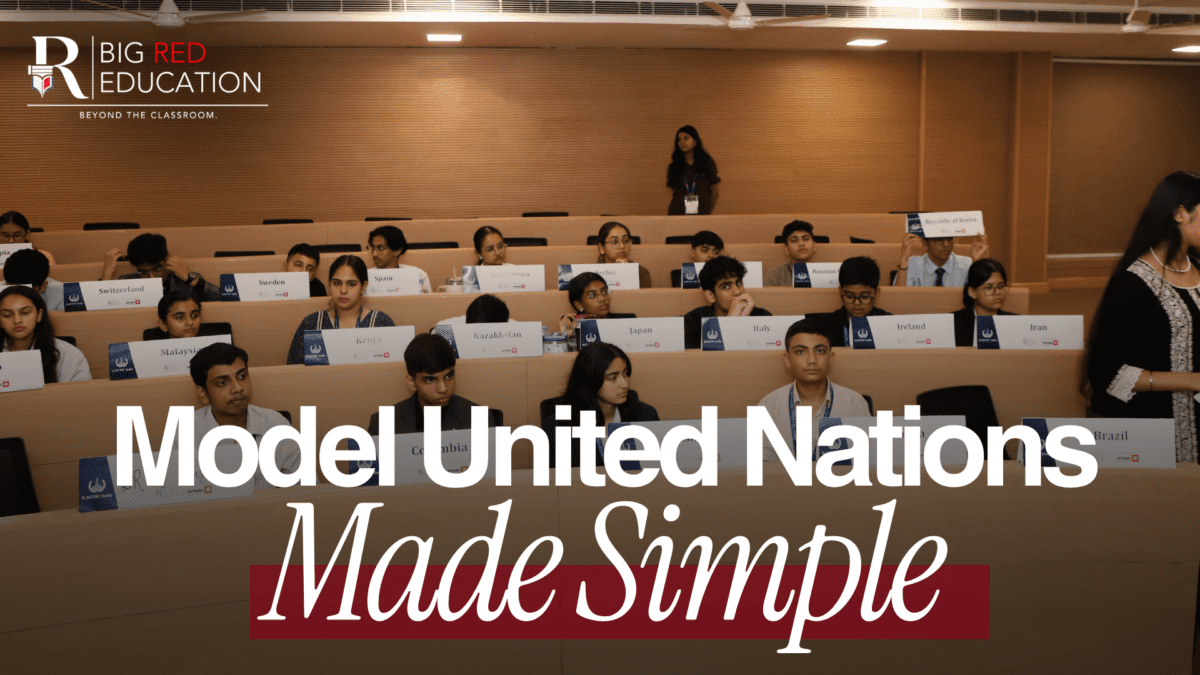
Picture this: you’re 16, standing at a podium in a conference hall, representing the Republic of France in a debate on global climate policy. Delegates from 30 other “countries” are listening. You have three minutes to make your case, hold your ground, and maybe even change a few minds.

No, this isn’t a scene from a political thriller. This is a regular Saturday for thousands of high school students who do Model United Nations and honestly? It might just be the most underrated skill-builder available to students today.


So, What Exactly Is MUN?


Model United Nations or MUN is an educational simulation of the United Nations. Students take on the roles of delegates representing different countries and debate real-world issues: climate change, nuclear disarmament, refugee crises, global health emergencies, you name it.

Think of it as part debate, part diplomacy, part theatre except the issues you’re arguing about are very, very real.

Each MUN conference is organised around committees, which mirror actual UN bodies like the Security Council, the General Assembly, or the Human Rights Council. Delegates research their assigned country’s position, write policy papers called “position papers,” debate with other delegates, and ultimately work toward drafting and passing resolutions.

It sounds formal. In practice, it’s equal parts exhilarating and nerve-wracking and students consistently describe it as one of the experiences that changed how they think.


What Skills Does MUN Actually Build?


MUN has a reputation for being “great for college applications.” That’s true, but it’s almost selling it short. The skills MUN develops are things you’ll use for the rest of your life in college interviews, in boardrooms, in any situation where you need to think fast, speak clearly, and work with people who disagree with you.

Public Speaking and Persuasion – There’s no substitute for actually standing up and speaking in front of a room full of your peers. MUN forces you to do it repeatedly, under pressure, on topics you’ve had to deeply research. Most MUN veterans say their fear of public speaking essentially disappears after their first few conferences.

Research and Critical Thinking – To represent a country well, you have to understand its foreign policy, its alliances, its economic interests, and its history. That kind of research teaches you to think in systems to understand that every policy has a context, and every position has a reason behind it.

Negotiation and Diplomacy – Here’s the part most people don’t expect: MUN is as much about the hallway conversations as it is about the podium speeches. The real work happens when you’re trying to convince three other delegates to co-sponsor your resolution, or when you’re negotiating a compromise between two completely opposing blocs. These are negotiation skills that MBA students pay a lot of money to learn.

Writing and Structured Argumentation – Position papers, draft resolutions, amendments, MUN involves a surprising amount of writing, and it’s writing with a specific purpose: to persuade, to structure arguments, to build consensus. It sharpens how you think on paper in ways that directly translate to essay writing and college applications.

Cross-Cultural Awareness – When you spend a weekend arguing a position from the perspective of a country that isn’t yours, defending its interests, understanding its constraints- something shifts in how you see the world. MUN alumni consistently describe it as one of the first times they genuinely tried to understand a viewpoint very different from their own.


How Does a MUN Conference Actually Work?


Most MUN conferences run over two to three days. Here’s a rough sense of how it unfolds:

Before the conference: You receive your country assignment and committee topic weeks in advance. You research, write your position paper, and prepare your opening speech.

Opening ceremonies: Large conferences often begin with a formal opening session speeches, rules of procedure, committee assignments.

Committee sessions: This is where the bulk of the conference happens. Delegates make speeches, raise points of information, form blocs, draft working papers, and debate amendments. The committee chair (called a “dais”) manages the procedure.

Informal lobbying: Between formal sessions, delegates negotiate in the corridors, building alliances, merging draft resolutions, making deals. This is often where the most interesting action happens.

Voting: At the end, committees vote on final resolutions. Delegates can abstain, vote yes, or vote no, consistent with their country’s position.

Awards: Most conferences give out awards – Best Delegate, Outstanding Delegate, Honorable Mention recognising delegates who showed exceptional diplomacy, research, and speaking skills.


MUN and College Admissions: What Admissions Officers Actually See


Let’s be direct about this, because it matters.

College admissions officers, especially at selective universities in the US and UK aren’t just looking at grades and test scores. They’re looking for evidence of intellectual curiosity, leadership, and the ability to engage with complexity. MUN, done well, ticks all three boxes.

But here’s the nuance: the students who stand out in their applications aren’t the ones who just “participated in MUN.” They’re the ones who can speak to what they learned, how their thinking evolved, and what they did with that experience. A student who went from nervous first-timer to committee chair, or who wrote a compelling essay about the moment they had to argue a position they personally disagreed with- that’s a story admissions readers remember.

MUN is also one of the few extracurriculars where the quality of the conference itself can matter. Participating in a nationally recognised or university-affiliated conference signals a level of seriousness and preparation that carries weight.

That’s why some students, particularly those aiming for top universities intentionally seek out higher-calibre MUN experiences. Conferences affiliated with Ivy League universities, for instance, tend to attract more competitive delegates, more rigorous committee work, and a level of intellectual challenge that genuinely prepares students for what university-level discourse feels like. The Ivy League Model United Nations Conference (ILMUNC), organised by the University of Pennsylvania students, has been brought to India by Big Red Education giving students access to that kind of experience without having to travel to the US.

The real advantage: Colleges don’t just look for the activity, they look for the story. Someone who started as a nervous first-timer, worked their way to Best Delegate, and then organised their own conference isn’t just listing an extracurricular. That’s a character arc.


Is MUN Right for You?


“I’m shy and hate public speaking.” This is actually the most common profile of a student who ends up loving MUN. The structure of MUN where you have a role, a script, a position makes it easier to speak than open-ended conversation. Most students who start terrified of the podium become some of the most confident speakers in their school within a year.

“I don’t know anything about global politics.” Perfect. that’s the point. You learn as you go. The research process is built into the experience. Most first-time delegates are surprised by how quickly they absorb geopolitical context when they have a reason (a speech, a debate) to understand it.

“My school doesn’t have a MUN club.” Start one. Seriously. The initiative of founding a MUN club at your school is, on its own, a significant leadership story and it makes every conference you subsequently attend mean more.

“Is it just for students who want to go into law or politics?” Not at all. The skills MUN develops- structured argumentation, negotiation, research, public communication are directly applicable in business, medicine, engineering, journalism, and virtually every field where you need to work with other people and make a case for your ideas.


How to Get Started


If you’re new to MUN, here’s a practical path forward:

  1. Find a conference near you. Most cities in India now have active MUN circuits; school-hosted conferences are a great entry point. Look for ones with beginner-friendly committees.
  2. Do your prep seriously. The delegates who get the most out of MUN are the ones who actually research their country. Even two or three hours of focused reading can transform your experience.
  3. Attend more than once. Your first conference will feel chaotic. Your second will feel like you’re starting to understand the game. Your third is when it starts to get genuinely exciting.
  4. Aim higher over time. As you gain experience, look for larger, more competitive conferences including those affiliated with universities. The challenge level matters.
  5. Reflect on what you learn. Keep notes. Think about what changed in how you see an issue, how you argued, how you negotiated. These reflections are what turn MUN participation into something you can actually articulate in a college essay or interview.

The Bottom Line

MUN is one of those activities that sounds impressive on a CV but is actually impressive in practice. It’s a place where curious, driven students learn to hold their own in a room, argue a case under pressure, listen carefully to the other side, and find common ground where it seemed impossible.

If you’re a student who wants to build real-world skills, not just tick boxes- MUN is worth your time.

And if you’re ready to take it seriously, the quality of the experience you choose matters. Seek out conferences that challenge you. Find ones that connect you with students and mentors who push your thinking. The more you put in, the more the room starts to feel like yours.




Editor's Pick

blog Productivity Trending | 5min Read

7 Ways to Make Your Summer Actually Count

Published on June 3, 2026

FacebookTwitterWhatsApp
Categories
blog Productivity Trending

7 Ways to Make Your Summer Actually Count

7 Ways to Make Your Summer Actually Count

It’s June. You have roughly 10 weeks before school starts again. Here’s the uncomfortable truth: most students waste them- not because they’re lazy, but because they never decide what they want from summer in the first place. Whether you’re looking for productive summer activities, structured summer learning opportunities, or simply a way to return to school more confident and capable, these 7 strategies will change how you approach the next 10 weeks.


01

Build one real skill- not ten half-finished ones

Every summer, students download Duolingo, sign up for a coding course, buy a guitar, and abandon all three by July 15th. The problem isn’t motivation- it’s breadth. Pick one skill you genuinely want, commit to 30 minutes a day, and watch what happens in 60 days. Whether it’s Python, public speaking, graphic design, or a second language, one skill done properly is worth ten things half-started. Colleges and employers remember specifics, not “I tried stuff.”

Quick start: Write down 3 skills you’ve been curious about. Cross out 2. Spend the summer on the one that’s left.


02

Start a project that solves something real

The best thing about summer is that no one’s grading you- which means you can actually make things instead of just studying them. Pick a problem in your world and build something around it: a small app, a short film, a research paper on a topic you care about, a social media page for a cause, a handmade product you sell to friends and family. It doesn’t have to be big. It has to be yours. Projects show initiative in a way that grades simply can’t-  and when interview or application season comes, “I built this” is one of the most powerful things a student can say.

Need a starting point?
Ask yourself: what’s something that annoys me, confuses me, or could be better in my school or neighbourhood? That irritation is usually a project idea in disguise.


03

Join a summer program that gives your summer actual structure

Self-discipline is hard to manufacture out of thin air – especially when every other signal in your environment says “relax.” That’s exactly why structured summer programs work so well for students who want to grow but struggle to stay consistent on their own. A good summer enrichment program gives you a schedule, peers who push you, and mentors who hold you accountable. 

Research from the Harvard Graduate School of Education consistently shows that students in structured summer programs retain more learning, perform stronger academically in the following school year, and report higher confidence going into new grades. 

Big Red Education runs some of the most hands-on student leadership programs available right now- here are three worth knowing about:

Leadership & Social Innovation Conference

In Partnership with NYU Stern’s Initiative on Purpose and Flourishing

A 5-day in-person conference where students develop leadership, design thinking, and social innovation skills aligned with the UN SDGs. Students develop:

  • Design thinking and social innovation skills
  • Strengths-based and adaptive leadership
  • Rapid prototyping and problem-solving
  • Pitching real solutions to an expert panel

Mentored by Dustin Liu, Senior Associate Director at NYU Stern’s Initiative on Purpose and Flourishing, who has taught design thinking at Stanford and worked with Cornell, Harvard, MIT, and the University of Chicago.

Ivy League MUN Conference 2.0

An immersive Model United Nations summer conference organised by University of Pennsylvania students designed to sharpen research, debate, diplomacy, and public speaking skills giving students a taste of high-stakes global problem-solving before they ever step into a university. Students develop:

  • Diplomacy and negotiation abilities
  • Public speaking and argumentation
  • Research and analytical thinking
  • Resilience under pressure

Command Z: Future Tech Lab

An intensive summer learning opportunity that introduces students to Generative AI through real hands-on projects mentored by Dr Blaine Fisher, a professor of information technology, emergency management & GIS at Tulane University. Students gain:

  • AI literacy and prompt engineering skills
  • Ethical technology awareness
  • The ability to build real projects using tools that are reshaping every industry
  • Original thinking, not just technical know-how


04

Read Beyond the Classroom to Build Knowledge and Critical Thinking

Not textbooks. Not revision guides. Pick up a non-fiction book about something you actually find fascinating, the psychology of decision-making, the history of the internet, how cities are built, how pandemics spread. Throw in a novel you’ve been meaning to read. Reading outside your curriculum does something school can’t easily replicate: it builds the kind of broad, connected knowledge that makes you interesting to talk to, sharper in arguments, and better at writing. Even 20 pages a day is 4-5 books by September.

Reading hack: Tell someone else what you read. Explaining a book out loud forces you to actually understand it, and it sticks far longer.


05

Build a physical routine before you need one

Summers without structure quietly destroy sleep schedules, eating habits, and energy levels- and then students arrive at September already running on empty. The fix is simple but non-negotiable: establish one physical habit and protect it. Run three times a week. Swim. Play a sport. Do yoga. It doesn’t have to be intense; it has to be consistent. A body that moves regularly sleeps better, thinks more clearly, and handles stress more effectively. Academic performance is not just a brain problem- it’s a whole-body problem.


06

Sit with boredom – Unstructured Time Actually Boosts Creativity

This one sounds counterintuitive. We live in an era of zero-tolerance for boredom, there’s always a scroll, a stream, a notification.But research from the American Psychological Association is clear: unstructured, screen-free time is where original thinking happens. The shower thoughts, the random ideas, the “what if I tried this” moments, they don’t come when your brain is constantly stimulated. Build at least a few hours a week with no agenda. Walk without podcasts. Sit without your phone. Let your mind wander. You might be surprised what it comes up with.


07

Write down what you want September to look like

Most students start the school year in reactive mode – responding to deadlines, assignments, and social pressures as they arrive. The ones who feel most in control? They spent some time before term deciding what they wanted. Not a rigid 5-year plan – just a clear sense of 2 or 3 things they want to do differently, achieve, or prioritize. According to research from Stanford’s Life Design Lab, students who set intentions before term are measurably more focused and less overwhelmed once the year gets busy.

Try this: Write “By the end of this school year, I want to have ___.” Fill it in three different ways. That’s your compass for the next 10 months.


A Note for Parents

Summer isn’t about filling every hour. The most impactful summers balance skill-building, exploration, and genuine rest. Encouraging students to pursue structured opportunities like a summer leadership program or entrepreneurship bootcamp alongside independent projects and downtime helps them return to school more confident, motivated, and ready to perform. The goal isn’t a packed schedule; it’s an intentional one.


Final Thoughts

The students who benefit most from summer aren’t necessarily the busiest they’re the most intentional. Whether you choose to develop a skill, launch a project, join a summer enrichment program, or simply read more widely, the goal is the same: start September with more confidence, knowledge, and direction than you had in June.

If you’re looking for a structured way to challenge yourself this summer, explore Big Red Education’s programs designed to help students build leadership, innovation, and real-world skills.


Editor's Pick

blog Trending | 2min Read

Embracing Global Standards: The Rise of International Baccalaureate in India

Published on December 11, 2023

FacebookTwitterWhatsApp
Categories
blog Trending

Embracing Global Standards: The Rise of International Baccalaureate in India

Introduction

In recent years, the Indian education landscape has been enriched by the introduction and expansion of the International Baccalaureate (IB) programme. This global education framework is transforming the way learning is approached in India, offering students a broader, more holistic educational experience. In this blog post, we will explore what the International Baccalaureate is, its impact on Indian education, and why it’s becoming a popular choice among students and parents alike.

Understanding the International Baccalaureate

The International Baccalaureate is a globally recognized educational board known for its rigorous, inquiry-based learning programmes. It aims to develop inquiring, knowledgeable, and caring young individuals who are equipped to tackle the challenges of our rapidly evolving world. The IB offers four educational programmes: the Primary Years Programme (PYP), Middle Years Programme (MYP), Diploma Programme (DP), and Career-related Programme (CP).

Check out IB’s official website!

The IB’s Growing Presence in India

India’s tryst with the IB began in the early 2000s and has since seen a steady rise in the number of IB schools across the country.

Today, major cities like Delhi, Mumbai, Bangalore, and Hyderabad boast several prestigious IB World Schools. This growth signifies a shift in the Indian educational paradigm, from traditional rote learning methods to a more comprehensive, skills-focused approach.

In picture : Shiv Nadar School Gurgaon, one of the best IB Schools in the country

Why Choose IB in India?

1. International Curriculum with a Local Twist:

The IB’s curriculum is internationally standardized yet offers flexibility to include local and regional elements, making it relevant in the Indian context.

2. Focus on Overall Development:

IB education goes beyond academic excellence, emphasizing the personal, emotional, and social growth of students.

3. Critical Thinking and Creativity:

IB programmes encourage students to think critically, be creative, and develop research skills – abilities that are highly valued in the modern workforce.

4. Global Recognition for Higher Education:

IB Diploma holders are highly regarded by universities worldwide, including in India, where an increasing number of higher education institutions recognize the IB diploma for admissions.

Challenges in the Indian Context

1. Cost Factor:

The cost of IB education in India is higher compared to national boards like CBSE and ICSE, which can limit accessibility for many families.

2. Adaptability:

As the IB is relatively new in India, there’s an ongoing process of adaptation among students, parents, and educators to align with its methodologies and assessment patterns.

Conclusion: A Future-Forward Approach

The International Baccalaureate represents a significant shift in the Indian educational system, aligning it more closely with global standards. As India continues to integrate into the global economy, the IB offers a pathway for students to develop into well-rounded, globally-minded individuals, equipped to meet the challenges of tomorrow. The expansion of IB in India is not just a trend; it’s a reflection of the country’s commitment to providing world-class education to its youth.

I will be covering the top 15 IB schools in the country in my next post. Stay tuned!

Regards,

Aanya


Editor's Pick

blog Trending | 3min Read

The Ivy League: A Tapestry of Grandeur, Intrigue, and Unexpected Tales

Published on September 8, 2023

FacebookTwitterWhatsApp
Categories
blog Trending

The Ivy League: A Tapestry of Grandeur, Intrigue, and Unexpected Tales

Author – Aanya Janan

campus

Ah, the Ivy League! Hearing the term might instantly conjure images of gothic libraries, academic elites, and future world leaders deeply engrossed in intellectual debates. But there’s so much more to this venerable group of institutions than just academic prowess. Allow me to pull back the curtain and guide you through the lesser-known tales and charming quirks of these prestigious schools.

A Brief on the Basics

Before we embark on this journey, let’s clear up what the Ivy League really is. Comprising eight private schools nestled in the Northeastern U.S., the Ivy League began as an athletic conference. Yes, sports! But over time, the term has come to signify academic brilliance, societal influence, and a dash of old-world charm. The magnificent eight include Brown, Columbia, Cornell, Dartmouth, Harvard, Penn, Princeton, and Yale.

sports

A Stroll Down Memory Lane

Each Ivy has a history rich and unique, akin to eight siblings with their own tales to tell.

  • Harvard, the eldest, founded in 1636, has John Harvard to thank for its name, and, fun fact, for its library too!
  • Yale, originating in 1701, was formerly the less catchy “Collegiate School” until Elihu Yale’s generous gift in 1718.
  • Princeton, initially the College of New Jersey, was founded in 1746 and, boasting one of the world’s most massive endowments, rebranded in 1896.
  • Columbia was established in 1754 as King’s College and holds the honor of being New York’s academic old-timer.
  • Brown, started in 1764, made history by being the first U.S. college to throw open its doors to students of all religions.
  • Dartmouth, from 1769, was christened in honor of the 2nd Earl of Dartmouth, William Legge, a champion of education.
  • Penn was Benjamin Franklin’s brainchild in 1740 and was ahead of its time, offering both undergraduate and graduate courses.
  • Cornell, the youngest at 1865, embodies the spirit of universal knowledge, intending to teach and make significant strides in every possible field.

A Dive into the Delightfully Quirky

You’ve probably heard a lot about the Ivies’ brilliance, but have you heard about…

  • Dartmouth’s Party Mascot? While tigers and lions are standard mascot fare, Dartmouth went for “Keggy the Keg,” an unofficial mascot that’s a beer keg! Talk about a party school vibe.
  • Harvard’s Mysterious Passageways? Rumors have it that secret tunnels snake underneath the historic campus. Were they used during Prohibition, or perhaps for more academic sneaking around?

  • Yale’s Secret Society Shenanigans? Skull and Bones isn’t just a dramatic name; it’s a society that boasts members from U.S. Presidents to influential magnates. Its cloak-and-dagger aura has fueled countless conspiracy theories.
  • Cornell’s Bear-y Unique Cheerleader? Old tales whisper that in the early 1900s, a live bear would occasionally grace Cornell’s football games. What a sight that must have been!

So, the next time you think of the Ivy League, think not just of its academic laurels, but also of the beer kegs, secret tunnels, and perhaps a bear cheering on a football team. The Ivy League is indeed a blend of the majestic, the historic, and the delightfully offbeat.

Until next time

Aanya

Editor's Pick

blog Trending | 2min Read

How to Craft a Memorable College Application “Hook”

Published on July 25, 2023

FacebookTwitterWhatsApp
Categories
blog Trending

How to Craft a Memorable College Application “Hook”

Discover the secrets to creating an impactful “hook” for your college application. Follow this step-by-step guide that merges personal authenticity with practical strategy.

Author – Jonada Cyrus

Art of crafting the perfect hook!

Embarking on the journey of applying to college often involves writing a personal statement or application essay that not only stands out but also resonates deeply with admission officers. But how do you cultivate such an unforgettable narrative? We’ll be exploring the art of crafting the perfect “hook” for your college application, one that harmoniously weaves your personal trials, unique qualities, and future aspirations into a compelling narrative tapestry.

Step 1: Brainstorm

Start by creating a list of ten unique aspects about you that you want to be highlighted in your application materials. This could involve your interests, accomplishments, or defining characteristics. Also, consider 3-4 pivotal moments in your life that have shaped you. Lastly, jot down 1-2 long-term goals that reflect your career or life ambitions. Ensure your ideas are exhaustive, honest, and authentic.

Step 2: Connect the Dots

Now, it’s time to find the common threads between your unique traits, life experiences, and career aspirations. For example, if you’re a state champion swimmer passionate about nature and aspiring to environmental preservation, your hook could revolve around how your competitive spirit is gearing you to fight for the planet through environmental advocacy.

Step 3: Outline

With the connection established, start outlining your narrative’s flow. This involves structuring your story from the introductory event through to the conclusion, outlining what each paragraph should discuss.

Step 4: Flesh it Out

Once your outline is in place, start drafting and adding details to each paragraph. The goal here is to ensure your prose transitions smoothly from one point to the next.

Step 5: Revise

Revision is the key to polishing your draft. This stage involves cutting, revising, re-writing, and editing. Remember, having a strong hook and outline is essential to decide what to keep and what to discard.

Step 6: Perfect

Now that your statement is revised, look at it critically. Does your hook stand out? Is it unique to you? Does your statement logically flow? If the answer is yes, then congratulations, you’ve crafted a compelling hook!

Remember, your “hook” should not only resonate with the admission officers but also stay relevant to your path long after the college application process.

The magic of a well-crafted “hook” lies in its longevity. A true hook speaks volumes about your past, present, and future. It encapsulates your identity, ambitions, and resilience, making your college application truly memorable.

Remember, the college application process is not just about securing a seat in your dream college. It’s also a journey of self-discovery and self-expression. So let your “hook” be the anchor that holds your unique story together. Happy writing!

Editor's Pick