
blog Communication Higher Education Leadership summer Trending | 4min Read
Published on June 22, 2026


Why Empathy Is One of the Most Important Leadership Skills for Students
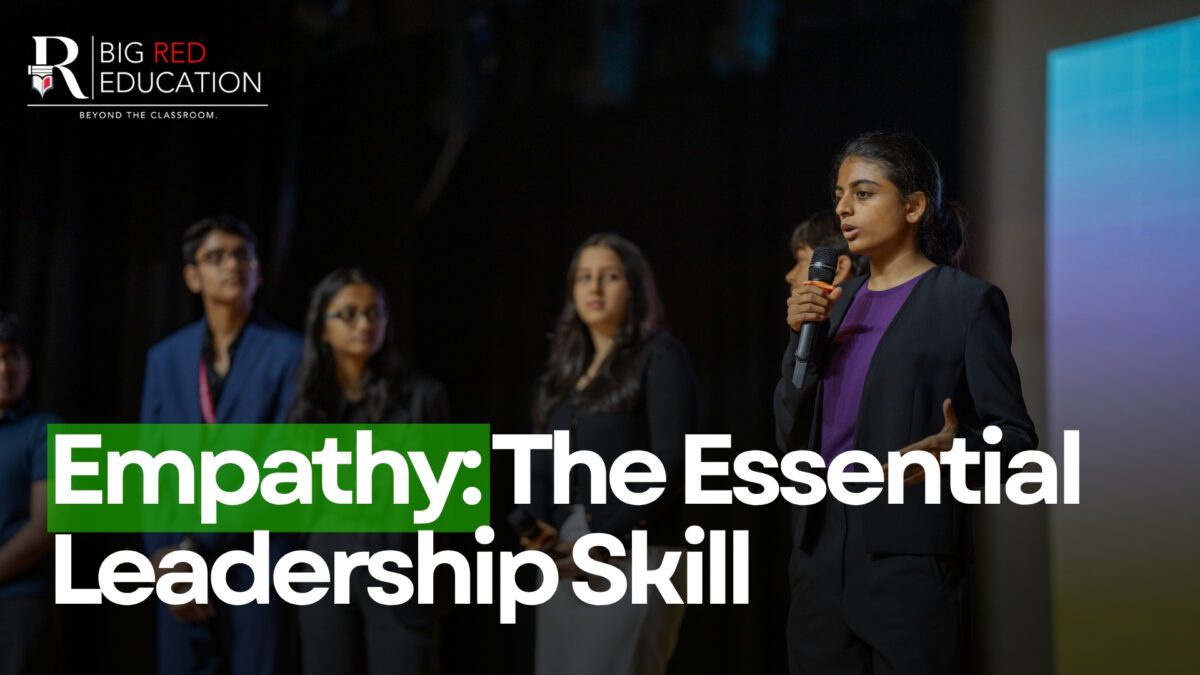
Why empathy is one of the most Important leadership skills for students?
We often romanticize the “eureka” moment in business and social innovation. The narrative usually focuses on a lone genius who has a brilliant idea, writes a revolutionary line of code, or designs a slick new product. But here is the hard truth: having a good idea is only about 10% of the equation. The same mistake isn’t limited to startups. Students often focus on presenting solutions before truly understanding the people they’re trying to help, whether in leadership roles, community projects, or social innovation initiatives.
The graveyard of failed startups is full of incredible, technically flawless products that nobody actually needed. Why? Because the founders fell in love with their solution rather than the people they were solving the problem for. At the core of every truly transformative initiative—whether it’s a global social enterprise or a local community project—is empathy. It is the most critical, yet frequently underestimated, leadership skill. And contrary to popular belief, it is incredibly difficult to master.
The Misconception of the “Ruthless” Leader
For decades, the archetype of a successful leader was someone stoic, hyper-logical, and uncompromising. Empathy was often dismissed as a “soft” skill, a nice-to-have trait that took a backseat to strategic vision and operational efficiency. However, recent data has completely shattered this myth. Empathy is not just a moral imperative; it is a measurable driver of success. According to research highlighted by the Harvard Business Review, organizations with empathetic managers experience:
- 76% less burnout among team members.
- 50% stronger work relationships.
- 37% higher innovation metrics.
When leaders actively listen and validate the experiences of their team, they create a psychologically safe environment. In these spaces, people aren’t afraid to take creative risks, flag potential failures early, and collaborate genuinely.
Social Innovation: Operating Like a Sociologist
When we look at social innovation—creating solutions that address systemic societal issues—empathy moves from a management tool to the very engine of design. The best founders and social innovators operate almost like sociologists. They don’t just look at a spreadsheet; they observe the “default” behaviors of a culture. They analyze how people interact in their daily lives, the language spoken in a typical household, and the unsaid friction points that make life difficult. To build a product that changes lives, you have to step entirely outside your own perspective.
It requires moving through the three dimensions of empathy:
- Cognitive Empathy: Intellectually understanding another person’s perspective.
- Emotional Empathy: Truly feeling what others feel.
- Compassionate Empathy: Taking actionable steps based on those insights.
You cannot design a health tech app, an educational platform, or a sustainability initiative without compassionate empathy. You have to understand the human on the other side of the screen.
Leadership Starts Before the Boardroom
Leadership doesn’t suddenly begin when you receive a C-suite title. It starts much earlier. It begins when you’re a school president trying to keep a diverse team motivated, or a mentor guiding anxious juniors through the grueling gauntlet of university entrance exams.
In those moments, you quickly learn that the root of a problem isn’t always what it seems. A peer’s sudden drop in performance might look like a lack of dedication, but an empathetic leader digs deeper. You might discover that their stress isn’t about the grand end-goal; sometimes, it’s the immediate, crushing weight of delayed college assignments or personal friction. By validating their specific reality, you don’t just fix a productivity issue—you build trust. According to Businessolver’s State of Workplace Empathy Study, 67% of employees are willing to work longer hours for an understanding employer. People don’t just work for companies; they work for people who genuinely care about them.
Cultivating the Empathy Muscle
Empathy is hard because it requires vulnerability, active listening, and the willingness to admit that your initial assumptions might be wrong. It takes energy to suspend your ego and center someone else’s experience. But the good news is that it is a muscle that can be trained.
If you are ready to move beyond traditional classroom learning and build real-world leadership capabilities, explore how you can turn your empathy into action:
- Master Collaborative Problem-Solving: Dive into real-world case studies and align your passion with the UN Sustainable Development Goals at the Leadership & Social Innovation Conference.
- Step Into Global Diplomacy: Develop your public speaking, high-level negotiation, and persuasion skills under pressure through intensive simulations at ILMUNC India.
At Big Red Education, we believe that the leaders of tomorrow need more than just academic excellence and technical acumen. They need the emotional intelligence to navigate complex human dynamics and turn ideas into tangible impact. We equip students with the frameworks needed to observe societal challenges, design thoughtful solutions, and lead with purpose.


