blog Money Personal Finance | 6min Read

5 Amazing Financial Literacy Apps for Money Management

Published on December 22, 2021

FacebookTwitterWhatsApp
Categories
blog Money Personal Finance

5 Amazing Financial Literacy Apps for Money Management

Not everyone around you is an expert when it comes to finance and money. People will tell you several answers to the question “What to spend money on?”, but often find it hard to answer the real question- “Where did I spend all the money?”

Did you ever observe how your grandparents used to track money, and how your parents are taking care of their finances right now? If yes, what’s the major difference that you’ve seen? It’s technology! They lacked the technical resources and technology to manage their finances. Your parents never got money from grandparents with just a few taps on their smartphones, and neither did they get the right platforms while they were at school to learn about money management skills. In today’s tech-savvy era wherein everything’s available right on your smartphone, why not choose the smart option to manage your finances as well?

Why Should You Use Apps For Money Management?

Just like the fitness app on your phone that shares data about your health, workout, steps walked, and other activities; money management or personal finance applications help you to track your expenses, savings and prepare you for the financial world. Such apps allow you to make better plans on what to do with your money, where to spend, how to invest, and much more.

Making a budget, tracking expenses, minimizing spendings, and investing are some of the good practices that make you financially smart. Many times, people often miss keeping a record of their transactions and struggle with their daily money management, thus creating havoc in the future. And in times like these, money management apps can provide us the necessary helping hand we need. Using financial literacy apps not only simplifies the whole process but provides you with great money management tips.

Time to get real now. Planning your finances and saving money for your retirement plans right in your teenage years seems a little boring, right? Wrong! Handling personal finance can be super interesting and we’ve got it covered for you! Let’s have a look at some of the best financial literacy apps that would help you become financially smart at an early age.

The 5 Amazing Apps You Need To Download Right Now

Before we start, here’s a quick riddle for you – “If money really did grow on trees, then what would be everyone’s favorite season?”

Still scratching your head? The answer is hidden in the article, all yours to find it! But let’s start with the 5 apps first –

1. Walnut

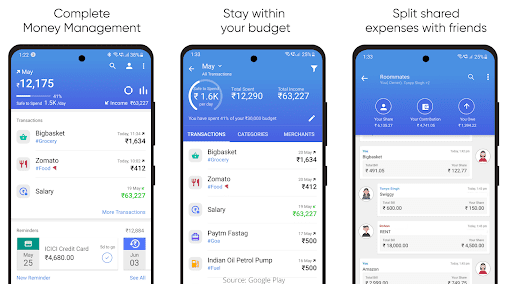
Walnut allows complete money management by automating your monthly transactions, expenses, and income. It analyzes your transactions through SMS, online billings, bookings,  etc. The app provides utmost visibility with auto-categorized transactions and helps you to stay within your budget.

Another amazing feature of Walnut is that you can split shared expenses with friends and tell you how much you contributed and how much you owe. You can also export your information and create expense reports in no time.
2. YNAB (You Need A Budget)

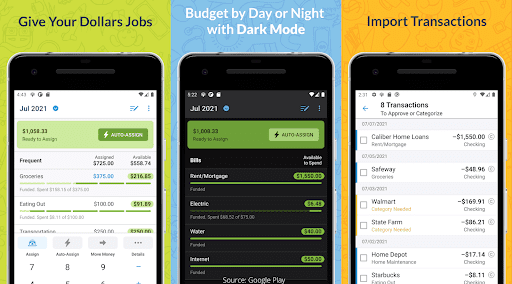
YNAB allows you to visualize your spending and progress with budget reports. It securely links your bank account giving you a complete overview of all our transactions. Another great feature of this app is that there are no ads at all, and has an auto-renewable subscription model.

With this best budgeting app, you have real-time tracking of your financial goals, modify and share across with anyone. It has an inbuilt loan calculator as well that gives a complete picture of interest and time to pay off the debt. According to YNAB, users save an average of $600 by their second month and more than $6,000 during their first year.  
3. Wallet

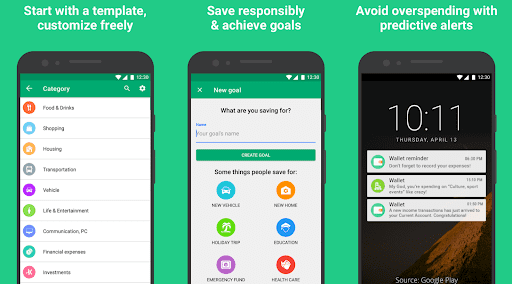
Through Wallet, you can gain full control of your finances and easily track your spending, budget, and save more money. With continuous financial insights, you can dive into weekly spendings, manage debts, and plan for future money management by centralizing all your financial needs.  

You can simply choose a template of your choice and customize your budget, view the upcoming payments and how they will impact your cash flow. Wallet helps you avoid overspending with predictive alerts, and stay in complete control of your credit. 

According to a BusinessWire study, 83% of the people that set financial goals, feel better about their finances in just a year. Try it for yourself – your goal could be your favorite watch or your dream college. Start working towards it right away!
4. FinArt

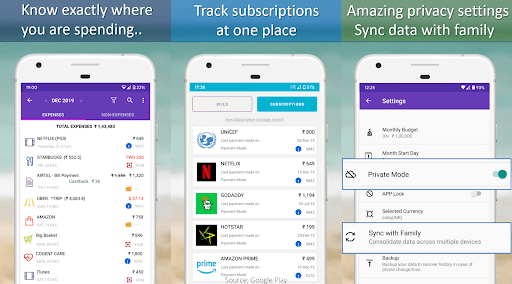
FinArt is money management and tracking app that gives you monthly bill reminders and can be used together with your family. Yes, you can avail 5-day free trial and then subscribe for as low as 799/year. One of the benefits you get with this app is that of a Family subscription that allows you to use this app for 2 devices, and a Business subscription that helps you manage business accounts separately. 

As soon as you download the app, it crawls through your SMS data and compiles all the expenses on one screen. You don’t have to spend hours remembering where you spent money – the app does it all! How cool is that?

The app categorizes your spending patterns, sets a budget for every category, and has a remarkable privacy setting to protect your data.
5. Monefy

Monefy is an easy, efficient, and user-friendly app that helps you with daily budgeting and expense tracking for excellent money management. It compares your expenses with the monthly income and shapes them accordingly to help with savings. 

Not just that, but it provides a detailed overview, handy widgets, and records. You can sync your Google Drive or Dropbox safely and protect your data with a passcode.

And here’s the answer to the riddle – ‘Fall’! Did you guess it right? How about you test your friends with this one?

Things to Consider before Downloading Financial Literacy Apps

Today, there are plenty of apps available on the internet related to personal finance, money management, financial literacy, and more. But before you choose and start using the right one for yourself, here are a couple of things we suggest you consider:

  1. Download the app only from secured sources like Google Play Store or Apple App Store. Make sure to not click on unverified links and download from any unsafe source.
  2. Check if the app is free or charges the users to access its features. If it has in-app purchases, make sure that it provides safe transaction options. 
  3. Check the app user interface and see if it’s user-friendly and has a good number of beneficial features.
  4. Ensure it is from a reliable source, and be careful about any personal data such as contact details, photos, emails, messages, etc. on your phone.

Final Thoughts

Not just for managing your money, these apps provide newsletters and information about other financial resources that will help with budgeting, saving, investments, and much more. Each platform is different and has extensive features of its own, but their ultimate goal is the same- making the end-user financially literate and instilling money management skills. 

While we have listed out some of the best financial literacy apps for students, there are plenty of others out there as well. So, all you need to do is do some research on the apps that pique your interest and choose the right one that ticks your boxes for money management. 

Will downloading and using these apps make you financially literate? Certainly not. It’s just a part of the process and there is a lot more to explore and learn to call yourself that. So, stop procrastinating about it when you can do it now! Head over to the other insightful articles in this section and discover more about the world of finance right away or simply join our student financial literacy course to become an expert.




Editor's Pick

blog Personal Finance | 5min Read

Why is Financial Literacy For Students a 21st Century Skill?

Published on

FacebookTwitterWhatsApp
Categories
blog Personal Finance

Why is Financial Literacy For Students a 21st Century Skill?

High-school years are undoubtedly some of the most crucial years of your life. It sets you up for all your future endeavours and also outlines success in the coming years. As you pave your way in the world, you realize how finance drives almost everything around you. Yet student financial literacy has continued to be the most disregarded topic over the years. As a result, we see news headlines like “Indian banks saw a 142% increase in student loan defaults during a period of just over three years.”

Financial Literacy Vs. Young Adults

Before you process the significance of money management skills for students, let’s have a quick exercise and check how much you know about money already. Take your time to solve this crossword and come back to understand why financial literacy can be the most lucrative skill for you to acquire in 2022!

Pro tip – Share the crossword with your friends and see who solves it first!

Without further ado, let’s find out the story of a 22-year-old software engineer, Viaan. Smart and intelligent, Viaan has always been one step ahead of his peers. Completing high school with exceptional scores, graduating from one of the best colleges in the world, he has fast-tracked his way into the professional world with one of the best IT firms in the world. He’s minting money while enjoying a great lifestyle. Sounds perfect, doesn’t it?

However, the facade of this perfect life breaks into truth when Viaan realizes he has no time or money to invest in himself, his passion project. So today, in spite of having a strong source of income, he is finding it difficult to manage his daily finances, let alone save up for his entrepreneurial dreams. The flame in his heart, of becoming financially independent early in his career and doing something on his own, is now flickering.

In this story, if you notice carefully, Viaan is not entirely wrong. He has equipped himself with some of the most sought-after 21st-century skills which made him employable as well as capable enough to work on his entrepreneurial ideas. But all these skills couldn’t help him learn how to manage the money he was making. Imagine owning a PS5 but not knowing how to use it! Who would want themselves in a situation like that?

Why Should You Learn Money Management Tips So Early On?

If you think Viaan’s story is an exception and he might have been the only person indifferent towards money management skills, you might be wrong. How to save money as a student is rarely on top of the minds of our young adults. The All India Financial Inclusion and Financial Literacy Survey revealed that merely 26% of the students in the adult population could cross the minimum threshold score when evaluated across different components of financial literacy. Before you scroll down, read that again!

What difference can student financial literacy bring into your life? A lot of you who are reading this might not even be an adult yet. Do you still need to worry about financial literacy?

Let’s break this down through these 5 pointers –

1. Manage Money And Do Budgeting

The first time Viaan received his internship stipend, he spent it all on his science project for the next term. Had he kept a track of his income and spending, and developed a plan to satisfy his goals back then, the same practice would have helped him today.

Budgeting is a basic money management skill that you can adopt today. Observe the incoming and outgoing flow of your money. Set your goals and adjust your savings and expenditures accordingly, to be able to achieve the target. Do it for a week, extend it to a month, and watch it become a rewarding habit as you grow.

2. Become Smart And Financially Independent

Nothing is as cool as owning an enviable skill that works for you, even when you’re sleeping. Some of the smartest minds on Earth are ready to pay loads of money to people who can help them manage their assets. This is only because they found out the way to earn money, not to manage it.

Building a new skill is a step-by-step process. Today you’ve picked up this article, tomorrow you might pick up a bestseller on personal finance. You just need to start!

3. Improve Financial Discipline And Capability

Your parents would always be there to support you financially. What matters is how soon are you ready to become financially capable enough to support your own dreams, and perhaps, some of theirs too!

How difficult is it to give up on one of the night-outs and dine-in instead? How challenging is it to save a little extra money to fund your next big purchase? Think about it and bring change.

4. Increase Your Self-Confidence And Fulfill Your Dreams

Being financially literate builds your arsenal to fight the cons of the real world. It can give you an edge you never thought you could have. Small-yet-smart financial decisions can pave the way for your big decisions in life. Be it the dream tour or the coveted university, every milestone becomes achievable if you start early.

Use a personal finance management app and set up a goal with the time you have to achieve it. Chalk out a plan and follow it religiously. Your future self will thank you!

5. Start Investing Right Away

The fact that early investments can make your portfolio multiply over time, is no stranger. What you need to know is that you can learn and start investing in some financial instruments, even before 18 years of age. On top of that, you can always add your own share to your parents’ portfolios. To learn how to start investing as a student, check this out! <add link to the blog ‘How to Start Investing as a Student?’ here>

All you need to do is, look up resources on the internet and start learning. Observe the market fluctuations, understand the various financial instruments, curate your analyses, and make sensible investments.

Going Forward

By now, you must have realized how financial literacy can outplay most of the other 21st century skills one can possess. Of course, all other skills have their own importance in different stages of your life and career, but money remains a constant.

Most 11-year-olds would spend their pocket money on toys or video games. The kid who decided not to do so ended up creating a fortune of a lifetime! Not everyone can be Warren Buffet but what’s stopping you from trying?

Watch this space for more insightful pieces that can be the game-changer for your financial decisions. Kickstart your financial literacy journey with us today!

Answers to the crossword:

Across: 2. BORROW; 3. SPEND; 6. ECONOMY; 8. WANT; 9. NEED

Down: 1. DONATE; 2. BUDGET; 4. JOB; 5. SAVE; 7. MONEY

Editor's Pick

blog Leadership | 2min Read

How Leadership Development Programs Set You Up For Success

Published on December 7, 2021

FacebookTwitterWhatsApp
Categories
blog Leadership

How Leadership Development Programs Set You Up For Success

Leaders inspire others to do more. They carry their team to greater heights by influencing people to achieve more. Most leaders want to lead well, but only a few succeed.

Leadership, learning and development are indispensable to each other. The foundation of leadership is constant development through learning. A good leadership development program helps metamorphose leaders into great leaders and accelerates growth. It has the ability to transform an organization.

Great Leaders Build Great Organizations

Leadership is a personalized, ongoing and engaging approach. It is by no means a one-and-done process.

Good Leadership Development Programs like Harvard YLC uncover unique strengths and areas of improvement. The programs work on the needs and requirements to nurture young leaders. They serve as a great platform to connect the young leaders with engaging content that is personalized based on their unique needs. The programs create opportunities for leaders to practice their skills and work with their teams.

Leadership Development Programs will give you clarity on where the gaps are and where help is needed the most. They give you a measure of where you stand. An assessment of your current skill is an effective way of knowing where improvement and strengthening is needed. It gives you the clarity to know where to focus your time.

Access to resources is another attribute of a good leadership development program. It helps in rapid skill acquisition and a better level of absorption and retention.

Helping young leaders connect with experienced leaders is yet another trait of an effective leadership development program. The transfer of knowledge between a mentor and a mentee is a powerful method of augmenting and nurturing young leaders.

A Leadership Development Program helps you identify and improve your communication skills and empowers you to have the greatest impact.

Discover & Nurture the Leader in You

Leadership is a proven program that accelerates growth and transforms organizations. Harvard Youth Lead the Change is a leadership development program created by professors of the Harvard Business School, Harvard Law School, and the Harvard School of education, and held by Harvard students. Held for students in grades 8 – 12, the program aims at empowering students and unlocking their leadership capabilities as they develop tangible solutions to global problems.

A 7-day conference provides the students with an opportunity to work in a group to understand a global issue and develop a social change project to address it. Through this program, students learn about core leadership skills such as collaboration, public speaking, time management, and self-knowledge.

Presented by The Leadership Institute at Harvard College (LIHC), this Harvard student organization aims to provide and promote leadership development opportunities across the world.

Editor's Pick

blog | 5min Read

7 Steps To Be Fully Prepared For Your First MUN Conference

Published on November 27, 2021

FacebookTwitterWhatsApp
Categories
blog

7 Steps To Be Fully Prepared For Your First MUN Conference

As a first-time MUNer, there is a lot of uncertainty in one’s mind about where to start, how to progress, and, most importantly, how to come up with compelling arguments to win an award at a conference. Big Red Education’s team has prepared the 7 steps you’ll need to start and flourish in your new career as a Diplomat, based on years of experience and study. Let’s take a look at each of these steps closely.

1. Begin with reading about your Country Profile

Before reading the conference’s Study Guide/Background Guide, it’s a good idea to study a little about the nation or designation, depending on your committee, you’ll be representing to overcome any inherent prejudices you might have. Remember to adopt an open mind when it comes to the country you’ll be representing. This will help you know facts, prepare arguments & also negotiate during the MUN sessions.

Things to research about your nation include:

  • Land – Use a map to locate your nation. Examine your size, terrain, and surroundings. Basically all of the demographics.

  • Politics – Determine whether you are a democracy, a pseudo-democracy, or a dictatorship. Check which party is in power in a democracy.

  • Data – population number, primary languages, demographic breakdown, and income, which is generally determined by examining the Gross Domestic Product (GDP).

  • News – Stay updated with the national news in your country. Look for any recent changes in law, policies, etc.

  • When you read the Study Guide, this research will help you come up with useful suggestions.

2. Read the Study Guide

The Study Guide (also known as a Background Guide) is where you’ll find all of the essential details regarding the issue your MUN committee will be debating upon. When you’ve finished reading the instructions, you should have a good idea of the issue and what you’ll be discussing.  Keep in mind that these guides are usually made by the chair and the vice-chair of your respective committees. Therefore, in case of any doubt or confusion prior to the conference, do not hesitate to reach out to them to clarify all possible doubts that you might have.

The Background Guide should provide you with background information about the subject. Ongoing concerns regarding the issue, statistics and facts that are relevant, the UN committee’s statements, positions in the block, questions to ponder as well as additional reading material. Additionally, they are also useful since they show you in what direction the chairs want the argument to proceed.

3. Learn more about your committee

As you must know, the UN has several committees like UNHRC, General assembly, etc. Your Background Guide should include all essential information about your committee. In case it does give you the full overview, a  short look at the Wikipedia page should help you understand it better.  Your aim is to understand the committee’s objectives, any ongoing activity, it’s previous actions (especially regarding the current agenda). Furthermore, learning what your MUN committee’s mandate is will assist you in comprehending everything it can and cannot do. This will come in handy when it’s time to write down concrete solutions.

4. Understand your country’s position

To succeed in your committee, you need to read as many news articles to obtain an understanding of what policies your nation might pursue in order to grasp its stance.

If you’re representing Japan, for example, you might want to examine things like – Has Japan ever dispatched relief workers in the event of a natural disaster? Is Japan a participant in global anti-virus efforts? Even if there is nothing specifically mentioned about your country’s link to the subject you will be debating, the answers to those questions will help you understand where your country’s diplomatic position is on the ongoing agenda.

If you still can’t seem to find anything about your country or position, search the same for your surrounding countries or countries that are similar to you. Take a look at how they handle the situation. If your country appears to be irrelevant to the issue being addressed, you may only get a well-informed guess of how it might work in case it was more involved in the issue at hand. Fortunately, even when there is little information, it is frequently sufficient.

5. Work on your Opening speech

Each delegate at an MUN is required to give an Opening Speech. If there are no opening addresses at a conference, the first speech you give will serve a comparable purpose.

Typically, the introductory address lasts 60 to 120 seconds

This speech should include an overview of your country’s perspective on the matter as well as solutions to the issues your committee is debating. Details and concrete policies to remedy the situation should be included in your speech. Lastly, your answers should be in the best interests of your country.

6. Go over the Rules of procedure again

It is critical that you have a basic understanding of the Rules of Procedure before attending your first MUN. Practicing is the greatest way to learn ROPs. While mastering the ROP is not required, it is beneficial to have a rudimentary understanding of delegate workflow and how to pass a motion. You’d be able to get your hands on these very easily on several websites on the internet. Fortunately, they are sometimes also mentioned in the background guide as well as repeated by every chair at the beginning of the conference.

7. Learn to draft a resolution

A Resolution Document is a collection of your block’s relevant policy proposals. Preambulatory Clauses and Operative Clauses are the most common types. To be deemed a genuine Draft Resolution, the Resolution must be prepared in a specified fashion. This structure can be found easily on several different websites including The Best Delegate Website.

Although, undoubtedly, MUNs are a lot of fun, coming prepared increases your chances of having a good time at the conference. This is because you’ll know where things are headed and how to get to your intended goal . You just need to show up and make the most of your first MUN conference. Also, don’t forget to take advantage of the sites, social media, and the easiest opportunity to establish friendships with hundreds of people who are just like you.

However, with every new generation, we see new patterns and skills being showcased at these MUNs. In case you did have the opportunity of attending a conference before coming across this guide, do you feel like you’ve learned and experienced something new?

Editor's Pick

blog Personal Finance | 5min Read

Cryptocurrency: A Financial Fairy Tale

Published on

FacebookTwitterWhatsApp
Categories
blog Personal Finance

Cryptocurrency: A Financial Fairy Tale

Imagine creating a payment system as a joke and ending up with a market cap of US$29 billion! Yes, that’s exactly what happened with software engineers Billy Markus and Jackson Palmer after they launched Dogecoin in 2013. It wasn’t until 2021 when Elon Musk vocalized his support towards Dogecoin, that the currency shot up by more than 20,000% in just one year!

If you’ve been seeing a lot of speculation around this but are not sure as to how cryptocurrency works – today’s your day. You will get to know the story behind cryptocurrency and what it means for you.

It is often said that you’re never too young to start saving money. One can start saving after settling down with the family, like your grandfather. Or, one can start saving after launching their first business, like your father. But someone like you can start saving right away – while still in high school.

While the ultimate motto behind saving money has remained the same, the resources from where we get this income and the form in which it has been stored have drastically changed over the past few decades. Cash is no longer the king. With the storming digital revolution, the need and the spread of digital money have seen remarkable growth. So, what is digital currency?

After the COVID-19 pandemic hit, the world has been more rapidly choosing digital money and going cashless. Digital money has brought immense ease of access, but at the cost of cybercrimes. With the world opting for digital transactions, every single day, security has become a major concern. And that’s where blockchain technology and cryptocurrency come into the picture.

What is Cryptocurrency and Why Was It Created?

Just like the dollar, euro, pound, or rupee, cryptocurrency is a digital coin that is used as money in the online medium. This is not physical money that you can pull out of your pocket or fiat currency that the banks can store on their premises. So, where do cryptocurrency, and the transactions made using it, reside? The answer to that is blockchain. Now, what is a blockchain? In simple words, a blockchain network is a ledger or a collection of all digital transactions that take place.

To summarize, you need to observe that physical money is being replaced by digital currency here. Also, all transactions are being done on the backbone of blockchain, which is a decentralized technology. Everyone can access it. No single entity has full control over cryptocurrency which makes it decentralized and hence immune against cyberattacks and sloppy, corrupt transactions. That explains why cryptocurrency was created in the first place.

Types of Cryptocurrencies

Broadly, there are two categories that cryptocurrencies can be divided into – coins and tokens. The major difference between these is that coins have their own blockchain network whereas tokens make use of the existing blockchain.

Bitcoin was the first cryptocurrency, released in 2009, and Satoshi Nakamoto was the developer who created and developed Bitcoin. With the rising demand and growing popularity of Bitcoins, people have created plenty of cryptocurrencies in this digital world. Did you know that there are more than 6,500 cryptocurrencies? This includes Ethereum, Ripple, Polkadot, Stellar, Bitcoin Cash, Chainlink, and yes, the reputed Dogecoin as well. Coins other than Bitcoin are also known as Altcoins.

How Will Crypto Wallets Replace Piggy Banks?

Cryptocurrencies follow a decentralized system, and not a centralized system used in banks and electronic money. Unlike the traditional currencies used in the world, cryptocurrencies aren’t owned by a single country or a person. This transparent technology allows to have more secured transactions and there are not any taxes or transaction charges involved while doing so. You can simply keep your money safe in these crypto wallets, and make use of it whenever required. Although, you cannot make use of cryptocurrency for daily transactions yet, the future surely would have a different story.

Cryptocurrency and Teenagers

Neither the top investors nor anybody else, it’s YOUR pocket money that is growing India’s crypto investments! Yes! The past year has witnessed a huge surge in crypto investments, a huge chunk coming from teenagers. In fact, a survey found that 45% of teens believe they know about cryptocurrency more than their parents. Undoubtedly, the dynamic nature of cryptocurrency makes it a perfect fit for inquisitive young minds.

Not only are teenagers researching and investing in cryptocurrency, but they are also mining their own digital tokens! What is crypto mining? Well, it involves a piece of sophisticated hardware that solves a complex computational problem. In simple words, you can consider crypto mining as a way of creating new coins, as these Texas siblings are doing. Remember we talked about blockchain being a ledger for crypto transactions? A verified crypto miner validates crypto transactions and adds them to the blockchain ledger, thereby earning money from the same.

While Indian crypto exchanges do not allow individuals below the age of 18 to invest yet, won’t it be cool if you could amplify your parents’ or your elder siblings’ investments?

Cryptocurrency is the Future

A decade ago, the concept of flipping your phone, scanning a QR code, and making payments on the go was a fancy dream. Today, it’s an inevitable reality. Innovation often finds itself in the hands of unpredictability.

Believe it or not, cryptocurrencies are here to transform our world and you will soon find yourself in a world that literally runs on them. While there’s still a lot of speculation around the stability of cryptocurrency, the best idea is to start learning about it, before it’s too late. You don’t want to be late to the smart investors’ bandwagon, do you?

Conclusion

The nature of cryptocurrency is volatile but highly rewarding. An investment that yields huge returns is a product of smart decisions and fundamental knowledge. Get your basics right with the Smart Money Camp – a student financial literacy course – and be ready to conquer the world of cryptocurrency. The sooner you start, the greater the edge you have.

The future of your money is in your hands, are you ready to learn?

Editor's Pick