
blog Communication Entrepreneurship Higher Education Innovation Internship Leadership MUN | 4min Read
Published on June 12, 2026


How AI Is Transforming Education: 4 Changes Every Student Should Understand
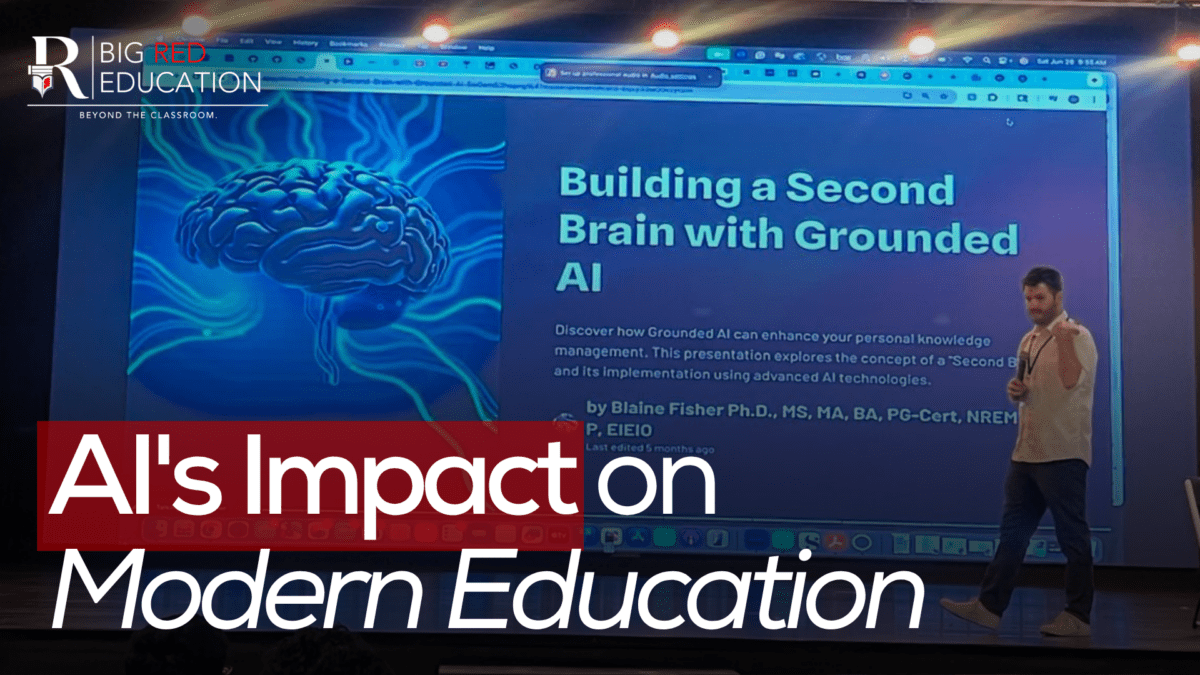
How AI Is Transforming Education
Whether you’re a student preparing for college or a parent thinking about future careers, artificial intelligence is already changing how students learn, solve problems, and prepare for the workforce. Understanding these changes is becoming just as important as understanding traditional academic subjects.
Here is a direct look at four ways artificial intelligence in education is reshaping the educational ecosystem and how to stay ahead of the curve.
1. The Shift from Rote Memorization to Critical Inquiry
For decades, traditional schooling disproportionately rewarded the ability to memorize facts and formulas. AI reduces the value of memorization as a primary educational outcome and increases the importance of critical thinking, analysis, and problem-solving. When global data can be recalled in milliseconds, the value of education shifts from knowing the answer to asking the right question.
- Before: Students memorized formulas.
- Now: Students need to evaluate AI outputs, verify information, ask better questions, and think critically.
As highlighted in the World Economic Forum’s report on Education Readiness for the Age of AI, the rapid integration of AI requires a fundamental shift in how we assess students. Educators are moving away from grading final answers and focusing instead on the logic and critical thinking a student uses to get there.
2. Radical Personalization at Scale
The holy grail of education has always been one-on-one mentorship, but traditional classrooms force a “one-size-fits-all” model. AI breaks this bottleneck by acting as an adaptive, hyper-personalized tutor.
Modern AI platforms analyze a student’s specific learning pace, identifying precise cognitive gaps. If a student struggles with algebraic concepts but excels at visual geometry, the AI dynamically restructures the lesson plan in real time, ensuring they are neither bored by repetition nor left behind.
3. Moving from Passive Consumers to Active Builders
The ultimate goal of classroom technology is not to create a generation that just knows how to use apps, but one that knows how to build them. True AI literacy in the future of education involves understanding the infrastructure of tech.
To evolve from being the “actor on the stage” to the “orchestrator” of AI tools (as discussed by Harvard University), students must develop automation thinking, prompt engineering, and product building skills.
4. Navigating the Ethics of the Algorithm
As AI integrates into everything from healthcare to climate modeling, the most critical skill a student can develop is ethical literacy. Understanding algorithmic bias, data privacy, and the social implications of automation is vital.
UNESCO’s AI competency frameworks emphasize that the leaders of tomorrow will not just be technical experts; they will be the ethical anchors ensuring technology serves human progress responsibly.
Why Human-Centric Skills Are the Ultimate Differentiator
While AI handles computation, data processing, and rapid content generation, it cannot replicate the nuance of human connection and strategic vision. To truly thrive in an AI-driven world, students must double down on the uniquely human skills:
- Leadership & Collaboration: The ability to inspire diverse teams, navigate human emotions, and drive collective action.
- Communication & Public Speaking: Articulating complex visions with personal charisma that algorithms lack.
- Entrepreneurship & Design Thinking: Identifying real-world human problems and iterating innovative, empathetic solutions.
- Negotiation: Managing conflicting interests, reading the room, and finding nuanced compromises.
What Can Students Do Next? Build Real-World Capability
Understanding these skills is one thing; practicing them is another. The traditional classroom cannot always provide the sandbox needed to build entrepreneurial resilience or high-stakes negotiation skills. This is where experiential learning ecosystems bridge the gap.
Big Red Education designs programs that move high schoolers from passive learning to active creation, specifically targeting the human-centric skills needed in an AI era. By learning directly from global mentors—including alumni and former faculty from Columbia, MIT, and Cornell—students can dive into specialized tracks designed to cultivate these very skills:
InnovateNOW Pre-College Entrepreneurship
- Core Skills Developed: Entrepreneurship, Design Thinking, Collaboration
- How It Prepares Students: Guided by Columbia Business School alumni, students build, validate, and pitch startup ideas. Through this intensive process, they learn how to identify critical market gaps and design deeply user-centric solutions.
Social Startup Bootcamp
- Core Skills Developed: Leadership, Communication, Social Innovation
- How It Prepares Students: Mentored by former admissions officers and Ivy faculty, students tackle complex real-world case studies. This environment helps them develop personal charisma and learn exactly how to influence and lead with lasting impact.
ILMUNC India (Ivy League Model UN)
- Core Skills Developed: Public Speaking, Negotiation, Global Policy
- How It Prepares Students: Through high-level diplomacy simulations, students develop the art of persuasion, geopolitical negotiation, and the invaluable skill of commanding a room under intense pressure.
Command Z: Future Tech Lab
- Core Skills Developed: AI Literacy, Automation Thinking, Problem Solving
- How It Prepares Students: This residential workshop takes students entirely out of their comfort zones, moving them beyond simply using apps. Here, they focus on building functional AI models and thoroughly understanding ethical tech infrastructure.
What Parents Should Know About AI in Education
For parents, navigating AI in education can feel overwhelming. The best approach is to shift focus from “Is my child using AI to do their homework?” to “Is my child developing the skills AI can’t replace?” Encourage them to engage in real-world problem-solving, debates, and leadership opportunities that force them to think on their feet, communicate effectively, and lead with purpose.
Stop waiting for the future of education to arrive, and start building the skills to lead it today.


