blog Communication Higher Education Leadership MUN Productivity summer | 5min Read

Beyond Grades: 5 Skills Ivy League Admissions Officers Value

Published on June 4, 2026

FacebookTwitterWhatsApp
Categories
blog Communication Higher Education Leadership MUN Productivity summer

Beyond Grades: 5 Skills Ivy League Admissions Officers Value


Beyond Grades: 5 Skills Ivy League Admissions Officers Value


Many students assume Ivy League admissions depend primarily on grades and standardised test scores. While academic performance remains important, top universities evaluate applicants holistically looking for leadership, intellectual curiosity, communication skills, resilience, and meaningful impact beyond the classroom. A 98 percentile score won’t get you in alone. Neither will a trophy shelf. What Ivy League admissions officers are really searching for- and what most students never think to build- are the five skills below. The good news? Every single one can be developed, starting now.


THE MYTH WORTH BUSTING FIRST

Most students and most parents believe that the path to a top university runs straight through grades and test scores. It doesn’t. Ivy League acceptance rates hover below 5%. At that level, nearly every applicant has stellar academics. What separates the ones who get in isn’t the GPA it’s who they are beyond it.


01. Leadership – and not the title kind

Every application has a “Head Boy” or “Club President.” Admissions officers have seen thousands of them. What they’re actually hunting for is something harder to fake: evidence that a student influenced people, changed something, or moved a group toward a goal- with or without an official title.

The student who noticed a gap in their school and did something about it. The one who organised a tutoring initiative for younger students, led a sustainability project, coordinated a community fundraiser because it needed to be done, or worked with peers to develop solutions to real-world challenges through experiences such as the Leadership & Social Innovation Conference. Leadership, in the Ivy League sense, is about impact, not position. If your leadership story starts with “I was elected,” it might be worth finding a deeper one.

Ask yourself: Have I ever changed the way a group of people thought or acted? That moment – however small – is your leadership story.

 alone.


02. Intellectual curiosity that goes off-syllabus

Top universities aren’t just looking for students who ace exams- they’re looking for students who would stay curious if exams didn’t exist. The applicant who read a paper that wasn’t assigned. Who pursued an independent research project or passion project just because it fascinated them. Who asked “why does this work this way?” instead of “what do I need to memorise?”

This quality, genuine intellectual hunger- shows up in essays, interviews, and the specificity of a student’s interests. It often develops when students explore ideas beyond the classroom, whether through independent projects, research, or experiences that expose them to emerging fields. 

Students who engage with topics such as Generative AI, technology ethics, and future-focused innovation through programs like Command Z often find themselves asking deeper questions and developing interests that extend well beyond the syllabus.

The tell: Can you talk for five minutes about something you learned recently that has nothing to do with your coursework? If not, that’s the gap to close.


03. The ability to communicate – not just correctly, but compellingly

Every student who applies to an Ivy League school can write a grammatically correct essay. Very few can write one that a tired admissions officer reads to the end and remembers the next day. The same goes for interviews and presentations.

Communication at the level these schools expect is not about being articulate, it’s about being specific, honest and human. It’s about having a point of view and expressing it with conviction.

Students who have debated, written creatively, presented research or participated in public speaking programs and Model United Nations conferences such as Ivy League MUN Conference 2.0 carry a visible edge in the application process

The test: Read your personal statement out loud. If it sounds like anyone could have written it, rewrite it until it sounds unmistakably like you.


04. A genuine commitment to something beyond yourself

Admissions officers can spot a résumé-padding volunteer experience from a mile away: the one-week trip, the charity drive that conveniently started in Grade 11, the activity that perfectly mirrors what the student thought the school wanted to see. 

What they actually respond to is depth over breadth- a student who cared about something real, demonstrated sustained impact over time, and can speak about it with genuine conviction.It doesn’t have to be saving the world. It could be tutoring kids in your neighbourhood for three years. It could be running a community initiative that started small and grew. The through-line is authenticity: you did it because it mattered, not because it looked good.

Depth check: How long have you been doing your most meaningful extracurricular? If the answer is less than a year, it’s time to build something you’ll actually stick with.


05. Resilience- the capacity to fail and keep going

This is the one most students never think to demonstrate- and the one admissions officers often find most telling. University is hard. The students who thrive are the ones who’ve already learned, in some meaningful way, how to handle setbacks. Not the ones who’ve never failed, but the ones who’ve failed, sat with it, and figured out what to do next.

A student who can write honestly about a challenge, a loss, a mistake- and what it taught them shows a kind of maturity that a perfect transcript never can. Top schools want people who will contribute to their campus community for four years. That requires more than intelligence. It requires character.

Worth reflecting on: What’s the hardest thing you’ve faced in the last two years? How did you respond? That’s potentially your most powerful application story.


Final Conclusion:

The students who get into the world’s best universities aren’t superhuman. They’re not necessarily smarter than everyone else in the applicant pool. What they have almost without exception- is a clear sense of who they are, what they’ve built and why it matters. That clarity doesn’t come from cramming. It comes from years of doing things that matter, reflecting on them honestly and learning to talk about them with conviction. Start now, and September of your application year will look very different.


 

What Parents Should Know About Ivy League Admissions

Many parents focus heavily on grades and test scores, but top universities increasingly seek students who demonstrate initiative, leadership, curiosity and meaningful engagement outside the classroom. Understanding this shift early and actively creating opportunities for your child to build these qualities makes a measurable difference by the time applications are due.


The students who get into the world’s best universities aren’t superhuman. They’re not necessarily smarter than everyone else in the applicant pool. What they have almost without exception- is a clear sense of who they are, what they’ve built, and why it matters. That clarity doesn’t come from cramming. It comes from years of doing things that matter, reflecting on them honestly and learning to talk about them with conviction. Start now, and September of your application year will look very different.


Editor's Pick

blog Productivity Trending | 5min Read

7 Ways to Make Your Summer Actually Count

Published on June 3, 2026

FacebookTwitterWhatsApp
Categories
blog Productivity Trending

7 Ways to Make Your Summer Actually Count

7 Ways to Make Your Summer Actually Count

It’s June. You have roughly 10 weeks before school starts again. Here’s the uncomfortable truth: most students waste them- not because they’re lazy, but because they never decide what they want from summer in the first place. Whether you’re looking for productive summer activities, structured summer learning opportunities, or simply a way to return to school more confident and capable, these 7 strategies will change how you approach the next 10 weeks.


01

Build one real skill- not ten half-finished ones

Every summer, students download Duolingo, sign up for a coding course, buy a guitar, and abandon all three by July 15th. The problem isn’t motivation- it’s breadth. Pick one skill you genuinely want, commit to 30 minutes a day, and watch what happens in 60 days. Whether it’s Python, public speaking, graphic design, or a second language, one skill done properly is worth ten things half-started. Colleges and employers remember specifics, not “I tried stuff.”

Quick start: Write down 3 skills you’ve been curious about. Cross out 2. Spend the summer on the one that’s left.


02

Start a project that solves something real

The best thing about summer is that no one’s grading you- which means you can actually make things instead of just studying them. Pick a problem in your world and build something around it: a small app, a short film, a research paper on a topic you care about, a social media page for a cause, a handmade product you sell to friends and family. It doesn’t have to be big. It has to be yours. Projects show initiative in a way that grades simply can’t-  and when interview or application season comes, “I built this” is one of the most powerful things a student can say.

Need a starting point?
Ask yourself: what’s something that annoys me, confuses me, or could be better in my school or neighbourhood? That irritation is usually a project idea in disguise.


03

Join a summer program that gives your summer actual structure

Self-discipline is hard to manufacture out of thin air – especially when every other signal in your environment says “relax.” That’s exactly why structured summer programs work so well for students who want to grow but struggle to stay consistent on their own. A good summer enrichment program gives you a schedule, peers who push you, and mentors who hold you accountable. 

Research from the Harvard Graduate School of Education consistently shows that students in structured summer programs retain more learning, perform stronger academically in the following school year, and report higher confidence going into new grades. 

Big Red Education runs some of the most hands-on student leadership programs available right now- here are three worth knowing about:

Leadership & Social Innovation Conference

In Partnership with NYU Stern’s Initiative on Purpose and Flourishing

A 5-day in-person conference where students develop leadership, design thinking, and social innovation skills aligned with the UN SDGs. Students develop:

  • Design thinking and social innovation skills
  • Strengths-based and adaptive leadership
  • Rapid prototyping and problem-solving
  • Pitching real solutions to an expert panel

Mentored by Dustin Liu, Senior Associate Director at NYU Stern’s Initiative on Purpose and Flourishing, who has taught design thinking at Stanford and worked with Cornell, Harvard, MIT, and the University of Chicago.

Ivy League MUN Conference 2.0

An immersive Model United Nations summer conference organised by University of Pennsylvania students designed to sharpen research, debate, diplomacy, and public speaking skills giving students a taste of high-stakes global problem-solving before they ever step into a university. Students develop:

  • Diplomacy and negotiation abilities
  • Public speaking and argumentation
  • Research and analytical thinking
  • Resilience under pressure

Command Z: Future Tech Lab

An intensive summer learning opportunity that introduces students to Generative AI through real hands-on projects mentored by Dr Blaine Fisher, a professor of information technology, emergency management & GIS at Tulane University. Students gain:

  • AI literacy and prompt engineering skills
  • Ethical technology awareness
  • The ability to build real projects using tools that are reshaping every industry
  • Original thinking, not just technical know-how


04

Read Beyond the Classroom to Build Knowledge and Critical Thinking

Not textbooks. Not revision guides. Pick up a non-fiction book about something you actually find fascinating, the psychology of decision-making, the history of the internet, how cities are built, how pandemics spread. Throw in a novel you’ve been meaning to read. Reading outside your curriculum does something school can’t easily replicate: it builds the kind of broad, connected knowledge that makes you interesting to talk to, sharper in arguments, and better at writing. Even 20 pages a day is 4-5 books by September.

Reading hack: Tell someone else what you read. Explaining a book out loud forces you to actually understand it, and it sticks far longer.


05

Build a physical routine before you need one

Summers without structure quietly destroy sleep schedules, eating habits, and energy levels- and then students arrive at September already running on empty. The fix is simple but non-negotiable: establish one physical habit and protect it. Run three times a week. Swim. Play a sport. Do yoga. It doesn’t have to be intense; it has to be consistent. A body that moves regularly sleeps better, thinks more clearly, and handles stress more effectively. Academic performance is not just a brain problem- it’s a whole-body problem.


06

Sit with boredom – Unstructured Time Actually Boosts Creativity

This one sounds counterintuitive. We live in an era of zero-tolerance for boredom, there’s always a scroll, a stream, a notification.But research from the American Psychological Association is clear: unstructured, screen-free time is where original thinking happens. The shower thoughts, the random ideas, the “what if I tried this” moments, they don’t come when your brain is constantly stimulated. Build at least a few hours a week with no agenda. Walk without podcasts. Sit without your phone. Let your mind wander. You might be surprised what it comes up with.


07

Write down what you want September to look like

Most students start the school year in reactive mode – responding to deadlines, assignments, and social pressures as they arrive. The ones who feel most in control? They spent some time before term deciding what they wanted. Not a rigid 5-year plan – just a clear sense of 2 or 3 things they want to do differently, achieve, or prioritize. According to research from Stanford’s Life Design Lab, students who set intentions before term are measurably more focused and less overwhelmed once the year gets busy.

Try this: Write “By the end of this school year, I want to have ___.” Fill it in three different ways. That’s your compass for the next 10 months.


A Note for Parents

Summer isn’t about filling every hour. The most impactful summers balance skill-building, exploration, and genuine rest. Encouraging students to pursue structured opportunities like a summer leadership program or entrepreneurship bootcamp alongside independent projects and downtime helps them return to school more confident, motivated, and ready to perform. The goal isn’t a packed schedule; it’s an intentional one.


Final Thoughts

The students who benefit most from summer aren’t necessarily the busiest they’re the most intentional. Whether you choose to develop a skill, launch a project, join a summer enrichment program, or simply read more widely, the goal is the same: start September with more confidence, knowledge, and direction than you had in June.

If you’re looking for a structured way to challenge yourself this summer, explore Big Red Education’s programs designed to help students build leadership, innovation, and real-world skills.


Editor's Pick

blog Entrepreneurship Higher Education Internship Leadership MUN Productivity Research Uncategorized | 5min Read

Why Debate Is Your Ultimate College & Career Cheat Code.

Published on

FacebookTwitterWhatsApp
Categories
blog Entrepreneurship Higher Education Internship Leadership MUN Productivity Research Uncategorized

Why Debate Is Your Ultimate College & Career Cheat Code.

Why Debate Is Your Ultimate College & Career Cheat Code.

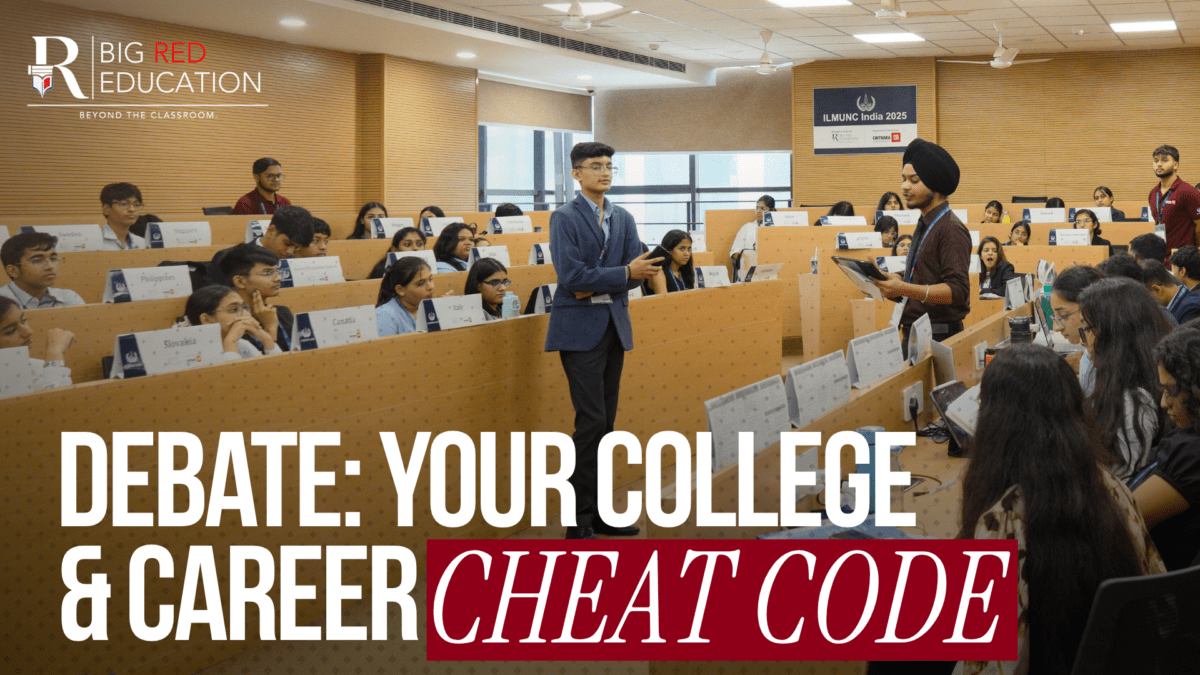
This article highlights the key reasons why participating in debate can significantly boost your academic journey and career prospects. It explores how debate programs enhance public speaking skills, critical thinking skills, and networking opportunities, all of which are valuable assets in the academic and professional world.

At Big Red Education, we have worked with students participating in international debate and MUN programs, helping them develop communication skills, leadership, and analytical skills that support both academic and personal growth. By addressing the most common questions regarding the benefits of debate for students, this post breaks down the cognitive, structural, and practical values that make finding your voice at the podium a major advantage.

Does Debate Look Good for College Applications? 

Admissions officers are flooded with identical transcripts and test scores. When evaluating extracurricular activities for college applications, universities look for a track record of critical engagement. Committing to a student debate program proves you have the intellectual stamina to handle the rigors of higher education, making debate for college admissions an incredibly powerful tool.

The Academic Proof: According to data from the National Speech & Debate Association (NSDA), the academic benefits are measurable: students who participate in debate are 17% more likely to graduate high school and 29% more likely to enroll in tertiary education.

Beyond Rote Memorization: Whether you are navigating competitive university cutoffs or drafting complex academic papers on state policy and fundamental rights, debate proves you can research deeply and articulate complex ideas under immense pressure. If you are wondering, does debate look good for college? the answer is a resounding yes.

The 3 M’s of Debate: Matter, Manner, and Method

To take a room by storm in any debate competition, you need to master the three core pillars of argumentation. Honing these debating skills will set you apart:

  1. Matter (The Content): This is the logic, evidence, and substance behind your claims. It is about taking daily observations—like the sociology of household dynamics or political science theories—and transforming them into air-tight, structured arguments.
  2. Manner (The Delivery): How you say something matters just as much as what you say. This encompasses your vocal modulation, eye contact, and the sheer, unshakeable confidence you project.
  3. Method (The Structure): This is the strategic flow and organization of your speech. Good debaters act as academic mentors for their audience, signposting their points so seamlessly that anyone can follow their train of thought.

“Debate isn’t just about winning an argument; it is about learning to view the world through multiple lenses and articulating your stance with absolute conviction.”

How Debate Improves Public Speaking Skills.

One of the most immediate benefits of joining a student debate program is the mastery of Public Speaking. While many students fear the podium, debate transforms that anxiety into confidence in public speaking.

Thinking on Your Feet: In a live debate, you cannot rely on a pre-written script. You must actively listen, process opposing arguments, and deliver sharp rebuttals on the spot. This ability to think quickly is essential for handling questions during presentations or defending a thesis.

Interview Preparation and Success: The communication skills built through debate translate directly into real-world success. When you learn to speak confidently and structure your thoughts under pressure, college interview success becomes much more attainable. Admissions officers and future employers alike value candidates who exhibit strong presentation skills and the ability to articulate their value clearly.

Does Debate Improve Intelligence and Critical Thinking?

Measurable Cognitive Growth: The cognitive agility you build through debate is scientifically proven. According to a study published in the Journal of Educational Psychology, researchers found significant improvements in critical thinking skills and analytical thinking among students who regularly participated in structured debate activities.

Accelerated Learning: Academic research further reveals that debate participants improve their reading scores by the equivalent of roughly two-thirds of a year of learning. This makes debate one of the most powerful educational tools available for developing advanced problem-solving skills.

Enhancing Emotional Intelligence: By constantly anticipating counter-arguments and being forced to understand opposing perspectives, debaters develop a profound sense of empathy alongside their analytical prowess.

Why is debate important for students?

Developing a Robust Worldview: Debate forces you to step outside your comfortable echo chamber. You learn to dissect societal issues and complex concepts from viewpoints you might not naturally agree with, a core component of student enrichment programs.

Scientifically Proven Teamwork: Research highlighted by frameworks like Harvard Project Zero emphasizes how collaborative learning environments build deep understanding. Working in teams on debate topics dramatically enhances students’ collaboration skills and their ability to genuinely understand diverse viewpoints.

Fostering Unshakeable Confidence: When you learn to hold your ground in a rapid-fire rebuttal, pitching a creative vision board to your peers or presenting a project to a room full of people becomes effortless second nature. These are the foundations of true leadership development.

Take Your Debate Skills Global Through ILMUNC India –

If debate has taught you to think critically, communicate persuasively, and defend ideas with confidence, the next step is applying those skills in real-world global discussions.

Join the Ivy League Model United Nations Conference (ILMUNC) India!

Brought to you by Big Red Education and organized by UPenn’s premier high school MUN conference resources, ILMUNC India 2.0 offers students the opportunity to move beyond classroom debates and engage in international diplomacy simulations led by mentors from top universities.

This isn’t just a mock debate—it is an immersive simulation where you will tackle the world’s most pressing challenges and collaborate with future leaders from across the globe. Whether you are looking to enhance your college admissions consulting profile, join elite summer programs, or participate in a world-class MUN conference, ILMUNC India is the ultimate platform.

You will connect with top-tier mentors, engage in intense multilateral negotiations, and walk away with real-world diplomacy skills, collaboration, and leadership traits that don’t just look good on a report card, but actually work in the real world. No memorization marathons here; you are in the driver’s seat.

Apply for ILMUNC 2026 Here

Editor's Pick

NYAC | 3min Read

The Echo of Our Choices

Published on May 26, 2026

FacebookTwitterWhatsApp
Categories
NYAC

The Echo of Our Choices

The Echo of Our Choices

‘It is our choices, far more than our abilities, that show who we truly are’- Albus Dumbledore, ‘Harry Potter and the Chamber of Secrets’. Countless times in life, we encounter people who may be very intelligent, very talented. However, sometimes no matter how talented they are, you just can’t seem to like them because of certain choices they made. Choices are an important part of life that determine what kind of person you are.

Indeed it has been proven time and again in history, and continues to be proven even today.

What better way than to prove it with examples?

One of the prominent figures from history that proves this quote is Hitler: the cruel, ruthless politician who was responsible for instigating World War II. Under him, Nazi Germany committed mass murder on an unparalleled level. The Jews were killed in several locations using several methods. It was a holocaust. It may be hard to believe, but Hitler had good intentions. He was a determined and encouraging individual. His ideologies caused him to put the whole world into a state of devastation while being under the misconception that he was making his nation better. Hitler had the ability to reshape the world in a positive way. He had the ability to paint well. However, it was his rapacious choice to dictate the whole nation- rather the whole world- into a frenzy. Despite his extraordinary abilities, to us, he is no more than a vile dictator.

Another notable figure, who further proves the quote is Socrates: “the founder of western philosophies”. Socrates had never been politically sound, nor did he have any military experience. In his time, such skills were conventional, and his disinterest caused his unpopularity and eventual condemnation. He lacked ability. Yet, just the mention of his name rings a bell today. Despite the absence of capability in times that valued everything but what

Socrates stood for, he managed to make his mark in history; a positive one too. Socrates chose to question the unjust authorities. It was his choice to dedicate his life towards knowledge and virtue. Despite the paucity of ability, to us, Socrates is a figure to look up to. He is a philosopher. Choices define what you do. Choices define how you do something. But most importantly, choices define YOU. Of course, ability is a vital aspect of who you are too; but it is worthy to note that it isn’t the ONLY aspect. Everyone has an ability. You could be born with it, or you could develop one over time. What is important is how you choose to use these abilities: whether you do it for the greater good, or you end up being the root of all evil. To conclude, I would like to say that good choices are made by good people. Yet, one bad choice doesn’t make someone evil; it makes them human. At the end of the day, what you do will always be more memorable than what you can do.

Editor's Pick

NYAC | 3min Read

Memory Loss

Published on

FacebookTwitterWhatsApp
Categories
NYAC

Memory Loss

Memory Loss

On March 27th, when I was driving home after work, I saw something strange; a man, looking like he was in his mid-20s, was being dragged into a van in front a house, and moreover, that man seemed sweaty and extremely pale. The men dragging him were wearing gloves and masks, I observed them silently. I felt dubious about the situation.

As I had memory loss I quickly noted all the details I could get in a notebook.

On March 28th, I made most of the moment and reported to the local station. The officer enquired me and I told him all about yesterday. The man however, seemed a bit distressed, so I kept my notebook to myself. “You are young, so why don’t you take my advise and take a not my monkey not my circus approach?”The officer asked in a pity. But that means he is hiding something, so, I gave him a submissive look as he expects me to, “Then I shall stay out of it. Then if I must.” i said as I stood up to leave.

On March 30th, I went back to Blue street, where the incident happened three days ago. I went and enquired every house in the street, asking them about it, but nobody showed any sign of knowledge about it, until I went to the last house in the street with no hopes. I went inside and asked him about that particular house. He didn’t wait a moment before asking, “What do you know?” He knew that there was something off with that place, so I told him everything that I knew. Dr. Vihaan, told me about his knowledge, “That man Aarvik, was infected with ’rabersiminon’. It’s caused by a plant that was believed to be extinct but it wasn’t.

Somebody got their hands on that plant and they’re dropping the poisonous plant in the water supply and unfortunately, rabersiminon doesn’t have a cure and it’s communicable.” I didn’t know how to reply, he also said that if one were ever infected with this, their mind will no longer be their own and that it’s better to kill themselves cause death will come when it’s time till then the person will suffer.

I gave him my notebook and told him that we will meet up tomorrow as I have to get home before it’s late. I believed him even though he felt strange, he didn’t have shadow.

On March 31st, I went to Dr. Vihaan’s house as I had said. “How about we inform the public?” I asked, in a way of greeting. “No” he said, ”I’ve tried, that’s why they think I’m crazy. We’ll have to do this the hard way – find the bad guys and stop them.

From what you’ve written in your notebook, Rua, I think that they’ve taken Aarvik to the locked down hospital, down the street.” “Why would they do it?” I asked. “Instead of preventing the infection, they’re trying to find the cure for rabersiminon. It’d be painful for the patient” He said. This isn’t what I expected. “Let’s get him out of there, then.” I said. “Yes, but you must remain in the car while I go get him and if I don’t come back within thirty minutes, you have to go back.” He said. I didn’t object because it’d be pointless anyway. We took precautions so the virus doesn’t spread and then left.

We executed the mission as planned. Barely fifteen minutes passed before I saw Dr. Vihaan again. He rushed into the car and asked me to drive away immediately. He seemed to be petrified by fear. “Aarvik isn’t the only one there, he’s dead.” He said.

April 2nd, “Rua is in the active phase of schizophrenia, it’s the active stage where the person hallucinate, it’s dangerous she might hurt herself.” I hear my doctor say.

I’m again at the hospital.

Editor's Pick