blog Higher Education Innovation | 6min Read

Practicality or Passion? Top Seven Professions of the 21st Century

Published on August 4, 2021

FacebookTwitterWhatsApp
Categories
blog Higher Education Innovation

Practicality or Passion? Top Seven Professions of the 21st Century

Tug Of War

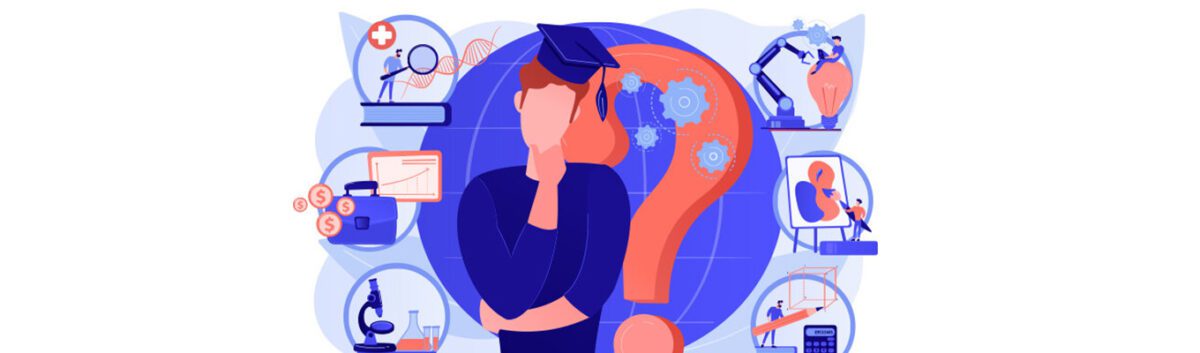
What do you want to be when you grow up? This is often an anxiety-inducing dilemma for all teenagers. It can be overwhelming to try to make such a decision when it feels like your life is up in the air and the only thing that feels certain is uncertainty. In the modern-day and age, this question gets even harder to answer as innumerable factors weigh in – some high schoolers value job satisfaction overpay and get stressed out when they struggle to find a career path that suits them. Others hold wage factors in higher regard and don’t care much if they get incredibly bored working 9 to 5. Others can fall victim to parental pressure, unable to pursue their true passion. There are countless scenarios where students struggle to decide, finding themselves stuck in a tug of war, wondering which to choose, practicality or passion?

The Promise Of Practicality

In the 21st Century, the way we work and the number of career choices have changed substantially. For most non-manual professions, being highly literate in technology, business and creativity is a necessity. New generations are continuously coming up with ingenious and inventive job prospects and carving their own paths in this new world. Radical changes in globalization, technology, and competition in the marketplace as well as shifts in societal conditions have altered our speculations for the future. Experts continue devising new scenarios about working in the 21st century and the careers that will be highest in demand. Currently, these include:

1. Nanotechnologists

For many years now, our gadgets have been getting smaller and smaller which has caused an increase in the demand for nanotechnologists. These are people who can manipulate matter at a molecular level, and as miniaturization and portability for our gadgets increases, so will the demand for this job. Those who wish to study <a href=”https://en.wikipedia.org/wiki/Nanotechnology”>nanotechnology</a> should opt to study organic chemistry, molecular biology, and microfabrication.

2. Stem Cell Research:

For many years now, our gadgets have been getting smaller and smaller which has caused an increase in the demand for nanotechnologists. These are people who can manipulate matter at a molecular level, and as miniaturization and portability for our gadgets increases, so will the demand for this job. Those who wish to study nanotechnology should opt to study organic chemistry, molecular biology, and microfabrication.

3. Business Developers

These workers pursue strategic opportunities for businesses by, for example, cultivating partnerships or other commercial relations. It is one of the most sought-after jobs for fresh graduates and has many sub-areas to work within. To get hired as a business developer an individual must possess good analytical, negotiation, creative, and communication skills.

4. Robotic Experts

Individuals in these careers will be sought after in the coming years due to increased automation outside of factories and production facilities. These developers and specialists will have a special responsibility as artificial intelligence and automation continues to grow.

5. Genetic Programmers

Another profession in the scientific field that is speculated to increase in demand is genetic programming. As a genetic programmer, you will work on the development of medication that suits the individual genetic code of the patients to achieve the best possible treatments for diseases such as cancer or Alzheimer’s. Health and medicine, in general, will remain hot topics, so seeking a career in them instead of genetic programming will also result in high pay.

6. Urban Farming

Even though manual jobs, specifically in the agricultural sector are fading, inhabitants of large cities will have to be increasingly provided for by urban farmers. Jobs in this area will require agricultural and technical knowledge and many sub-areas involving R&D, automation, etc. may open up under it.

7. Data Scientists

This unusual profession shocked many when it originally came to be, but now its demand is expected to increase in the coming decades. Data scientists are big data wranglers who gather and analyze large sets of structured and unstructured data. Their role combines mathematics, computer science, and statistics.

8. Software engineers

The demand for software engineers has been growing with technological development. It will most probably grow more as the need for never-before-seen solutions increases. Along with mathematical skills, to be a software engineer you need to be creative and be able to make new, innovative software systems.

9. Healthcare Workers

The demand for nurses and care workers is predicted to grow as the work hours of physicians decrease and the population grows. These jobs have many opportunities to grow and succeed and are perfect for someone interested in healthcare.

10. Artificial Intelligence Practitioners

AI promises to deliver some of the most cutting-edge breakthroughs and innovations of this century. With an upcoming AI revolution, there are limitless opportunities for those who want to go into this field.

The Heart Wants What It Wants

Of course, working in the highest-paid professions is tempting. But what if you just don’t want to? What if you know that the benefits of entrepreneurship are far better than pursuing something you’re not interested in? Teenagers struggle to decide what to do, especially at such a young age but should you really settle for something that you don’t love doing just for money? Or just to make your parents proud? Taking the more creative path is riskier, and will probably result in uncles and aunties judging you, but if it may ultimately result in contentment – is it worth it? 

The answer may be affected by many external factors, but following your heart can rarely ever prove to be detrimental. Rather than being average at a job you dislike, but get paid a lot of money to do, it may very well be better to get paid less but be much happier. In your one life, it should be your choice and your will that guides you, not the opinions of others. Even if you possibly end up disliking what you once thought was your passion, that is perfectly fine. In fact, it’s needed because knowing is always better than wondering.

So, to know, to experience, to be satisfied and happy, listening to your heart instead of your head may be what’s best for you. 

Passion and Practicality can go hand in hand, but even if they don’t, your choice matters most. Deciding what you want to do based on your situation is completely up to high schoolers or even adults as it’s never too late to switch sides.

Big Red Education and our Ivy Early Entrepreneur Program

In our entrepreneurial workshop – Ivy Early Entrepreneur, students go through the process of business development and leave the entrepreneur program having completed a business model canvas, competitive analysis, financial model, minimum viable product, and a pitch deck.

Students get an opportunity to learn from successful entrepreneurs who are alumni of reputed universities and are experts in their respective industries.

These experts serve as coaches guiding students through the processes of developing a business concept. Risk-Taking, Decision Making, Critical Thinking, Problem Solving, Communication &

Storytelling, Design Thinking & Innovation, and Opportunity Recognition are a few of the key learning areas of our program.

On successfully completing the entrepreneur workshop, the guaranteed internship will be extended to all the students within our partner firms and with most of the mentors teaching the program. Students will be provided with a certificate of participation by Big Red Education. This certificate can be used for your college portfolio.

Ivy Early Entrepreneur

11th – 17th Jan 2022

Idea Generation | Market Research | Design Thinking | Pitching

Editor's Pick

blog Higher Education | 3min Read

3 Ways Of Going About Your Career

Published on January 20, 2021

FacebookTwitterWhatsApp
Categories
blog Higher Education

3 Ways Of Going About Your Career

Just like a coin, a dice, or any other multifaceted thing in the world, there’s never only one way to go about doing things. Conventionally? Yes. However, realistically? No. Similarly, there are numerous ways to go about making your career. We like to assume that most of them have been discovered, but in today’s ever-changing times, we shouldn’t be surprised if a new, never-before trodden career path emerges because of some kid who believed in their abilities.

We dug into this matter further and discovered 3 profound ways of embarking upon your career.

1. Bolting

The people who sprint through their careers are usually characterized as being ready, willing, and able. Such students start early. They select a degree and stick with it, allowing them to learn and advance through internships that look more and more impressive each year. Some people have the dream job waiting for them after graduation; others with eagle-like excellent long-distance vision concentrate and move from one job to the other, up the career ladder. They have little to no student loans, which helps them in choosing jobs without regard to pay. But pace is not the only defining characteristic of this group. Some are unrushed but methodical, putting together the building blocks for a promising career by investing in personal capital, possibly in graduate or vocational schools, before the job market is hit.

2. Strolling

These are students that are unsure and pursue an uncertain path. Usually, this involves lesser planning or a sudden lack of interest in their previously chosen profession. In today’s world when the master’s or postgraduate degree has become the new bachelor’s degree, it has become even harder to plan and select one major that would enhance our capabilities for the job market post-graduation. Even after that, about 30 percent of college graduates are back in school within two years. Graduate school offers structure and guidance. These students usually have a blurred idea of what they want to do with their lives, and more often than not do not consider a gap year as a practical option to discover their interests or explore majors in different ways due to the conservative thinking of their parents. However, after much pondering and understanding, they too find their perfect fit for a career.

3. Drifting

Many stragglers struggle after high school to find viable career choices. They either choose to stay home and get work or enter the family business if that’s an option. They might hop, skip and jump from one career path to another. However, a longer life expectancy for today’s children means that we could define new paths to adulthood in various ways. We should no longer think of college as a place in our lives that must be visited at 18 years of age. Nevertheless, educators and advisers keep pushing families on a one-size-fits-all route. It is nearly inconceivable to think differently on when a college education should take place as a parent in our hyper-competitive society — the result is that it has become more difficult than ever to forge a path to a satisfying career and a meaningful life. We may also argue that the pathway is more gradual and varied than it was a few decades ago. Traditional milestones like marriage and parental ties are now not the beginning, but the end of adulthood.

No career journey is inferior or superior to the other, it might only take a little longer or quicker in terms of pace and age before you get there. And as long as you have faith in yourself, you will harness the abilities and skills needed to develop a unique and shining career that is tailored to your liking like none other.

Furthermore, the issue is that colleges have sought to improve the predictability for a four-year experience by incorporating substantial guidance and related programs so that basically everything is done to ensure that students graduate and then secure a job. However, this also discourages students from gaining the strength they need to handle risks as adults and excel in an unforeseen profession. There are also career counselling programs for students that are curated to help you identify the right career for you.

Do Entrepreneurship interest you? To pursue their dreams of becoming an Entrepreneur, you can learn leadership skills and join an entrepreneur program to build an empire in your teenage or continue to chase your passion.

Editor's Pick

blog Higher Education | 3min Read

How The Pandemic Can Boost Your College Applications!

Published on January 4, 2021

FacebookTwitterWhatsApp
Categories
blog Higher Education

How The Pandemic Can Boost Your College Applications!

It is safe to mention that the pandemic has undoubtedly reshaped the manner in which colleges look at the application process. However, in instances like this, it is natural to overlook the benefits this situation has brought to us. Having to juggle Senior school classes alongside a very vigorous college application process places an inconceivable weight on young shoulders.

Furthermore, this could naturally be demotivating for a lot of graduating students who had been preparing for university in advance and are now having to face unprecedented challenges.

The good news: “Faculties are going to be far more flexible this year,” says Todd Rinehart, president of the National Association for College Admissions Counseling.

Here are a few pointers that will help you use this last-minute ‘extrade of rules’ to your advantage.

1. Most Indian Universities Have A Merit-Based Admissions Criteria

In the race of bagging accolades to their name so as to qualify for certain colleges that require a high standing in these non-academic features along with high grades on a student’s application, a primary factor that numerous college students lose track of is if you’re aiming to get into an Indian University, you aren’t required to provide your extracurricular activities (ECA) certificates at the time of your admission. This fact should be taken into account, provided that a big number of students who had initially been intending to study overseas are opting to stay in India for their undergraduate studies.

2. Most Universities Have Become SAT-Optional Or SAT-Blind

Not too long ago, the College Board, conductor of the Scholastic Aptitude Test, announced that keeping the pandemic in mind, the universities would most likely not give the same weight it did to the aptitude tests, earlier. They have asked colleges to extend score deadlines for early action and early decision to take some pressure off students and give them more time to test and send their scores. Additionally, they’ve requested colleges to recognize that students who do submit scores might not have been able to test more than once. (e.g., taking into account that students who tested as high school juniors but who could not as seniors would have likely achieved score gains). Additionally, The University of California and several other universities formally declared their admission process to be SAT blind, i.e. applications containing SAT scores would no longer be favored.

3. More Number Of Opportunities Online

When seeking to boost our university applications, we generally tend to search for any and every volunteering, internship, and/or conference opportunity to participate in. Luckily, this pandemic has taken all of these activities and much more online! Reputed organizations are starting to arrange and conduct their conferences, seminars, and debates virtually, thereby giving us the upper hand through having the ability to participate in more activities than we might otherwise have in an offline environment. The price and inconvenience of moving to another city or country has been absolutely wiped out and you can still get a legitimate certificate sent to your doorstep.

4. There Is No Better Time To Explain A Gap Year!

Earlier, Gap years used to be a hush-hush topic, almost a taboo, amongst graduating students. However, this year has seen more students deciding to take a gap year than any other before. Be it your mental health, indecision regarding your field of higher studies, financial difficulties, or just an urge to take a break — this year has got your back! Your reasons for taking a gap year, the projects you undertook and how you learnt through the process is not only going to be easier to work out but also more legitimate and generally accepted on your college application now than it used to be.

Several important factors like colleges’ refusal to reduce tuition fees even though education has transitioned onto the online platform, constant and spontaneous travel bans, and the uncertainty of health at this time have put parents under pressure as well. Sending off their loved ones in these distressing times can be extremely difficult. Taking a step back to reflect on some of these points could help ease that stress! Remember, no application is more important than you are.

Editor's Pick