blog Higher Education MUN Trending | 7min Read

What Is Model United Nations (MUN)? A Beginner’s Guide to Leadership, Diplomacy, and College Success

Published on June 11, 2026

FacebookTwitterWhatsApp
Categories
blog Higher Education MUN Trending

What Is Model United Nations (MUN)? A Beginner’s Guide to Leadership, Diplomacy, and College Success

What Is Model United Nations (MUN)? A Beginner’s Guide to Leadership, Diplomacy, and College Success


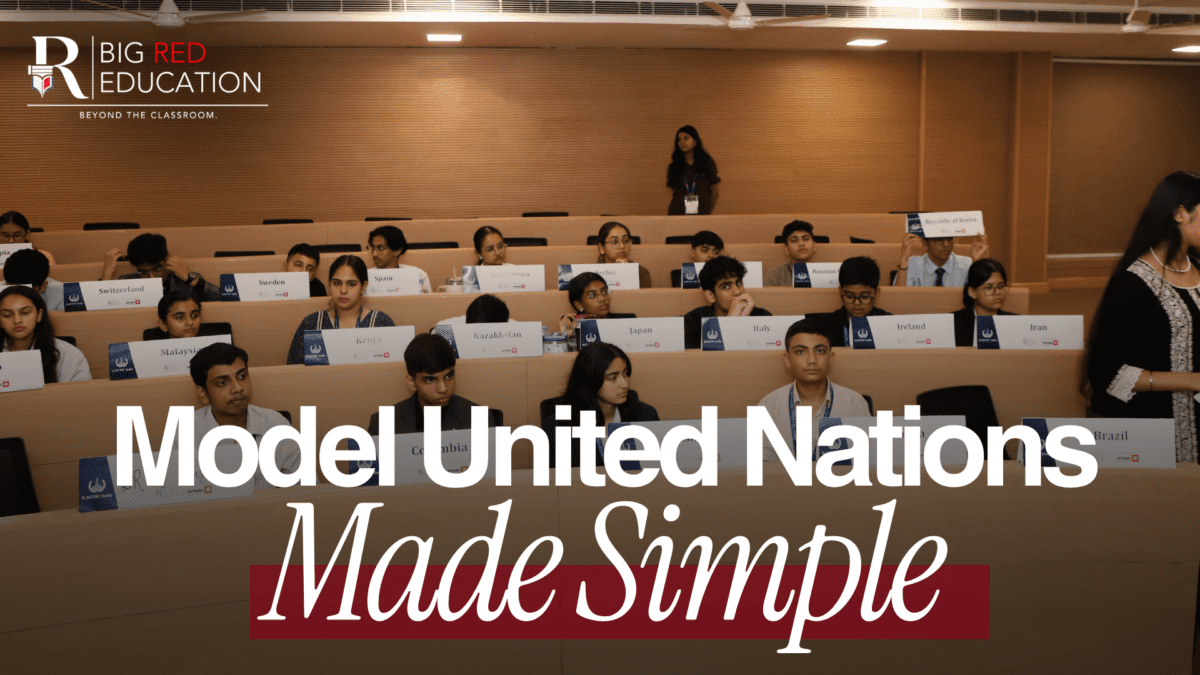
Picture this: you’re 16, standing at a podium in a conference hall, representing the Republic of France in a debate on global climate policy. Delegates from 30 other “countries” are listening. You have three minutes to make your case, hold your ground, and maybe even change a few minds.

No, this isn’t a scene from a political thriller. This is a regular Saturday for thousands of high school students who do Model United Nations and honestly? It might just be the most underrated skill-builder available to students today.


So, What Exactly Is MUN?


Model United Nations or MUN is an educational simulation of the United Nations. Students take on the roles of delegates representing different countries and debate real-world issues: climate change, nuclear disarmament, refugee crises, global health emergencies, you name it.

Think of it as part debate, part diplomacy, part theatre except the issues you’re arguing about are very, very real.

Each MUN conference is organised around committees, which mirror actual UN bodies like the Security Council, the General Assembly, or the Human Rights Council. Delegates research their assigned country’s position, write policy papers called “position papers,” debate with other delegates, and ultimately work toward drafting and passing resolutions.

It sounds formal. In practice, it’s equal parts exhilarating and nerve-wracking and students consistently describe it as one of the experiences that changed how they think.


What Skills Does MUN Actually Build?


MUN has a reputation for being “great for college applications.” That’s true, but it’s almost selling it short. The skills MUN develops are things you’ll use for the rest of your life in college interviews, in boardrooms, in any situation where you need to think fast, speak clearly, and work with people who disagree with you.

Public Speaking and Persuasion – There’s no substitute for actually standing up and speaking in front of a room full of your peers. MUN forces you to do it repeatedly, under pressure, on topics you’ve had to deeply research. Most MUN veterans say their fear of public speaking essentially disappears after their first few conferences.

Research and Critical Thinking – To represent a country well, you have to understand its foreign policy, its alliances, its economic interests, and its history. That kind of research teaches you to think in systems to understand that every policy has a context, and every position has a reason behind it.

Negotiation and Diplomacy – Here’s the part most people don’t expect: MUN is as much about the hallway conversations as it is about the podium speeches. The real work happens when you’re trying to convince three other delegates to co-sponsor your resolution, or when you’re negotiating a compromise between two completely opposing blocs. These are negotiation skills that MBA students pay a lot of money to learn.

Writing and Structured Argumentation – Position papers, draft resolutions, amendments, MUN involves a surprising amount of writing, and it’s writing with a specific purpose: to persuade, to structure arguments, to build consensus. It sharpens how you think on paper in ways that directly translate to essay writing and college applications.

Cross-Cultural Awareness – When you spend a weekend arguing a position from the perspective of a country that isn’t yours, defending its interests, understanding its constraints- something shifts in how you see the world. MUN alumni consistently describe it as one of the first times they genuinely tried to understand a viewpoint very different from their own.


How Does a MUN Conference Actually Work?


Most MUN conferences run over two to three days. Here’s a rough sense of how it unfolds:

Before the conference: You receive your country assignment and committee topic weeks in advance. You research, write your position paper, and prepare your opening speech.

Opening ceremonies: Large conferences often begin with a formal opening session speeches, rules of procedure, committee assignments.

Committee sessions: This is where the bulk of the conference happens. Delegates make speeches, raise points of information, form blocs, draft working papers, and debate amendments. The committee chair (called a “dais”) manages the procedure.

Informal lobbying: Between formal sessions, delegates negotiate in the corridors, building alliances, merging draft resolutions, making deals. This is often where the most interesting action happens.

Voting: At the end, committees vote on final resolutions. Delegates can abstain, vote yes, or vote no, consistent with their country’s position.

Awards: Most conferences give out awards – Best Delegate, Outstanding Delegate, Honorable Mention recognising delegates who showed exceptional diplomacy, research, and speaking skills.


MUN and College Admissions: What Admissions Officers Actually See


Let’s be direct about this, because it matters.

College admissions officers, especially at selective universities in the US and UK aren’t just looking at grades and test scores. They’re looking for evidence of intellectual curiosity, leadership, and the ability to engage with complexity. MUN, done well, ticks all three boxes.

But here’s the nuance: the students who stand out in their applications aren’t the ones who just “participated in MUN.” They’re the ones who can speak to what they learned, how their thinking evolved, and what they did with that experience. A student who went from nervous first-timer to committee chair, or who wrote a compelling essay about the moment they had to argue a position they personally disagreed with- that’s a story admissions readers remember.

MUN is also one of the few extracurriculars where the quality of the conference itself can matter. Participating in a nationally recognised or university-affiliated conference signals a level of seriousness and preparation that carries weight.

That’s why some students, particularly those aiming for top universities intentionally seek out higher-calibre MUN experiences. Conferences affiliated with Ivy League universities, for instance, tend to attract more competitive delegates, more rigorous committee work, and a level of intellectual challenge that genuinely prepares students for what university-level discourse feels like. The Ivy League Model United Nations Conference (ILMUNC), organised by the University of Pennsylvania students, has been brought to India by Big Red Education giving students access to that kind of experience without having to travel to the US.

The real advantage: Colleges don’t just look for the activity, they look for the story. Someone who started as a nervous first-timer, worked their way to Best Delegate, and then organised their own conference isn’t just listing an extracurricular. That’s a character arc.


Is MUN Right for You?


“I’m shy and hate public speaking.” This is actually the most common profile of a student who ends up loving MUN. The structure of MUN where you have a role, a script, a position makes it easier to speak than open-ended conversation. Most students who start terrified of the podium become some of the most confident speakers in their school within a year.

“I don’t know anything about global politics.” Perfect. that’s the point. You learn as you go. The research process is built into the experience. Most first-time delegates are surprised by how quickly they absorb geopolitical context when they have a reason (a speech, a debate) to understand it.

“My school doesn’t have a MUN club.” Start one. Seriously. The initiative of founding a MUN club at your school is, on its own, a significant leadership story and it makes every conference you subsequently attend mean more.

“Is it just for students who want to go into law or politics?” Not at all. The skills MUN develops- structured argumentation, negotiation, research, public communication are directly applicable in business, medicine, engineering, journalism, and virtually every field where you need to work with other people and make a case for your ideas.


How to Get Started


If you’re new to MUN, here’s a practical path forward:

  1. Find a conference near you. Most cities in India now have active MUN circuits; school-hosted conferences are a great entry point. Look for ones with beginner-friendly committees.
  2. Do your prep seriously. The delegates who get the most out of MUN are the ones who actually research their country. Even two or three hours of focused reading can transform your experience.
  3. Attend more than once. Your first conference will feel chaotic. Your second will feel like you’re starting to understand the game. Your third is when it starts to get genuinely exciting.
  4. Aim higher over time. As you gain experience, look for larger, more competitive conferences including those affiliated with universities. The challenge level matters.
  5. Reflect on what you learn. Keep notes. Think about what changed in how you see an issue, how you argued, how you negotiated. These reflections are what turn MUN participation into something you can actually articulate in a college essay or interview.

The Bottom Line

MUN is one of those activities that sounds impressive on a CV but is actually impressive in practice. It’s a place where curious, driven students learn to hold their own in a room, argue a case under pressure, listen carefully to the other side, and find common ground where it seemed impossible.

If you’re a student who wants to build real-world skills, not just tick boxes- MUN is worth your time.

And if you’re ready to take it seriously, the quality of the experience you choose matters. Seek out conferences that challenge you. Find ones that connect you with students and mentors who push your thinking. The more you put in, the more the room starts to feel like yours.


Editor's Pick

blog Communication Higher Education Leadership MUN Productivity summer | 5min Read

Beyond Grades: 5 Skills Ivy League Admissions Officers Value

Published on June 4, 2026

FacebookTwitterWhatsApp
Categories
blog Communication Higher Education Leadership MUN Productivity summer

Beyond Grades: 5 Skills Ivy League Admissions Officers Value


Beyond Grades: 5 Skills Ivy League Admissions Officers Value


Many students assume Ivy League admissions depend primarily on grades and standardised test scores. While academic performance remains important, top universities evaluate applicants holistically looking for leadership, intellectual curiosity, communication skills, resilience, and meaningful impact beyond the classroom. A 98 percentile score won’t get you in alone. Neither will a trophy shelf. What Ivy League admissions officers are really searching for- and what most students never think to build- are the five skills below. The good news? Every single one can be developed, starting now.


THE MYTH WORTH BUSTING FIRST

Most students and most parents believe that the path to a top university runs straight through grades and test scores. It doesn’t. Ivy League acceptance rates hover below 5%. At that level, nearly every applicant has stellar academics. What separates the ones who get in isn’t the GPA it’s who they are beyond it.


01. Leadership – and not the title kind

Every application has a “Head Boy” or “Club President.” Admissions officers have seen thousands of them. What they’re actually hunting for is something harder to fake: evidence that a student influenced people, changed something, or moved a group toward a goal- with or without an official title.

The student who noticed a gap in their school and did something about it. The one who organised a tutoring initiative for younger students, led a sustainability project, coordinated a community fundraiser because it needed to be done, or worked with peers to develop solutions to real-world challenges through experiences such as the Leadership & Social Innovation Conference. Leadership, in the Ivy League sense, is about impact, not position. If your leadership story starts with “I was elected,” it might be worth finding a deeper one.

Ask yourself: Have I ever changed the way a group of people thought or acted? That moment – however small – is your leadership story.

 alone.


02. Intellectual curiosity that goes off-syllabus

Top universities aren’t just looking for students who ace exams- they’re looking for students who would stay curious if exams didn’t exist. The applicant who read a paper that wasn’t assigned. Who pursued an independent research project or passion project just because it fascinated them. Who asked “why does this work this way?” instead of “what do I need to memorise?”

This quality, genuine intellectual hunger- shows up in essays, interviews, and the specificity of a student’s interests. It often develops when students explore ideas beyond the classroom, whether through independent projects, research, or experiences that expose them to emerging fields. 

Students who engage with topics such as Generative AI, technology ethics, and future-focused innovation through programs like Command Z often find themselves asking deeper questions and developing interests that extend well beyond the syllabus.

The tell: Can you talk for five minutes about something you learned recently that has nothing to do with your coursework? If not, that’s the gap to close.


03. The ability to communicate – not just correctly, but compellingly

Every student who applies to an Ivy League school can write a grammatically correct essay. Very few can write one that a tired admissions officer reads to the end and remembers the next day. The same goes for interviews and presentations.

Communication at the level these schools expect is not about being articulate, it’s about being specific, honest and human. It’s about having a point of view and expressing it with conviction.

Students who have debated, written creatively, presented research or participated in public speaking programs and Model United Nations conferences such as Ivy League MUN Conference 2.0 carry a visible edge in the application process

The test: Read your personal statement out loud. If it sounds like anyone could have written it, rewrite it until it sounds unmistakably like you.


04. A genuine commitment to something beyond yourself

Admissions officers can spot a résumé-padding volunteer experience from a mile away: the one-week trip, the charity drive that conveniently started in Grade 11, the activity that perfectly mirrors what the student thought the school wanted to see. 

What they actually respond to is depth over breadth- a student who cared about something real, demonstrated sustained impact over time, and can speak about it with genuine conviction.It doesn’t have to be saving the world. It could be tutoring kids in your neighbourhood for three years. It could be running a community initiative that started small and grew. The through-line is authenticity: you did it because it mattered, not because it looked good.

Depth check: How long have you been doing your most meaningful extracurricular? If the answer is less than a year, it’s time to build something you’ll actually stick with.


05. Resilience- the capacity to fail and keep going

This is the one most students never think to demonstrate- and the one admissions officers often find most telling. University is hard. The students who thrive are the ones who’ve already learned, in some meaningful way, how to handle setbacks. Not the ones who’ve never failed, but the ones who’ve failed, sat with it, and figured out what to do next.

A student who can write honestly about a challenge, a loss, a mistake- and what it taught them shows a kind of maturity that a perfect transcript never can. Top schools want people who will contribute to their campus community for four years. That requires more than intelligence. It requires character.

Worth reflecting on: What’s the hardest thing you’ve faced in the last two years? How did you respond? That’s potentially your most powerful application story.


Final Conclusion:

The students who get into the world’s best universities aren’t superhuman. They’re not necessarily smarter than everyone else in the applicant pool. What they have almost without exception- is a clear sense of who they are, what they’ve built and why it matters. That clarity doesn’t come from cramming. It comes from years of doing things that matter, reflecting on them honestly and learning to talk about them with conviction. Start now, and September of your application year will look very different.


What Parents Should Know About Ivy League Admissions

Many parents focus heavily on grades and test scores, but top universities increasingly seek students who demonstrate initiative, leadership, curiosity and meaningful engagement outside the classroom. Understanding this shift early and actively creating opportunities for your child to build these qualities makes a measurable difference by the time applications are due.


The students who get into the world’s best universities aren’t superhuman. They’re not necessarily smarter than everyone else in the applicant pool. What they have almost without exception- is a clear sense of who they are, what they’ve built, and why it matters. That clarity doesn’t come from cramming. It comes from years of doing things that matter, reflecting on them honestly and learning to talk about them with conviction. Start now, and September of your application year will look very different.


Editor's Pick

blog Entrepreneurship Higher Education Internship Leadership MUN Productivity Research Uncategorized | 5min Read

Why Debate Is Your Ultimate College & Career Cheat Code.

Published on June 3, 2026

FacebookTwitterWhatsApp
Categories
blog Entrepreneurship Higher Education Internship Leadership MUN Productivity Research Uncategorized

Why Debate Is Your Ultimate College & Career Cheat Code.

Why Debate Is Your Ultimate College & Career Cheat Code.

This article highlights the key reasons why participating in debate can significantly boost your academic journey and career prospects. It explores how debate programs enhance public speaking skills, critical thinking skills, and networking opportunities, all of which are valuable assets in the academic and professional world.

At Big Red Education, we have worked with students participating in international debate and MUN programs, helping them develop communication skills, leadership, and analytical skills that support both academic and personal growth. By addressing the most common questions regarding the benefits of debate for students, this post breaks down the cognitive, structural, and practical values that make finding your voice at the podium a major advantage.

Does Debate Look Good for College Applications? 

Admissions officers are flooded with identical transcripts and test scores. When evaluating extracurricular activities for college applications, universities look for a track record of critical engagement. Committing to a student debate program proves you have the intellectual stamina to handle the rigors of higher education, making debate for college admissions an incredibly powerful tool.

The Academic Proof: According to data from the National Speech & Debate Association (NSDA), the academic benefits are measurable: students who participate in debate are 17% more likely to graduate high school and 29% more likely to enroll in tertiary education.

Beyond Rote Memorization: Whether you are navigating competitive university cutoffs or drafting complex academic papers on state policy and fundamental rights, debate proves you can research deeply and articulate complex ideas under immense pressure. If you are wondering, does debate look good for college? the answer is a resounding yes.

The 3 M’s of Debate: Matter, Manner, and Method

To take a room by storm in any debate competition, you need to master the three core pillars of argumentation. Honing these debating skills will set you apart:

  1. Matter (The Content): This is the logic, evidence, and substance behind your claims. It is about taking daily observations—like the sociology of household dynamics or political science theories—and transforming them into air-tight, structured arguments.
  2. Manner (The Delivery): How you say something matters just as much as what you say. This encompasses your vocal modulation, eye contact, and the sheer, unshakeable confidence you project.
  3. Method (The Structure): This is the strategic flow and organization of your speech. Good debaters act as academic mentors for their audience, signposting their points so seamlessly that anyone can follow their train of thought.

“Debate isn’t just about winning an argument; it is about learning to view the world through multiple lenses and articulating your stance with absolute conviction.”

How Debate Improves Public Speaking Skills.

One of the most immediate benefits of joining a student debate program is the mastery of Public Speaking. While many students fear the podium, debate transforms that anxiety into confidence in public speaking.

Thinking on Your Feet: In a live debate, you cannot rely on a pre-written script. You must actively listen, process opposing arguments, and deliver sharp rebuttals on the spot. This ability to think quickly is essential for handling questions during presentations or defending a thesis.

Interview Preparation and Success: The communication skills built through debate translate directly into real-world success. When you learn to speak confidently and structure your thoughts under pressure, college interview success becomes much more attainable. Admissions officers and future employers alike value candidates who exhibit strong presentation skills and the ability to articulate their value clearly.

Does Debate Improve Intelligence and Critical Thinking?

Measurable Cognitive Growth: The cognitive agility you build through debate is scientifically proven. According to a study published in the Journal of Educational Psychology, researchers found significant improvements in critical thinking skills and analytical thinking among students who regularly participated in structured debate activities.

Accelerated Learning: Academic research further reveals that debate participants improve their reading scores by the equivalent of roughly two-thirds of a year of learning. This makes debate one of the most powerful educational tools available for developing advanced problem-solving skills.

Enhancing Emotional Intelligence: By constantly anticipating counter-arguments and being forced to understand opposing perspectives, debaters develop a profound sense of empathy alongside their analytical prowess.

Why is debate important for students?

Developing a Robust Worldview: Debate forces you to step outside your comfortable echo chamber. You learn to dissect societal issues and complex concepts from viewpoints you might not naturally agree with, a core component of student enrichment programs.

Scientifically Proven Teamwork: Research highlighted by frameworks like Harvard Project Zero emphasizes how collaborative learning environments build deep understanding. Working in teams on debate topics dramatically enhances students’ collaboration skills and their ability to genuinely understand diverse viewpoints.

Fostering Unshakeable Confidence: When you learn to hold your ground in a rapid-fire rebuttal, pitching a creative vision board to your peers or presenting a project to a room full of people becomes effortless second nature. These are the foundations of true leadership development.

Take Your Debate Skills Global Through ILMUNC India –

If debate has taught you to think critically, communicate persuasively, and defend ideas with confidence, the next step is applying those skills in real-world global discussions.

Join the Ivy League Model United Nations Conference (ILMUNC) India!

Brought to you by Big Red Education and organized by UPenn’s premier high school MUN conference resources, ILMUNC India 2.0 offers students the opportunity to move beyond classroom debates and engage in international diplomacy simulations led by mentors from top universities.

This isn’t just a mock debate—it is an immersive simulation where you will tackle the world’s most pressing challenges and collaborate with future leaders from across the globe. Whether you are looking to enhance your college admissions consulting profile, join elite summer programs, or participate in a world-class MUN conference, ILMUNC India is the ultimate platform.

You will connect with top-tier mentors, engage in intense multilateral negotiations, and walk away with real-world diplomacy skills, collaboration, and leadership traits that don’t just look good on a report card, but actually work in the real world. No memorization marathons here; you are in the driver’s seat.

Apply for ILMUNC 2026 Here

Editor's Pick

blog Higher Education Trending | 2min Read

SAT is going DIGITAL!

Published on April 28, 2023

FacebookTwitterWhatsApp
Categories
blog Higher Education Trending

SAT is going DIGITAL!

I know right, like everything else in life.

This move to digital means that students will take the exam on a computer,

What does that mean?

The exam will be adaptive, streamlined, and shorter than the current format.

Here’s what you need to know about the changes:

Adaptive Test Format

The digital SAT exam will be customized to each student’s performance. Students who perform better in the first section will receive more challenging questions in the second section, but each question will be worth more points.

Shorter Test Duration

The new version of the SAT exam will be about two hours, which is shorter than the current three-hour format. The shorter duration will be beneficial in preventing testing fatigue. Additionally, the exam will have shorter reading passages and more direct questions.

Expanded Calculator Use

The “no calculator” section of the exam will be removed, and all students will have access to a built-in graphic calculator. Students can also bring their own calculators to use during the exam.

Computers

Students can bring their own computers or tablets to the testing center on the day of the exam, or they can use the computers provided at the center.

Colleges and Universities

Although more colleges are opting for the test-optional policy, however, all colleges are not moving at the same pace. In a recent survey, colleges have still stated that they would consider standardized test courses as part of the application process.

In conclusion, the digital format of the SAT exam is a significant change that students need to prepare for accordingly.

Keep an eye out for more updates from the College Board regarding the new digital SAT exam.

Editor's Pick

blog Higher Education | 9min Read

7 Tips to Improve your Public Speaking in High School: Ace it to make it!

Published on July 23, 2022

FacebookTwitterWhatsApp
Categories
blog Higher Education

7 Tips to Improve your Public Speaking in High School: Ace it to make it!

Do you also believe public speaking is a nerve-wracking skill like I do? Yes, fear of public speaking is pervasive in all ages, especially teens like us who are hesitant to speak gibberish. For this reason, it may become a difficult pill to swallow. Public speaking is often overlooked in school, which results in children not being acquainted with the skills to speak in front of a large gathering, especially on a prompt topic. This results in high palpitations and a state of a meltdown when faced with the possibility of being asked to present a topic in public, even when the subject is well versed in your brain. 

As seen in most of us, when given a topic to present in front of the class or school, we usually hesitate, have a second thought or wait for the time to pass by quicker. And then, you may have realized it too. Don’t we all end up envying the person comfortable in public speaking? While you struggle to complete it quicker, you question how the other person is good at this. Making you feel insecure and less skilful than others. Well, that is the importance of good communication and public speaking skills in today’s life.

Why is public speaking important?

Adolescents usually believe that public speaking is associated with marketing or sales, as you require it during elevator pitches and promoting your product. Indeed, that isn’t true. It is a skill primarily needed in all fields of life. It is a hallmark of good communication skills, and having good communication skills is essential for any career unless you are the only person in the entire office (which, of course, is next to impossible).

Nowadays, jobs and firms also judge you based on your communication skills and how you express yourself rather than just confining it to your qualifications. Even if you are the most intelligent person in the room but do not know how to communicate how you feel, the audience can’t grasp the primary objective of the presentation, losing the essence of the most brilliant idea. Likewise, the most common argument expressed more creatively is effective and appreciated as it is necessary to maintain the perspective and motive of your presentation that you want to educate the audience about. 

Tips to improve public speaking skills:

1. Confidence is the key

It is essential to convey the message to your audience confidently. If you are hesitant or underconfident, the audience does not take your message seriously, and the ethos of the message usually fades away. They are attracted to good public speakers. This means that if you have the right public speaking skills, the more people you can motivate and influence. Communication plays an essential role in success, without which one is doomed. Yet for some reason, even those who are excellent communicators seem to lose their talent the minute they are asked to stand and speak before an audience. As this particular set of skills seems to be so rare and hard to find, if you study harder and you apply yourself to become a better public speaker, you will instantly see yourself growing as a different person altogether.

 Likewise, the audience is always attracted to those who speak well in public. Listeners are more likely to listen to someone with killer presentation skills than someone who just stumbles their way through their cue cards. This means that if you have the right skill set, people are likely to learn from you, be swayed by you, or buy from you.

2. Bring creativity through simplicity

When talking about public speaking as a skill, the foremost aspect that needs to be kept in mind is to have no fear of failure by bringing on your creativity through simplicity. Children believe that using complex or ambitious words to express can help elevate the pitch or make it sound more pleasing to one’s ear. 

However, that misconception needs to be detached from every developing mindset. The more complex your dictionary is when expressing yourself to an audience, the harder it becomes for the audience to understand what you are trying to convey. This often results in misunderstandings and the audience finding you ‘over-smart’ and not a ‘good communicator.’ Thus, it is best to keep your message crisp, clear and in the simplest form so that every kind of audience can understand the crux of the message. 

3. Be clear without any fear

In a survey conducted in the United States of America, students chose ‘public speaking’ over ‘death’ when asked what their most significant fear (Ankur Warikoo, October 2020). This is the fear retained in every young heart. The reason why most teens lose out on their confidence when they are sent on stage to present a piece of art. As students, it is important to understand why this happens and how to overcome it:

  1. One should listen to themselves and what they are speaking. If you hear yourself, you will understand how much sense you make from the message you are trying to convey to the greater audience.
  2. ‘Be heard by the public. If they don’t take you seriously, considering you to be a child, no concrete message is being passed on by you to them.
  3. Be vulnerable and rhetorical. You must have a sense of emotional vulnerability to engage the audience in your speech/dialogue. The audience wants to be able to understand and connect to the speaker. But, one has to be eloquent in doing so too. Extending your hand across the stage and accepting perspectives isn’t easy even for public speakers- it requires a lot of reflection and active listening. 

4. Maintain a good body language & wardrobe

Simultaneously, a point often neglected by people which plays an important role just as confidence does is body language and a decent wardrobe. When standing in front of an audience, it is important to have the correct body language and outfit. Well, most high schoolers like me would question why. This is because a first impression always sets a standard and is essential in judging what lies ahead. 

When speaking in front of an audience, a sluggish posture portrays a bad image of us as children and loses the importance of the message being conveyed. One can’t tell if they’re relishing themselves, but one of the things that makes them compelling is their surrender to the moment, being fully present in their story and message. In my opinion, this presence makes them credible, captivates us, and makes us want to follow them.

5. Weave your speech in the form of a story

Furthermore, ever noticed how a speech or presentation that has left a mark on you is usually woven into a story. This is the influential art of storytelling which leaves a stone on every young/old heart. Storytelling is the most potent speaking tool in your public speaking skills toolbox. Teens like us may question why storytelling is the key to becoming a great speaker. Because people are hungry for stories. It is part of our very being. The storyteller brings a story to life and transports the listener to another time, location, or situation. When we connect to a story well, it foreshadows other thoughts and memories running in our mind. We remember the experience long after the account has been told. 

A story provides the “hook to hang on” that a good speech must have to be remembered. Firstly, to be a creative storyteller and a great public speaker, the hunger to be creative and spontaneous is very much required. You should be well-versed in the topic, more than just cramming information from your speech that you rote-learned last evening. Nevertheless, bringing the story to your life is essential for the audience to connect better with it. The need for pathos is necessary to understand and captivate the audience. 

6. Don’t repeat or linger around

Lastly, don’t be repetitive and linger around. For example, you may have noticed when someone tells a good joke, but then they mess it up by repeating it? It feels like you are being robbed of the experience. Once you’re done reciting, stop! Don’t try to explain it. Let the audience savour it. Let their thoughts linger on so they can enjoy it, think about what has been said and draw their meaning from it. By reflecting on it, they internalize the lesson and will remember your speech long after it’s been given. The more you become explanatory, the more the message loses its meaning, affecting the speech and the speaker.

7. Don’t look out for appreciation

Adapting to your innate abilities and current circumstances is critical for successful public speaking. It is crucial to assimilate and adapt to changing knowledge, circumstances, and environmental demands. The ability to adapt to the audience; real-world problems necessitate the active deployment of your intelligence, a key characteristic of excellent public speakers. Simon Sinek, a famous public speaker, said, “No speaker comes on the stage to receive anything; they come to give.” He validates his quote through an example: no speaker from backstage says that he is delivering a speech to get a standing ovation. Obviously, you get one if the audience relishes you, but it is not why we deliver it. This showcases a vital characteristic of a public speaker: have a selfless attitude, where you don’t believe in getting anything in return. The attitude shift is what marks a significant difference between a public speaker and a sales analyst.

Conclusion

Public speaking abilities are helpful in situations where you must address a large group of people. Because communication and general speaking skills are inextricably linked, improving your public speaking skills will inevitably enhance your interpersonal communication skills with your peers and family. As a result, if you are ever allowed to practise or learn public speaking skills, don’t pass it up. Please pick up your courage and go for it whether you’re in class, the office, or any other situation that requires you to deliver a message to an audience. The ability to speak in public is a skill; the more you use and practice it, the better you will become. There are many public speaking audio books or guide books to learn from if you want to improve your public speaking skills or are a new beginner. You will have an advantage over others if you learn to speak in public.

It doesn’t take much time to improve your speaking skills, and with all the potential benefits you can reap from those skills, it seems clear that this is an area you need to be involved in. Even working just a little bit each week can, over time, turn you into a speaker that will be the envy of everyone around you. That is why we must accept that speaking in front of an audience is inevitable, and when life throws lemons at us, we squash it to make lemonades. Face our fears head-on. Before you let that fear get to you, catch it head-on. Learn better public speaking skills. Be the best speaker you can be. Remove all the hesitations and insecurities and do what you must do. You have to do them anyway, so do them with style and make yourself proud. These tips (mentioned above) are helpful as they mostly came from a group of professional speakers who want to help you conquer that fear.

Check out our Harvard YLC Programme

Finally, I will reiterate that the best way to improve your communication and public speaking skills is through practice, because practice makes a man perfect. You must speak to enhance these skills—volunteer to speak whenever you can. Our Harvard Youth Leadership Conference is a five-day conference on leadership through the realms of public speaking, collaboration, and communication. The 5-day conference is aimed at high school students who are essentially advised to learn these skills, as it helps in every aspect of life post-school. You, as children, learn how to collaborate and communicate with your peers to develop a social project that you present in front of a large audience by the end of the conference. This way, you learn the skills of public speaking from collaborating, being confident and then communicating. This results in boosting not only your confidence but also helps you conquer your greatest fear. 

To have an in-depth understanding of the conference, you can check out our website or various masterclasses on youtube! Don’t forget to check it out and educate yourself from our webinars and masterclasses, which are easily accessible and targeted at YOU and YOUR PEERS. For more information, please go check out our official website @www.thebigredgroup.com. Till then, we will keep you updated!

Editor's Pick