blog Colleges Higher Education MUN Productivity summer Trending | 7min Read

Model UN vs. Debate Club: Which Actually Teaches You to Think on Your Feet?

Published on June 25, 2026

FacebookTwitterWhatsApp
Categories
blog Colleges Higher Education MUN Productivity summer Trending

Model UN vs. Debate Club: Which Actually Teaches You to Think on Your Feet?

Model UN vs. Debate Club: Which Actually Teaches You to Think on Your Feet?

Picture this: It’s 11 PM the night before your conference. One student is memorizing their country’s position on climate finance, rehearsing opening speeches in front of a mirror. Another is speed-reading about nuclear non-proliferation, scribbling arguments they’ve never thought about before – because they just found out they’re arguing the other side tomorrow.

Both are sharpening skills that could define their careers. But they’re sharpening very different ones.

The Model UN vs. Debate Club debate has been alive in school corridors for decades. Parents wonder which one looks better on college apps. Students wonder which one is actually fun. Teachers wonder which one builds the sharper mind.

The real question everyone’s dancing around: Which one actually teaches you to think on your feet?

Let’s break it down – honestly, and without the usual fluff.


First, Let’s Understand What We’re Actually Comparing

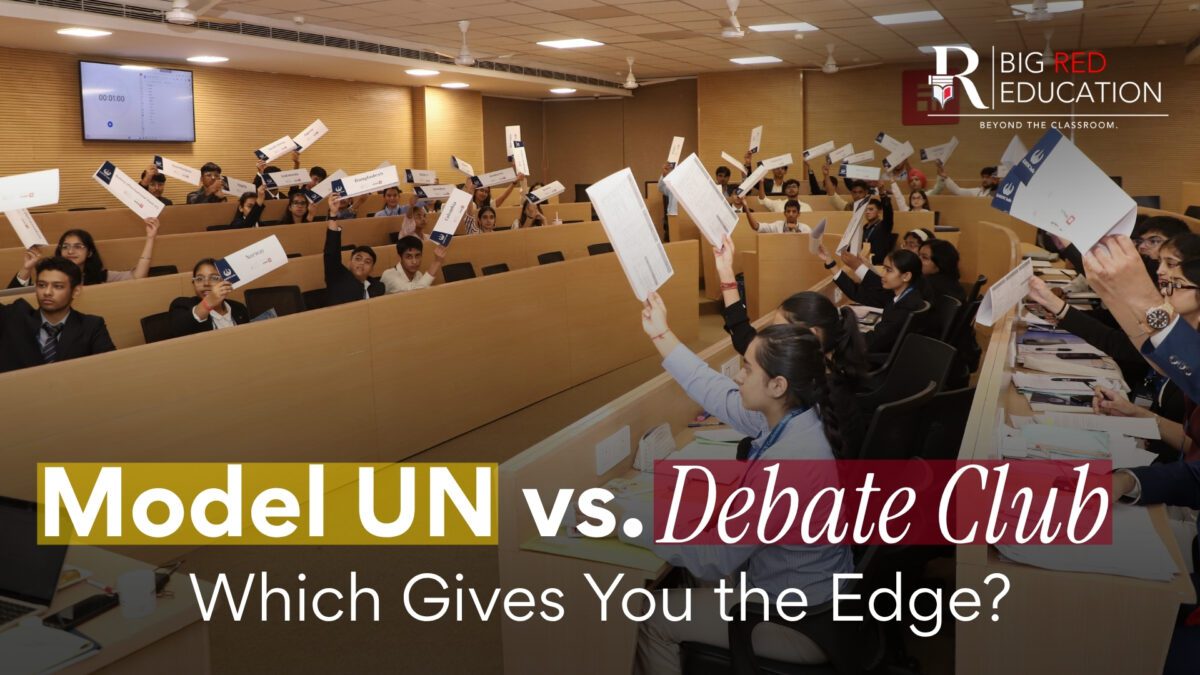
Model UN simulates the United Nations. You’re assigned a country, you represent their foreign policy position on a global issue, you collaborate (and sometimes clash) with 30–200 other delegates, write policy documents called “resolutions,” and try to build coalitions. Sessions can last hours. The clock is always ticking.

Debate Club (whether British Parliamentary, Asian Parliamentary, Oxford, or Lincoln-Douglas style) gives you a motion – a statement and asks you to argue for or against it. Sometimes you know in advance. Sometimes you find out 15 minutes before you speak. You deliver speeches, cross-examine opponents, and a panel of judges decides who argued better.

Same stage fright. Completely different game.


Round 1: Improvisation Under Pressure

Here’s where the two activities diverge dramatically.

In Debate, improvisation is the entire point. The best debaters aren’t the ones who memorize the most facts, they’re the ones who can listen to what their opponent just said and dismantle it in real time. In competitive formats like Asian Parliamentary, your “Points of Information” (POIs) mean opponents can interrupt your speech mid-sentence and demand you respond. Right now. No notes. No escape.

That moment – standing at a podium, mid-thought, while someone punches a hole in your argument is one of the highest-pressure cognitive experiences a student can have. And it’s routine in debate.

MUN’s pressure is different. It’s less about sharp, one-on-one verbal sparring and more about navigating a crowded room where dozens of agendas are in play simultaneously. When the chair opens the floor for an unmoderated caucus, you have 20 minutes to convince five delegates from five different countries to sign your working paper – while someone else is trying to poach your allies. That’s a different kind of on-your-feet thinking: diplomatic, strategic, almost chess-like.

Edge for raw improvisation: Debate. But MUN teaches a kind of lateral, real-world improvisation that debate doesn’t.


Round 2: Research, Depth, and Intellectual Rigor

This is where MUN pulls ahead – and it’s not close.

Preparing for MUN means genuinely understanding geopolitics. When you represent Brazil in the UN Security Council’s discussion of AI governance, you need to know Brazil’s foreign policy stance, its economic interests, its relationships with the US and China, and what international AI agreements already exist. You’re not just pretending to understand global issues. You’re actually developing fluency in how the world works.

The research process for a well-prepared MUN delegate is closer to writing a policy brief than preparing a school presentation. The Position Paper alone – a formal document explaining your country’s stance demands structured argumentation, evidence, and awareness of competing perspectives.

Debate research is substantial too, but it often has a narrower intellectual scope. You’re prepping arguments for and against a specific motion, building a case rather than building a worldview.

If you want to walk out knowing more about the world than when you walked in, MUN wins.

Edge for intellectual depth: MUN – decisively.


Round 3: Public Speaking and Verbal Confidence

Here’s the honest truth most MUN enthusiasts don’t want to hear: if your goal is to become a genuinely powerful speaker, Debate will get you there faster.

Debate is ruthless feedback. You win or you lose. Judges score your clarity, your logical structure, your rebuttals, your delivery. You can’t hide behind a coalition or a bloc. When you stand up, it’s you and your arguments.

MUN speeches, especially at large conferences, can sometimes become performative – polished, prepared speeches that get applause but don’t actually engage with what other delegates said. The diplomatic norm of not directly attacking another delegate’s position can, ironically, reduce the sharpness of the verbal exchange.

The best MUN speakers are genuinely excellent communicators. But the format doesn’t force you to be one the way debate does.

Edge for public speaking development: Debate.


Round 4: Collaboration, Negotiation, and People Skills

This is MUN’s home turf, and no debate about it (pun intended).

MUN teaches you something schools almost never teach: how to get people who disagree with you to work with you anyway. Coalition-building in MUN – finding common ground between, say, India’s position and Sweden’s position – is a genuine negotiation skill. You’re not trying to win against someone. You’re trying to find a language that everyone can live with.

That skill – collaborative problem-solving under time pressure is what most leadership roles actually demand. CEOs don’t debate their board. Diplomats don’t win arguments; they find agreements. Activists don’t just speak truth to power; they build movements.

The best MUN conferences lean hard into this. At something like ILMUNC India organised by the University of Pennsylvania’s students the committees are designed to put delegates in exactly these high-stakes coalition moments, not just speech-making ones. That’s where the real growth happens.

Debate, by its structure, is adversarial. Even when debaters respect each other, the format rewards defeating the other side, not collaborating with them. That’s valuable but it’s a different muscle.

Edge for real-world leadership skills: MUN, by a mile.


Round 5: What Do Colleges Actually Think?

Let’s be real, this is what a lot of students and parents actually want to know.

Both activities look excellent on college applications. But the quality of your involvement matters more than the activity itself.

Here’s what stands out:

  • Leadership positions: Secretary-General of a MUN conference, Debate Team Captain – both signal initiative and commitment.
  • Achievements: Best Delegate awards, winning tournaments, being selected for high-profile conferences – these demonstrate excellence, not just participation. High-quality conferences like ILMUNC India can help students demonstrate sustained commitment, leadership, and global awareness-qualities that selective universities often value when considered alongside the rest of an application.
  • Narrative: Which activity lets you tell a more compelling story about who you are and what you care about? If you’re applying for International Relations or Political Science, MUN is an almost perfect fit. If you’re headed toward Law, Philosophy, or any field that demands argumentation, Debate is your signal.

The mistake students make is treating these as trophies to collect rather than experiences to grow through. One deep, committed involvement beats two half-hearted ones every time.


The Surprising Answer: They Train Different Brains

After all of this, here’s the real verdict – and it’s not a cop-out.

Debate trains the sharp, analytical, adversarial mind. The kind that can construct and deconstruct arguments on demand, spot logical fallacies under pressure, and hold their own in a room full of people trying to out-argue them.

MUN trains the collaborative, strategic, globally-aware mind. The kind that can read a room, build alliances, think about systemic problems, and find solutions that work for multiple stakeholders at once.

The world’s most impactful leaders tend to need both.

And if you look closely, the skills actually complement each other. MUN delegates who do debate become sharper in their speech-making and better at engaging with opposing positions. Debaters who do MUN become more nuanced in how they think about complex issues – less interested in “winning” and more interested in “solving.”

The students who do both – and there are quite a few of them, often find that something clicks. They become the ones who don’t just speak well, but think well. Who don’t just argue convincingly, but lead convincingly.


So Which Should YOU Choose?

Ask yourself three questions:

  1. What kind of pressure do you want to get comfortable with? Verbal sparring, one-on-one → Debate. Diplomatic maneuvering, room dynamics → MUN.
  2. What skills feel weakest for you right now? If you freeze under challenge and struggle to articulate on the spot → Debate will force you to grow fastest. If you’re great at speaking but terrible at listening and adapting to others → MUN will humble you in the best way.
  3. What does your future look like? Law, journalism, policy advocacy, academia → Debate gives you the foundation. Diplomacy, business leadership, international development, consulting → MUN mirrors your future more directly.

And if you can’t choose — don’t. The best thing about high school is that you have time.


The Bottom Line

Model UN and Debate Club are two of the most genuinely skill-building extracurricular activities a high school student can pursue. Neither is “better.” Both are underrated.

But if you asked us which one teaches you to think on your feet faster, in the most raw, unforgiving sense of the phrase?

Debate draws first blood.

And if you asked which one prepares you for the actual complexity of the world you’re about to enter – where problems don’t have clean “pro” and “con” sides, where you need to bring people along rather than defeat them, and where global awareness is a superpower?

MUN is the longer game.

Play both if you can. Master one if you must.

And when you’re ready to take your MUN game to the next level – at a real Ivy League conference, with delegates from across India and beyond – you know where to find us.


Editor's Pick

blog Colleges Higher Education Productivity Research summer Trending | 9min Read

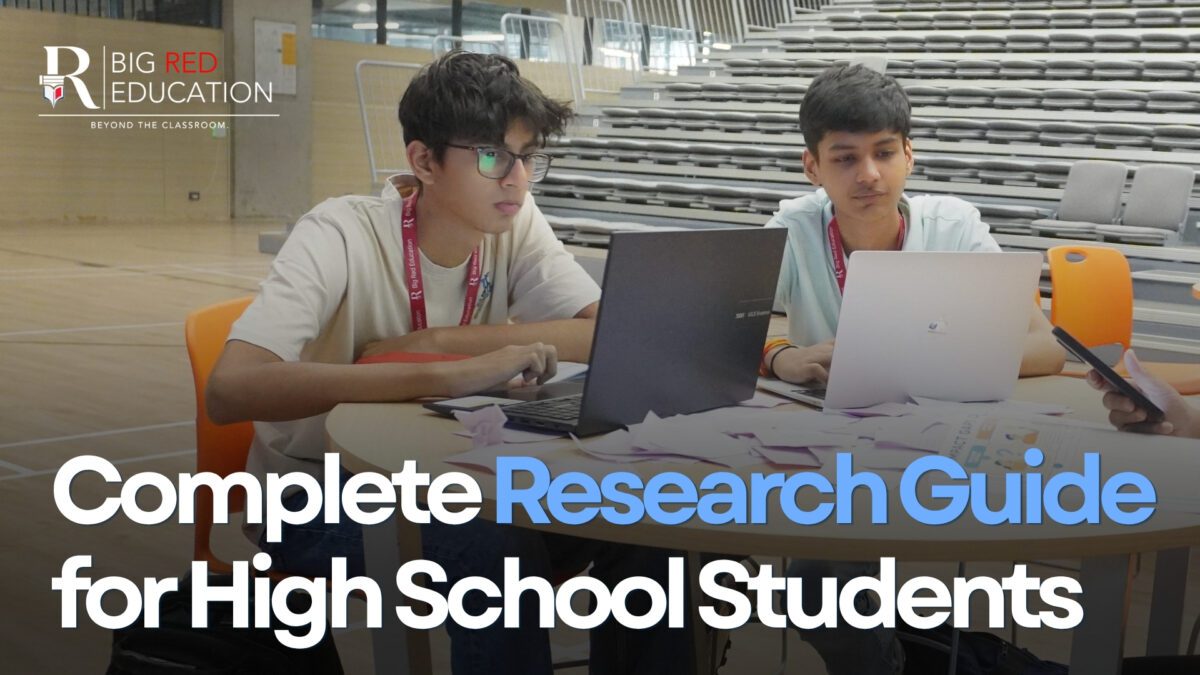
From Hypothesis to Publication: The Complete Research Guide for High School Students

Published on June 24, 2026

FacebookTwitterWhatsApp
Categories
blog Colleges Higher Education Productivity Research summer Trending

From Hypothesis to Publication: The Complete Research Guide for High School Students

From Hypothesis to Publication: The Complete Research Guide for High School Students

Most high school students think research is something that happens in a lab coat, in a university, after years of studying. The kind of thing you see in documentaries – slow, serious, full of jargon.

Here’s the truth: the research process is one of the most learnable, most transferable, and most misunderstood skills in education. And the students who figure it out early? They don’t just get into better colleges. They think better. They ask better questions. They see the world differently.

This is the guide nobody gave you. From the first spark of curiosity to a paper with your name on it  here’s how research actually works.

Stage 1: The Question (Your Hypothesis Starts Here)

Every piece of research – whether it ends up in Nature or in your school science fair begins with a question. Not an answer. Not a topic. A question.

There’s a big difference between:

  • Topic: Climate change and food security.
  • Question: Does rising temperature variability in North India correlate with decreased wheat yield per hectare over the past two decades?

The second one is researchable. It’s specific. It has variables. It points you toward data.

How to generate a good research question:

Start with what genuinely bugs you or fascinates you. The students who produce the best research are usually the ones who were annoyed by something – a statistic that seemed off, a claim their teacher made that didn’t fully add up, a problem in their own community that nobody seemed to be studying.

Then narrow it down. The more specific your question, the more manageable your project, and paradoxically, the more interesting your findings.

Finally, ask: is this answerable? A good research question has to be answerable with data, evidence, or reasoned argument – not opinion.

The hypothesis is your tentative answer to that question before you’ve collected evidence. It’s not a guess – it’s an educated prediction based on what you already know. It sets the direction for everything that follows.


Stage 2: The Literature Review (Standing on Giants’ Shoulders)

Before you start collecting your own data, you need to understand what’s already known. This is called the literature review, and most students skip it – which is why most student research projects reinvent the wheel or miss huge, obvious gaps.

A literature review does three things:

1. Shows you what’s been done. You don’t want to spend three months on a study that was published in 2019. Find out what exists.

2. Reveals the gaps. Good research fills a gap that existing work leaves open. The literature review is where you find your gap – the specific angle that hasn’t been explored yet.

3. Gives you a framework. The concepts, methods, and vocabulary of your field come from the literature. Reading existing papers teaches you how research in your area is actually structured and argued.

Where to find academic literature:

  • Google Scholar (free, comprehensive)
  • PubMed (for biology and medicine)
  • JSTOR (for humanities and social sciences)
  • Semantic Scholar (great AI-assisted search)
  • ResearchGate (authors often share free PDFs)

Don’t be intimidated by papers full of jargon. Start with the abstract and conclusion. Work your way in. You’ll get faster at it.

Stage 3: Methodology – How You’re Actually Going to Answer Your Question

This is where most students get paralysed. Methodology sounds technical, but it just means: how will you collect and analyse your evidence?

There are broadly two types of research:

Quantitative research involves numbers, data, statistical analysis. If your question asks “how much,” “how many,” or “is there a correlation,” you’re probably doing quantitative research. Tools include surveys, experiments, datasets, and statistical software like SPSS, R, or even Excel.

Qualitative research involves understanding experiences, meanings, and patterns. If your question asks “why,” “how do people feel about,” or “what does this mean,” you’re doing qualitative research. Tools include interviews, focus groups, and thematic analysis.

Most strong research actually combines both.

The key questions to answer in your methodology:

  • What data will you collect? From where? From whom?
  • How will you collect it? (Survey? Experiment? Archive research?)
  • How will you ensure your sample is fair and unbiased?
  • How will you analyse what you find?
  • What are the limitations of your approach? (Being honest about this isn’t weakness — it’s scientific integrity.)

This is also the stage where having a mentor makes an enormous difference. A good mentor — especially one who has done real research themselves — can save you months of methodological errors. They’ll spot when your sampling is off, when your variables aren’t controlled, when your analysis plan won’t actually answer your question.

This is exactly what the Big Red Education STEM Research Bootcamp is designed for. Unlike generic science programs, the Bootcamp pairs students with mentors from Harvard, Columbia, and other leading research universities, people who have actually navigated peer review, grant applications, and academic publishing  and walks them through the methodology design process from scratch. Because methodology done right is the difference between a project that produces real findings and one that produces noise.

Stage 4: Data Collection – The Unglamorous Heart of Research

There’s a reason scientists are methodical to the point of seeming obsessive. Data collection is where everything can go wrong, and if it does, no amount of clever analysis will save you.

A few principles that separate serious researchers from everyone else:

Document everything. Keep a research journal. Note dates, conditions, anomalies, decisions you made and why. If you ran a survey, note who responded and who didn’t. If you conducted an experiment, note every variable – even the ones that seemed irrelevant at the time.

Collect more data than you think you need. Data has a way of shrinking once you start analyzing it – outliers get removed, incomplete responses get discarded. Start with more.

Stay honest with your data. This sounds obvious, but confirmation bias is real. If your data isn’t supporting your hypothesis, that’s not a failure. That’s a finding. Some of the most important discoveries in science came from results that surprised the researcher. Stay committed to what the data actually shows, not what you wanted it to show.

Protect privacy and get consent. If your research involves human participants – surveys, interviews, observations – you need informed consent. This isn’t optional. It’s ethical practice, and it’s what separates legitimate research from careless data collection.


Stage 5: Analysis – Making Sense of What You Found

You have your data. Now what does it actually mean?

Analysis is about looking for patterns, relationships, and answers to your original research question. This process looks different depending on your methodology:

For quantitative data: run your statistical tests (correlation, regression, t-tests – whatever your research question demands). Look for statistical significance, but also look for practical significance. A result can be statistically significant and still be too small to matter in the real world.

For qualitative data: use thematic analysis. Read through your interviews or responses multiple times. Identify recurring themes. Code them. Look for patterns across your sample.

In both cases, the goal is the same: let the data tell you what’s there, rather than telling the data what you want to find.

This is also the stage where you revisit your hypothesis. Was it supported? Partially supported? Contradicted? All of these are valid outcomes. Contradicted hypotheses are especially valuable – they mean you’ve discovered something that pushes against the current understanding.


Stage 6: The Paper – Writing Research That Actually Gets Read

Here’s the structure of virtually every research paper in every discipline, from biology to economics to literary criticism:

Abstract – A 150–250 word summary of your entire paper. Usually written last, placed first. It tells the reader what you studied, how, and what you found.

Introduction – Background on your topic, the gap in the literature your research addresses, and your research question/hypothesis. This is where you show you’ve done the literature review.

Methodology – Exactly what you did and why. Detailed enough that another researcher could replicate your study.

Results – What you found. Just the facts. No interpretation yet. Tables, graphs, and figures live here.

Discussion – What your results mean. How they connect to the existing literature. What’s surprising. What the limitations are. What questions remain unanswered.

Conclusion – A tight summary of the key finding and its implications.

References – Every source cited, in your field’s citation format (APA, MLA, Chicago, or Vancouver for sciences).

Writing advice that actually matters:

Write your methodology section first – it’s the most factual and will ground everything else. Then write results. Then discussion. Then introduction. Then abstract. Last of all, write your title (it should reflect exactly what the paper actually is, not what you hoped it would be).

Clarity beats impressiveness every time. The best research papers in the world are written in plain language. Jargon exists to be precise, not to sound smart.

Stage 7: Revision, Feedback, and Peer Review

Here’s something every first-time researcher needs to hear: your first draft is not a paper. It’s a starting point.

Real research goes through multiple rounds of revision. You share it with your mentor, your peers, your teacher. They point out what’s unclear, what’s missing, what’s contradictory. You fix it. You share again.

This is called peer review, and it’s the cornerstone of how science and scholarship maintain quality. When a paper is “peer reviewed,” it means other experts in the field – who have no stake in whether the paper is good or bad – have read it critically and agreed it meets the standards for publication.

As a student, your peer review process might look like:

  • Sharing with a classmate in a similar field for a critical read
  • Presenting your findings in a seminar or school symposium and fielding questions
  • Getting feedback from a mentor who has published research themselves

That last one is invaluable. A mentor who has been through actual peer review knows exactly what reviewers look for – and what gets papers rejected. The STEM Research Bootcamp’s mentors from Harvard, Columbia, and leading research institutions bring this real-world editorial instinct to every student they work with, which is a genuinely rare thing to access at the high school level.

Stage 8: Publication – Getting Your Name on Real Research

Yes, students can publish. Real journals, real conferences, real platforms. It’s more accessible than most students think.

Journals that publish student research:

  • Journal of Emerging Investigators (specifically for middle and high school students)
  • American Journal of Undergraduate Research
  • Cureus (medical and clinical research, open access)
  • Young Scientists Journal

Conferences and competitions:

  • Intel International Science and Engineering Fair (ISEF)
  • Regeneron Science Talent Search
  • Google Science Fair
  • Regional and national science olympiads

Online platforms:

  • ResearchGate (for sharing preprints and connecting with researchers)
  • Academia.edu
  • Your school’s research journal if one exists – and if it doesn’t, starting one is a project in itself

Publication is not the only measure of a good research project. A rigorous, well-designed, honestly reported research project is valuable whether or not it ends up in a journal. But if your work is strong, there’s no reason not to try.


What Research Does to You

Here’s the thing nobody tells you about research: it changes how you think permanently.

Once you’ve gone through the process of forming a hypothesis, reviewing what’s known, designing a rigorous methodology, collecting and analysing data, and writing it all up – you can never un-see the world that way. You start looking at news headlines and asking where the data came from. You notice when an argument is correlation dressed up as causation. You get comfortable saying “I don’t know, but here’s how we could find out.”

These are not just academic skills. They’re survival skills for the information age.

The students who learn to do research in high school – real research, with real methodology and real intellectual honesty – arrive at university running. And they arrive at the rest of their lives with a relationship to truth that most people never develop.

Ready to Start?

The research process can seem overwhelming when you look at all eight stages at once. It isn’t, when you take it one step at a time – and especially when you have someone in your corner who’s done it before.

If you’re a high school student curious about doing real research in STEM, the Big Red Education STEM Research Bootcamp is built exactly for this. Working directly with mentors from Harvard, Columbia, and other top research universities, you’ll go from research question to completed paper — with guidance at every stage from people who have actually published, peer reviewed, and navigated the academic research world themselves.

Your hypothesis is waiting. The only question is whether you’ll test it.

Editor's Pick

Colleges Communication Entrepreneurship Higher Education Internship Leadership Trending | 4min Read

Beyond the GPA: Why High School Research Gives Students a Competitive Edge in College Admissions

Published on

FacebookTwitterWhatsApp
Categories
Colleges Communication Entrepreneurship Higher Education Internship Leadership Trending

Beyond the GPA: Why High School Research Gives Students a Competitive Edge in College Admissions

Beyond the GPA: Why High School Research Gives Students a Competitive Edge in College Admissions

If you are a student or a parent navigating the increasingly competitive world of college admissions, you likely already know that a perfect GPA and high test scores are no longer enough to guarantee a spot at a top-tier university. The bar has been raised. But how exactly do you stand out in a sea of high achievers?

In this blog, you will discover why high school research is rapidly becoming a powerful differentiator on college applications. By the end of this read, you will understand the hard data behind research-based college acceptances, what admissions officers actually look for when reading your application, and how to successfully navigate research opportunities for high school students to build a standout academic profile.

The New Standard for Selective Admissions: What the Data Says

For ambitious students aiming for highly selective universities, participating in academic research programs is no longer just an extracurricular activity—it is a valuable strategic asset.

A CollegeXpress analysis of Ivy League applicant profiles revealed that students who had documented research experience were significantly more likely to be admitted to highly selective institutions compared to peers who had equivalent GPAs and test scores but no research background. The numbers speak for themselves:

  • At the California Institute of Technology (Caltech), the most compelling applicants are consistently those who have spent significant time working through single research problems, proving that depth matters more than a long list of disconnected clubs.
  • Some established research mentorship programs report notably higher admissions outcomes among participants. While these students are typically highly motivated and academically strong to begin with, the data suggests that meaningful research experience can strengthen an already competitive application.

This data directly addresses common parent concerns regarding where their teens should be investing their limited time outside of school. The return on investment for authentic research is clear.

Why Do Universities Value Research for College Applications?

You might be wondering if admissions committees expect teenagers to produce Nobel-prize-worthy discoveries. They don’t. However, admissions officers at elite institutions—including Harvard, Princeton, MIT, and Stanford—have publicly stated that conducting original research demonstrates an applicant’s intellectual depth in a way that grades and standardized test scores simply cannot. Organizations like NACAC and the Council on Undergraduate Research have also emphasized the immense value of this kind of academic engagement.

Here is what research projects for students actually communicate to a college admissions board:

  • Intellectual Curiosity: It shows you are willing to identify a knowledge gap, ask complex questions, and pursue answers outside of a mandated classroom syllabus. (Read more: Critical Thinking & Missing Skills)
  • Resilience and Problem-Solving: Real academic research involves trial, error, and iteration. Describing what didn’t work in a lab or a study is one of the strongest signals of real academic engagement. (Read more: Why Most High School Research Projects Fail)
  • University-Level Competency: By conducting a literature review, analyzing data, and potentially publishing your findings, you prove you are already capable of handling the rigors of a collegiate academic environment.

Crucial Pointers for a Successful Research Journey

If you want to leverage research to elevate your college profile, you have to do it right. Here are a few essential pointers:

  • Start Early: Research takes months. Students often underestimate the time required for ethical compliance, rigorous revisions, and incorporating mentor feedback.
  • Find the Right Niche: Don’t pick a topic just because it sounds impressive. Choose a highly specific, passion-driven question that you can feasibly research within your available resources.
  • Avoid “Pay-to-Publish” Traps: Admissions officers can easily spot fake or pay-to-play journals. Aim for legitimate peer-reviewed journals vetted by the Directory of Open Access Journals, or simply present the depth of your research at state science fairs if publication isn’t possible. It is the process they care about, not just the title. (Read more: From Hypothesis to Publication)
  • Seek Out Expert Guidance: Finding a credible mentor who specializes in your field is the single most important step. A mentor will guide you through methodologies, ethical compliance, and the grueling revision process.

Take the Next Step with Big Red Education

We know that starting an independent research project from scratch can feel overwhelming for both students and parents. You don’t have to navigate it alone.

At Big Red Education, we are dedicated to transforming your academic potential into meaningful results. Our premier STEM Research Accelerator program pairs driven high schoolers with mentors with research experience from leading universities and research institutions, guiding you step-by-step from formulating your first hypothesis to submitting your findings. By joining us, you are not just completing a project—you are engaging in comprehensive college profile development that ensures your application tells a compelling, authentic story of intellectual ambition.

Don’t leave your college admissions to chance. Explore Big Red Education’s programs today and start building the competitive edge that top universities are actively searching for!

Editor's Pick

blog Colleges Communication Higher Education Leadership summer | 4min Read

The Well-Rounded Trap: Why Selective Colleges Prefer Students with Depth

Published on June 22, 2026

FacebookTwitterWhatsApp
Categories
blog Colleges Communication Higher Education Leadership summer

The Well-Rounded Trap: Why Selective Colleges Prefer Students with Depth

The Well-Rounded Trap: Why Selective Colleges Prefer Students with Depth

Many students believe that getting into a top university means excelling at everything. In reality, selective colleges often value depth, sustained commitment, and meaningful impact over a long list of unrelated activities. Society often tells students that success requires being perfect at everything, but sacrificing your well-being and authenticity to build a generic resume usually leads to absolute burnout.

Strong grades and broad involvement are valuable, but at highly selective universities, they are often not enough on their own. Depth, sustained commitment, and meaningful impact are what frequently help applicants stand out. If you are evaluating your high school extracurriculars and wondering what do top colleges look for, understanding the well-rounded vs spiky student dynamic is essential. Here is why specializing is your true competitive advantage in college admissions.

The Exhausting Illusion of Doing It All

In the past, the ideal applicant had a 4.0 GPA, played three sports, learned an instrument, and volunteered on weekends. Today, as applications to selective universities skyrocket, campuses are saturated with students who are moderately good at many things but rarely exceptional at one.

Bouncing from activity to activity might show you are a hard worker, but it yields a shallow depth of engagement. A resume packed with 15 unrelated clubs does not tell a compelling story about who you are. It just looks like a checklist.

Enter the “Spiky” Student

Spiky students take a deep dive into one or two core passions and consciously choose to let go of other activities. They demonstrate excellence and create tangible value in their specific niche through dedicated passion projects.

According to admissions guidance from recognized organizations like NACAC (National Association for College Admission Counseling) and PrepWell Academy, elite campuses increasingly prioritize these angular students. Instead of a dozen superficial commitments, a spiky student’s profile stands out. For a deeper look into how these focused profiles succeed, CollegeBound Mentor’s Case Studies offer excellent real-world examples.

For example, a student deeply interested in diplomacy might participate in Model United Nations for several years, mentor younger delegates, organize a school conference, and eventually represent their school at ILMUNC India. The strength of the application comes from sustained growth and real leadership experience—not simply attending one event. They could also be a dedicated programmer who bypassed traditional summer camps to build a working prototype for a tech startup, reflecting the project-based focus championed by programs like BetterMind Labs.

The Ivy League Secret: Building a Well-Rounded Class

A common fear is that if you are not perfectly balanced, a university will view you as incomplete. The reality is quite the opposite. In the context of holistic admissions, admissions officers are not trying to build a class full of well-rounded students. They are assembling a well-rounded class.

While universities seek academically capable students, many selective institutions also value applicants who demonstrate sustained commitment, meaningful impact, and a clear sense of purpose. To create a vibrant campus ecosystem, they need the visionary debate champion, the brilliant lab researcher, and the theater prodigy. As noted by a former Stanford Admissions Officer via InGenius Prep, highly selective schools often prefer lopsided students over well-rounded ones. Identifying your specific area of excellence allows admissions officers to confidently place you into their community. They want to know exactly what unique value you bring to the table.

How to Build Your Spike

One of the best college application tips is to transition from a burnt-out generalist to a standout specialist. This requires a shift in mindset. Here is how to begin:

  1. Audit your time: Evaluate your current extracurriculars. Keep what genuinely excites you and identify what you are doing solely because it looks good.
  2. Choose one or two focus areas: Dare to drop the activities you are only halfway invested in. Reallocate that time toward the one or two passions where you can truly excel.
  3. Build depth over time: Focus on sustained commitment to your chosen area rather than jumping between short-term projects.
  4. Create measurable impact: Move from participation to impact. Do not just join a club—lead a team that builds a solution to a specific community problem.
  5. Reflect and communicate your journey: If an admissions officer had to describe you in three words, what would they be? Make sure your college application tells one cohesive and memorable story. This step is especially crucial for your college essays and interviews.

Trading Burnout for Brilliance 

The pressure to do everything is a myth that dilutes your potential and drains your energy. True success is not about ticking boxes. It is about leaning into what makes you uniquely capable and pursuing it with integrity.

At Big Red Education, we believe your high school journey should be about moving from passive learning to active creation. That is exactly why we are launching immersive experiential programs designed to help you build your spike. Explore our programs below:

By embracing your authentic passions, you trade burnout for brilliance and create a powerful narrative that top-tier colleges simply cannot ignore.

Editor's Pick